Test question: Respiring cells release CO2 into the bloodstream

Click For Summary

Discussion Overview

The discussion centers around the physiological process of CO2 release by respiring cells and its effect on blood pH levels. Participants explore the biochemical mechanisms involved in CO2 transport and its implications for acidity in the bloodstream.

Discussion Character

  • Exploratory
  • Technical explanation
  • Conceptual clarification
  • Debate/contested

Main Points Raised

  • One participant questions how CO2, perceived as neutral, can lower blood pH, suggesting an initial belief that it would not affect acidity.
  • Another participant describes the process of CO2 being absorbed by red blood cells and forming carbonic acid (H2CO3), which dissociates into H+ and bicarbonate (HCO2-), contributing to acidity.
  • A later reply emphasizes that adding CO2 is akin to adding carbonic acid to the system, which inherently lowers pH.
  • There is confusion about the timing of pH changes, particularly whether the acidity occurs immediately upon CO2 release from cells or later when bicarbonate is involved.
  • One participant expresses frustration over the test material not covering the CO2 and O2 exchange process adequately, indicating a gap in understanding necessary for answering the question.

Areas of Agreement / Disagreement

Participants express differing views on the timing and mechanisms of pH changes related to CO2 release, with some confusion remaining about the role of bicarbonate and the immediate effects of CO2 on blood acidity. No consensus is reached on the exact nature of these processes.

Contextual Notes

Participants note limitations in their understanding based on the test material, which did not cover the biochemical processes involved in CO2 transport and its effects on blood pH in detail.

Lo.Lee.Ta.
Messages
217
Reaction score
0
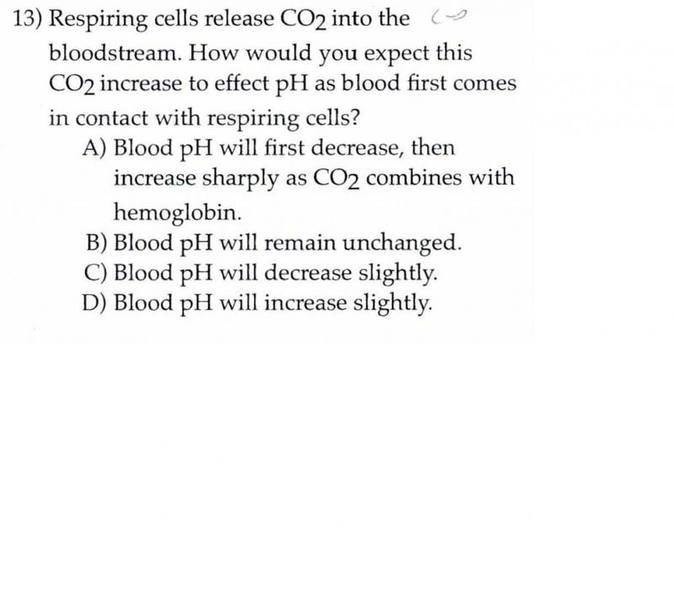
Test question: "Respiring cells release CO2 into the bloodstream..."

1.
testquestionrespiringcells_zps600ae6a9.jpg


2. For this question, I was thinking about the nature of CO2.
It's not an acid or base, so how could it drop or raise the pH level?!
So I put that the pH level won't change (B), but the real answer is C (it will decrease slightly).


How is this? How can a neutral substance make the blood more acidic?
Or is it really NOT neutral...? Hm.:confused:

Would you please explain why the pH value gets lowered?

Thank you so much! :)
 
Physics news on Phys.org


Okay, I read the article you posted.

I hope I understood correctly.

So is it that once cells use up oxygen, CO2 is released and then absorbed by red blood cells.
But once the CO2 is absorbed, it combines with H2O to form H2CO3, which dissociates into
H+ and HCO2-.

The H+ plus attached to a hemaglobin, and the HCO2- gets pumped out of the red blood cell. The red blood cell takes in Cl- in its place.

So now the HCO2- is in the blood plasma.

Once the blood gets to the lungs, the HCO2- gets back into the red blood cell and the Cl- gets kicked out. The H+ detaches from the hemaglobin, and so H2CO3 is formed again.

Now the H2CO3 gets broken down again into water and CO2.
The CO2 diffuses into the lungs and is breathed out. ...I guess the water stays.


Okay, makes sense. But weren't they asking about the pH right at the moment when the CO2 leaves the cell (before taken up by the red blood cells)?

And they couldn't be talking about when the HCO2- gets kicked out of the red blood cell and into the plasma because then the blood would be more basic, right?
HCO2- wants a H+, so it is a base, right?
...So I still am not sure as to how the blood gets more acidic when CO2 leaves cells! :/
Hm. =_=


Adding CO2 to the system is equivalent to adding H2CO3 to the system. Further reactions can lower the effect, but they can't change the direction - adding acid always lowers pH.


Oh, okay! Since the CO2 combines with water to form H2CO3 (carbonic acid), the blood becomes more acidic.

I guess it was required for us to know the carbonic acid step in order to answer this question!
...(The chapters the test was over did not include information about how CO2 and O2 are expelled and taken up by cells!)

Ugh. =_=# Oh well.

Thank you so much, Borek and jedishrfu! Makes sense now! :D
 

Similar threads

  • · Replies 7 ·
Replies
7
Views
3K
  • · Replies 2 ·
Replies
2
Views
3K
Replies
1
Views
2K
Replies
63
Views
26K
  • · Replies 1 ·
Replies
1
Views
4K
  • · Replies 2 ·
Replies
2
Views
2K
  • · Replies 1 ·
Replies
1
Views
2K
  • · Replies 1 ·
Replies
1
Views
402
Replies
4
Views
2K
  • · Replies 10 ·
Replies
10
Views
2K