Textbook error relating to uncountability?

  • Thread starter Thread starter JerryG
  • Start date Start date
  • Tags Tags
    Error Textbook
Click For Summary
The discussion centers around a perceived error in a communications systems textbook regarding the limit of a vector of samples as the number of samples approaches infinity. It questions the implication of a bijection between natural numbers and a continuous interval, which contradicts Cantor's second theorem. Participants highlight the need for a clearer definition of limits for sequences of functions, noting that the book's statement lacks rigor. There's a consensus that the textbook should have referenced step functions for clarity. Ultimately, while the statement may hold for bandwidth-limited signals in engineering, the explanation provided is considered vague and insufficient.
JerryG
Messages
58
Reaction score
0
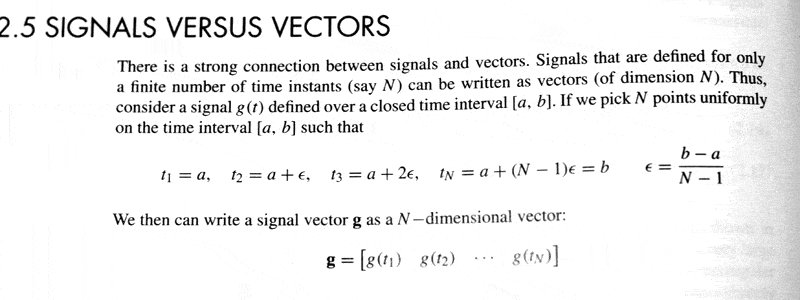
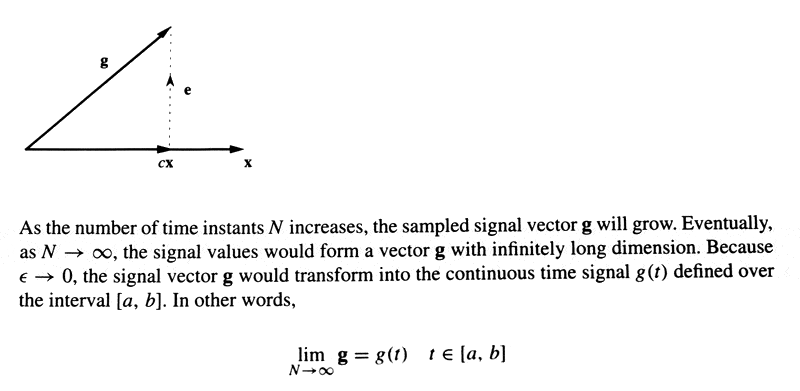
I am reading a textbook about communications systems, and just came across a part that I believe to be wrong. As shown below, it says that if you take a vector g = [g(t1) g(t2) ... g(tN)] and take the limit as the number of samples goes to infinity, the result is a continuous function of t. Wouldn't this imply a bijection between the natural numbers and a continuous interval which was disproven by cantor's second theorem?
bij1.gif


bij2.gif
 
Mathematics news on Phys.org
Informal statements are often saved from outright errors by being vague. That passage did not give a definition for lim_{N \rightarrow \infty} \mathbb{g}.

The definition of a limit of a sequence of vectors (which can be regarded as a sequence of function) cannot be deduced from the definition of the type of limit used in calculus, which deals with the limit of a single function at a given point. There are actually many different types of limits that are defined for sequences of functions. I'd have to look these up and re-study them before I could swear that none of them make the book's statement true.

You are correct that the infinite sequence of discrete time samples does not ever become an uncountable set.
 
Stephen Tashi said:
There are actually many different types of limits that are defined for sequences of functions. I'd have to look these up and re-study them before I could swear that none of them make the book's statement true.

A "sequence of functions" would require the domains to be the same though...
The only option I could think is define the sequence of sequences
h = [g(t_1), \ldots, g(t_N), 0, 0, \ldots]
and then look at limits. Err.

The book really should have used step functions.
 
pwsnafu said:
A "sequence of functions" would require the domains to be the same though...
.

Yes, by many definitions it would. But statisticians say things like "For large N the binomial distribution can be approximated by a normal distribution". That's a statement connecting a function with a discrete domain to a function with a continuous domain. I don't know if people bother to formulate that type of approximation as a theorem about a limit of a sequence of functions, but I think if they wanted to, they could come up with something. There are so many possibilities for making up definitions!
 
This a nice example of the difference between math and engineering.

In engneering, any "real world" signal will be bandwith limited, and the statement in the book is true for bandwidth-limited signals.

But I agree that the book's "explanation" isn't much more than an arm-waving reason why that seems plausible.
 
Here is a little puzzle from the book 100 Geometric Games by Pierre Berloquin. The side of a small square is one meter long and the side of a larger square one and a half meters long. One vertex of the large square is at the center of the small square. The side of the large square cuts two sides of the small square into one- third parts and two-thirds parts. What is the area where the squares overlap?

Similar threads

  • · Replies 1 ·
Replies
1
Views
3K
  • · Replies 1 ·
Replies
1
Views
10K
  • · Replies 7 ·
Replies
7
Views
2K
  • · Replies 7 ·
Replies
7
Views
3K
Replies
5
Views
3K
Replies
93
Views
20K
  • · Replies 2 ·
Replies
2
Views
3K
  • · Replies 24 ·
Replies
24
Views
3K
  • · Replies 4 ·
Replies
4
Views
2K
  • · Replies 4 ·
Replies
4
Views
5K