brettng
- 17
- 0
TL;DR Summary: The reason to force us consider complex solution for harmonic motion.
Reference textbook “The Physics of Waves” in MIT website:
https://ocw.mit.edu/courses/8-03sc-...es-fall-2016/resources/mit8_03scf16_textbook/
Chapter 1 - Section 1.3 (see attached file)
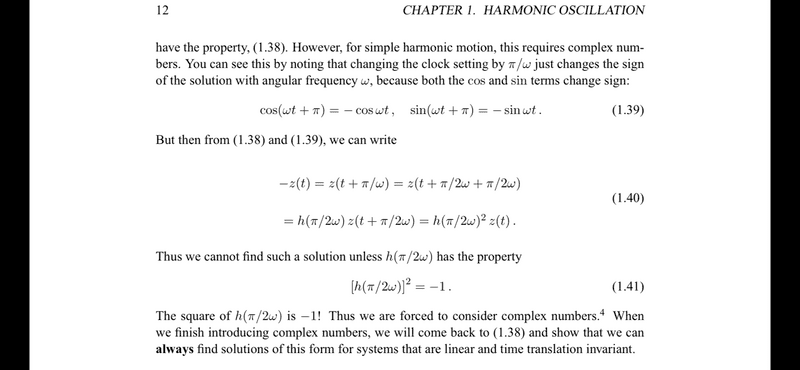
In (1.40), it breaks down the time translation from pi/omega to pi/2omega + pi/2omega; and concludes the square of h(pi/2omega) implying that we need to consider complex solution.
However, what prevents us use the property of irreducible solution and adopt
z(t+pi/omega) = h(pi/omega)z(t)
directly? (And this does not force us to use complex solution!)
Reference textbook “The Physics of Waves” in MIT website:
https://ocw.mit.edu/courses/8-03sc-...es-fall-2016/resources/mit8_03scf16_textbook/
Chapter 1 - Section 1.3 (see attached file)
In (1.40), it breaks down the time translation from pi/omega to pi/2omega + pi/2omega; and concludes the square of h(pi/2omega) implying that we need to consider complex solution.
However, what prevents us use the property of irreducible solution and adopt
z(t+pi/omega) = h(pi/omega)z(t)
directly? (And this does not force us to use complex solution!)