anhnha
- 179
- 1
Can you help me explain this part from my book?
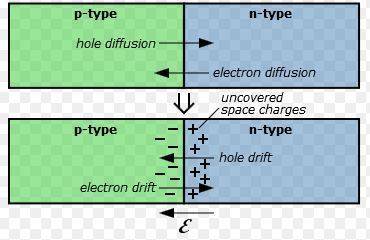
In equilibrium, the pn junction has no external connections, i.e., the terminals are open and no voltage is applied across the device.
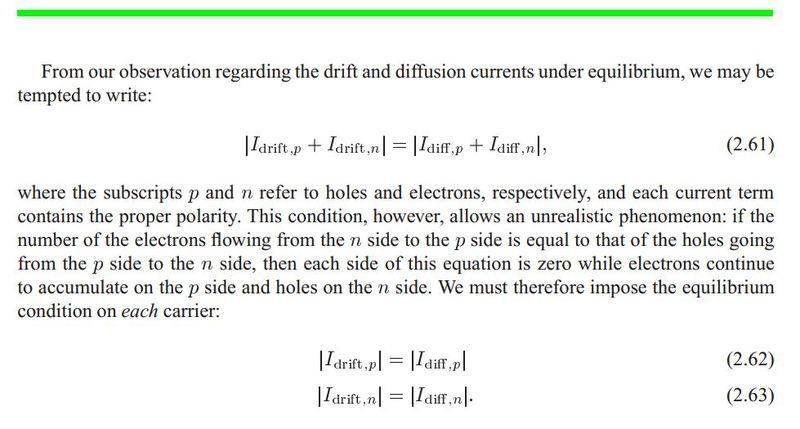
If so, I wonder why there is drift current in the equation above. In equilibrium, the total current is zero but I don't understand how can they get the equation.
Is it right that in equilibrium, the total current is zero but each current (drift and diff currents) are not necessary to be zero?
PS: I have just seen the image. It is relatively clear now. In equilibrium, the net current is zero.
From that I can get the equation above. However, I am confused about these currents. I think they are only exist in a short of time, right?
After that time:
The diffusion is zero when the concentration of electrons and holes are equal in P and N sandwiches.
The dift currents are zero when all minority charge carriers are depleted.
If possible, can you explain about the next part?
Attachments


Last edited:

