The Modulus functionNeed a little Explanation

  • Context: High School 
  • Thread starter Thread starter nishantve1
  • Start date Start date
  • Tags Tags
    Explanation Modulus
Click For Summary

Discussion Overview

The discussion centers around the modulus function, specifically its definition and application in graphing. Participants express confusion regarding the function's behavior, particularly when dealing with negative inputs, and seek clarification on how to graph complex expressions involving the modulus function.

Discussion Character

  • Exploratory
  • Technical explanation
  • Conceptual clarification
  • Debate/contested

Main Points Raised

  • One participant describes their understanding of the modulus function, noting that for negative inputs, the output should be the negation of the input, which leads to confusion.
  • Another participant clarifies that the modulus function outputs the negation of a negative number, thus |-5| = 5, and provides examples to illustrate this point.
  • A different participant suggests that thinking of the function as "absolute value" instead of "modulus" might aid understanding, and discusses the nested nature of the function f(x) = |1-x+|x||.
  • One participant emphasizes the distinction between the arithmetic of negative numbers and their representation on the number line, explaining the dual meanings of the negative sign in different contexts.

Areas of Agreement / Disagreement

Participants express varying levels of understanding and confusion regarding the modulus function, with no clear consensus on the best way to conceptualize it. Some participants agree on the definition but differ in their interpretations and intuitions about the function's behavior.

Contextual Notes

Participants highlight the potential for confusion arising from the dual meanings of negative numbers in different contexts, which may complicate understanding of the modulus function.

Who May Find This Useful

This discussion may be useful for students grappling with the concept of the modulus function, particularly those who are encountering it for the first time or who are struggling with its implications in graphing and arithmetic.

nishantve1
Messages
74
Reaction score
1
So I have been dealing with the modulus function for almost a year now , I didn't ran into it many times so didn't really tried to understand it well . But it has started to get a little bit confusing . So if someone helps me I will be really happy .
From what I know
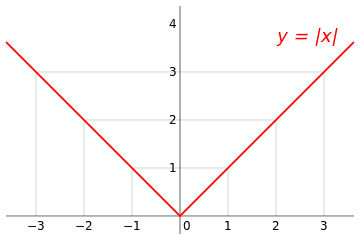
f(x) = |x| = { x ; x >= 0 and -x ;x<=0

That means |-5| = 5 and |5| = 5
And it has a graph
360px-Absolute_value.svg.png


But this does not satisfy my intuition , for me the function and the graph says two different thing , I mean the function says
f(x) = |x| = {-x ;x<=0

so if I plug in -5 which is less than 0 then the output should be -5 only
I know I am wrong but I am just going with function definition . What does the definition actually say ?

Also I encounter problems while sketching graphs of the mod function .
If someone can help me with the graph of
f(x) = |1-x+|x|| it would be awesome
I can graph it using wolframalpha but I want to know how it came about
Thanks
 
Mathematics news on Phys.org
Hey nishantve1.

What the definition means is that you negate the number if less than zero and keep the original if greater than 0 (or equal).

So with your example of -5, if we negate this we get -(-5) = +5 = 5. Another example is -10 which we negate giving us -(-10) = +10 = 10.

Now if we give say +5, we leave it alone giving us + 5 = 5.

Basically we define |x| to be -x if x < 0 and x if x >= 0, and the above examples show how we calculate this.
 
nishantve1 said:
If someone can help me with the graph of
f(x) = |1-x+|x|| it would be awesome

Check this absolute value article over at Wikipedia, it might help a bit (the first paragraph sums it up nicely).

Thinking of it as "absolute value" instead of "modulus" might help you grasp the concept.

For the case above f(x) = |1-x + |x|| you have 2 absolute value functions within one another.

Imagine the case: |x| - x which is the same as -x + |x|

If x is positive, it ends up being x-x... what happens when x is negative? remember that -(-1) = 1
 
nishantve1 said:
So I have been dealing with the modulus function for almost a year now , I didn't ran into it many times so didn't really tried to understand it well . But it has started to get a little bit confusing . So if someone helps me I will be really happy .
From what I know
f(x) = |x| = { x ; x >= 0 and -x ;x<=0

That means |-5| = 5 and |5| = 5
And it has a graph
360px-Absolute_value.svg.png


But this does not satisfy my intuition , for me the function and the graph says two different thing , I mean the function says
f(x) = |x| = {-x ;x<=0

so if I plug in -5 which is less than 0 then the output should be -5 only
Then your difficulty is not so much algebra as arithmetic. The "algebra" you have written correctly- if x< 0 then |x|= -x. So, because -5< 0, |-5|= -(-5). If you think that is -5 then the difficulty is basic arithmetic: you can think of this as (-1)(-5)= 5. Or you can, a little more sophisticated, think of -(-5) as the "negative" (additive inverse) of -5. And, since -5+ 5= 0, 5 is the "negative" of -5. Either way, |-5|= -(-5)= 5.

I know I am wrong but I am just going with function definition . What does the definition actually say ?

Also I encounter problems while sketching graphs of the mod function .
If someone can help me with the graph of
f(x) = |1-x+|x|| it would be awesome
I can graph it using wolframalpha but I want to know how it came about
Thanks
 
nishantve1 said:
But this does not satisfy my intuition , for me the function and the graph says two different thing , I mean the function says
f(x) = |x| = {-x ;x<=0

so if I plug in -5 which is less than 0 then the output should be -5

Others have already answered the question, but I wanted to mention this point. It's often confusing for students.

A negative number is a point on the number line "to the left" of zero, or technically, a real number which is less than zero as defined by the '<' relationship. In this sense, the fact that -5 is five units to the left of zero is functioning like an address. A house address on a street, or a memory address in a computer, to mention two familiar contemporary usages. An address is an label; but unlike completely arbitrary labels, the address space is endowed with an order relation so that we can find our way around.

On the other hand, what do we mean when x is a variable and we say -x?

Do we mean that x, or perhaps -x, is to be found to the left of zero on the number line? No, not at all! What we mean is that if x is to the left, we want -x to denote the point equidistant on the right; and vice versa.

In other words, -5 denotes the point five units to the left of zero.

But if x is a variable, and x = -5, then -x = 5, a point to the RIGHT of zero.

We are overloading the meaning of '-'. Sometimes it's and address that tells us which side of zero we're on; and other times, it's an instruction or operator that flips the direction while preserving the magnitude of a number.

This is why -x confuses students. We're actually flim-flamming them a bit, by using '-' two different ways.
 
Last edited:

Similar threads

  • · Replies 5 ·
Replies
5
Views
2K
  • · Replies 5 ·
Replies
5
Views
2K
  • · Replies 10 ·
Replies
10
Views
3K
  • · Replies 2 ·
Replies
2
Views
1K
  • · Replies 13 ·
Replies
13
Views
3K
  • · Replies 4 ·
Replies
4
Views
4K
  • · Replies 2 ·
Replies
2
Views
2K
  • · Replies 5 ·
Replies
5
Views
3K
  • · Replies 51 ·
2
Replies
51
Views
4K
  • · Replies 7 ·
Replies
7
Views
2K