Parthib Roy
- 10
- 1
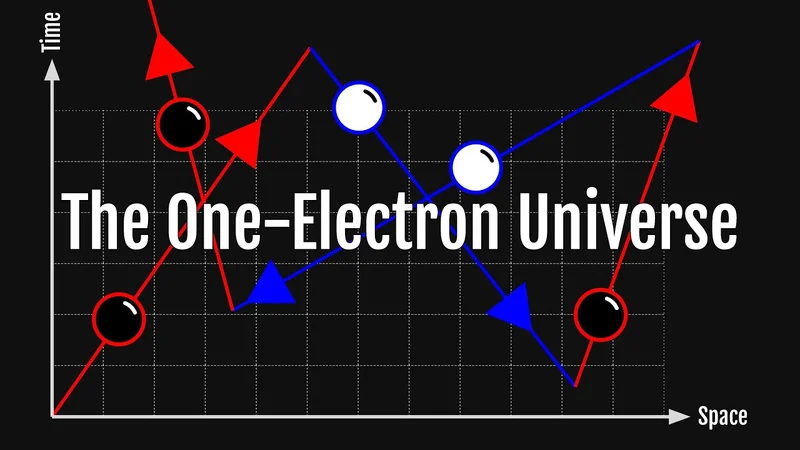
The one-electron universe is the hypothesis that all electrons and positrons are actually manifestations of a single entity moving backwards and forwards in time. It was proposed by theoretical physicist John Wheeler in a telephone call to Richard Feynman in the spring of 1940.
The idea is based on the world lines traced out across spacetime by every electron. Rather than have myriad such lines, Wheeler suggested that they could all be parts of one single line like a huge tangled knot, traced out by the one electron. Any given moment in time is represented by a slice across spacetime, and would meet the knotted line a great many times. Each such meeting point represents a real electron at that moment.
At those points, half the lines will be directed forward in time and half will have looped round and be directed backwards. Wheeler suggested that these backwards sections appeared as the antiparticle to the electron, the positron.
My Question is that the reasoning given by Feynman that many more electrons have been observed than positrons, and electrons are thought to comfortably outnumber them, seems insufficient to me for rejecting a beautiful hypothesis like this as evidently Feynman arrived at a defining conclution that antiparticles could be represented by reversed world lines, and credits this to Wheeler, saying in his Nobel speech - "I took the observation that positrons could simply be represented as electrons going from the future to the past in a back section of their world lines. That, I stole!" shown enough result that Wheelers hypothesis wasn't vague or random at all! So why wasn't any attempts made in reconsidering his predictions? And how does the fundamental nature of electrons change when they travel backwards in time ?
sources - https://en.wikipedia.org/wiki/One-electron_universe
https://kids.kiddle.co/Pocono_Conference
Thank you,
Parthib Roy
The idea is based on the world lines traced out across spacetime by every electron. Rather than have myriad such lines, Wheeler suggested that they could all be parts of one single line like a huge tangled knot, traced out by the one electron. Any given moment in time is represented by a slice across spacetime, and would meet the knotted line a great many times. Each such meeting point represents a real electron at that moment.
At those points, half the lines will be directed forward in time and half will have looped round and be directed backwards. Wheeler suggested that these backwards sections appeared as the antiparticle to the electron, the positron.
My Question is that the reasoning given by Feynman that many more electrons have been observed than positrons, and electrons are thought to comfortably outnumber them, seems insufficient to me for rejecting a beautiful hypothesis like this as evidently Feynman arrived at a defining conclution that antiparticles could be represented by reversed world lines, and credits this to Wheeler, saying in his Nobel speech - "I took the observation that positrons could simply be represented as electrons going from the future to the past in a back section of their world lines. That, I stole!" shown enough result that Wheelers hypothesis wasn't vague or random at all! So why wasn't any attempts made in reconsidering his predictions? And how does the fundamental nature of electrons change when they travel backwards in time ?
sources - https://en.wikipedia.org/wiki/One-electron_universe
https://kids.kiddle.co/Pocono_Conference
Thank you,
Parthib Roy
Last edited: