The oscillation of a particle in a special potential field

Click For Summary
SUMMARY

The discussion focuses on analyzing the oscillation of a particle in a potential field described by the function U0tan²(x/a). The force acting on the particle is derived from the potential, leading to the equation of motion d²x/dt² + U0(2sec²(x/a)(x/a²)) = 0. The participants explore the application of Taylor series expansion for small oscillations to simplify the analysis. The challenge lies in handling the sec²(x/a) term effectively to derive further insights into the particle's motion.

PREREQUISITES
  • Understanding of classical mechanics, specifically Newton's laws of motion.
  • Familiarity with potential energy functions and their derivatives.
  • Knowledge of Taylor series expansion and its application in physics.
  • Basic calculus, including differentiation and solving differential equations.
NEXT STEPS
  • Study the application of Taylor series expansion in classical mechanics.
  • Research methods for solving second-order differential equations.
  • Explore the implications of potential energy functions on particle motion.
  • Learn about small oscillations and their characteristics in physics.
USEFUL FOR

Physics students, researchers in classical mechanics, and anyone interested in the dynamics of particles in potential fields.

Peter Jones
Messages
4
Reaction score
1
Homework Statement
Prove that the particle moves periodically between two points and find the period of small angle oscillations
Relevant Equations
The question is:
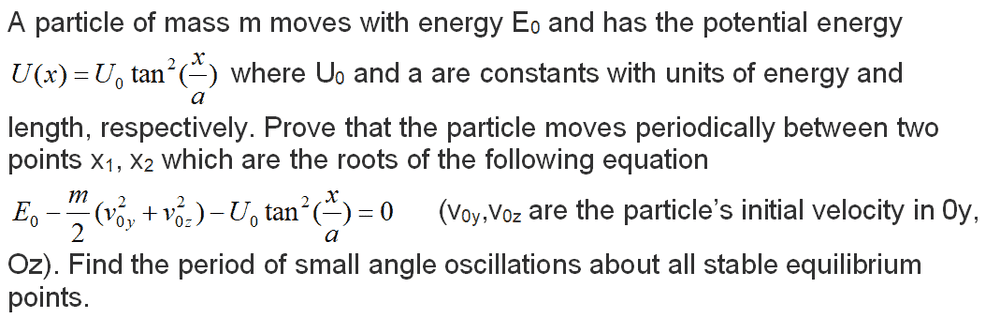
A particle of mass m moves with energy E0 and has the potential energy Ụ(x)=U0tan^2(x/a) where U0 and a are constants with units of energy and length, respectively. Prove that the particle moves periodically between two points x1, x2 which are the roots of the following equation E-m/2(v0y^2+v0z^2)-U0tan^2(x/a)=0 (v0y,v0z are the particle’s initial velocity in 0y, Oz). Find the period of small angle oscillations about all stable equilibrium points.
I couldn't prove the first one but i tried to find the period

F = -dU / dx

= - d( U0tan^2( x / a ) ) / dx

= - U0 ( ( 2 sec^2( x / a ) tan( x / a ) / a )
with F=d^2x/dt^2, tan(x/a)=x/a we have
d^2x/dt^2 + U0 ( ( 2 sec^2( x / a ) ( x / a^2 ) =0
from there i don't know how to handle the sec^2(x/a)
Capture20201116231651.png
 
Physics news on Phys.org
Have you seen the general idea of using a Taylor series expansion of the potential function for small oscillations?
 
  • Like
Likes   Reactions: PhDeezNutz
PS For the first part, you could think about the fact that the particle cannot keep moving in the x-direction, so it must reach a turning point where ##\frac{dx}{dt} = 0##.
 
  • Like
Likes   Reactions: PhDeezNutz

Similar threads

  • · Replies 20 ·
Replies
20
Views
3K
  • · Replies 11 ·
Replies
11
Views
2K
Replies
19
Views
3K
Replies
3
Views
2K
  • · Replies 1 ·
Replies
1
Views
3K
  • · Replies 4 ·
Replies
4
Views
2K
Replies
44
Views
6K
Replies
16
Views
3K
Replies
4
Views
2K
  • · Replies 16 ·
Replies
16
Views
3K