The Set of Borel Sets .... Axler Pages 28-29 .... ....

  • Context: Undergrad 
  • Thread starter Thread starter Math Amateur
  • Start date Start date
  • Tags Tags
    Set Sets
Click For Summary
SUMMARY

The discussion centers on the properties of Borel sets as outlined in Sheldon Axler's book, "Measure, Integration & Real Analysis." Specifically, it addresses why the set of all intersections of open sets is not equivalent to the set of Borel sets due to its failure to be closed under countable unions. The argument presented demonstrates that while singletons in the real numbers are Borel sets, the set of rational numbers, which is a countable union of singletons, is not a Borel set. This conclusion is supported by the Baire category theorem, which is crucial for understanding the limitations of Borel sets.

PREREQUISITES
  • Understanding of Borel sets and their properties
  • Familiarity with the Baire category theorem
  • Knowledge of Gδ sets as countable intersections of open sets
  • Basic concepts of measure theory and real analysis
NEXT STEPS
  • Study the Baire category theorem in detail
  • Explore the concept of Gδ sets and their significance in topology
  • Review the properties of Borel sets in the context of measure theory
  • Investigate examples of sets that are not Borel sets and their implications
USEFUL FOR

Mathematicians, students of real analysis, and anyone interested in the foundational aspects of measure theory and the properties of Borel sets.

Math Amateur
Gold Member
MHB
Messages
3,920
Reaction score
48
TL;DR
I need help in order to fully understand the concept of the set of Borel sets ...
I am reading Sheldon Axler's book: Measure, Integration & Real Analysis ... and I am focused on Chapter 2: Measures ...

I need help in order to fully understand the set of Borel sets ... ...

The relevant text reads as follows:
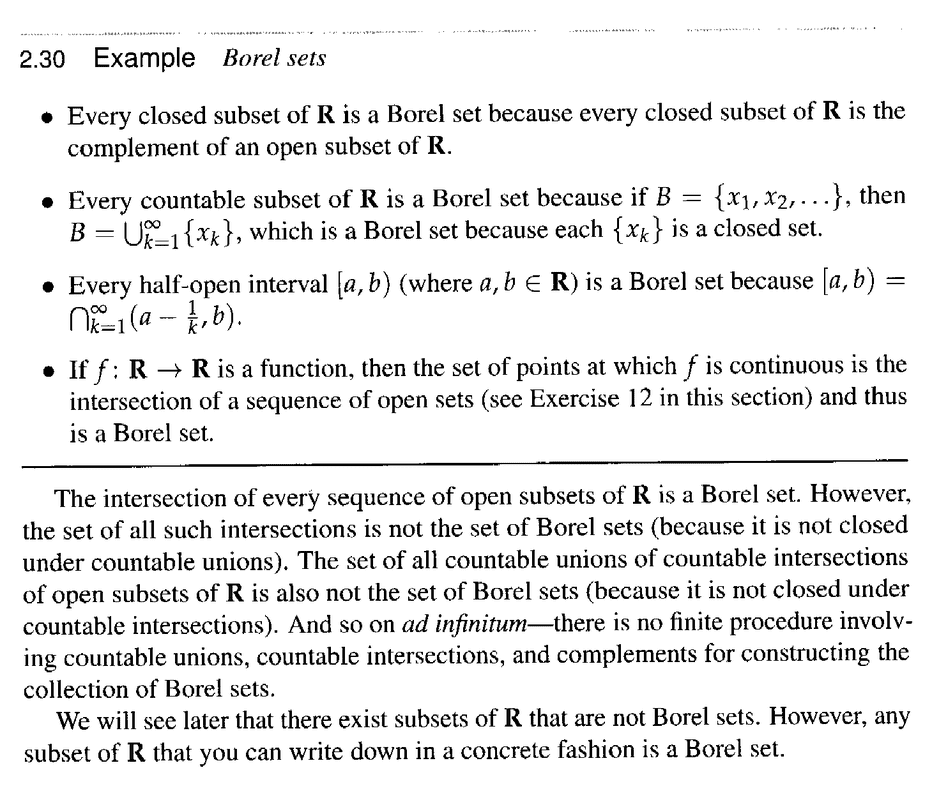
Axler - 1 - Borel Sets ... PART 1 ... .png

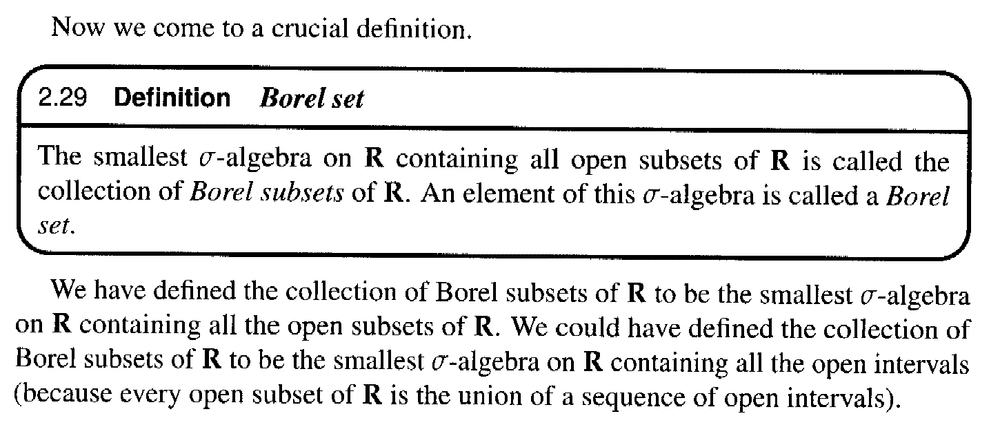
Axler - 2 - Borel Sets ... PART 2 ... .png


My questions related to the above text are as follows:QUESTION 1

In the above text by Axler we read the following:

" ... ... However, the set of all such intersections is not the set of Borel sets (because it is not closed under countable unions). ... ..."Can someone please explain why exactly that the set of all such intersections is not the set of Borel sets ... ? Why exactly is such a set not closed under countable unions and why is this relevant?
QUESTION 2

In the above text by Axler we read the following:

" ... ... The set of all countable unions of countable intersections of open subsets of ##\mathbb{R}## is also not the set of Borel sets (because it is not closed under countable intersections). ... ... "Can someone please explain why exactly that the set of all countable unions of countable intersections of open subsets of ##\mathbb{R}## is not the set of Borel sets ... ? Why exactly is such a set not closed under countable intersections and why is this relevant?
Help with the above two questions will be much appreciated ...

Peter
 
Physics news on Phys.org
Question 1 and question 2 are dual (use complements), so I will only answer question 1.

Q1: Axler claims that the set ##\mathcal{B}:=\{\bigcap \epsilon\mid \epsilon \mathrm{\ countable \ collection \ of \ opens}\}## is not equal to all Borel sets. His argument is: showing that there exists a sequence of sets ##(B_n)_n## in ##\mathcal{B}## such that ##\bigcup_n B_n \notin \mathcal{B}##. Since the Borel sets have the property that countable unions remain Borel, we deduce that ##\mathcal{B}## cannot be equal to the Borel sets.

I'll give an explicit example now for the situation I'm describing above. First, note that every singelton in ##\Bbb{R}## is in ##\mathcal{B}##. To see this, note that ##\{x\}= \bigcap_{n=1}^\infty(x-1/n, x+1/n)##. Hence, ##\Bbb{Q}## is a countable union of sets in ##\mathcal{B}##. It suffices to show that ##\Bbb{Q}## is not in ##\mathcal{B}##. This is non-trivial (and probably why Axler does not go in detail) as it uses the Baire category theorem (this theorem is probably proven later in the book). Here you can find a proof:

https://math.stackexchange.com/questions/69451/

To understand that link, we introduce a definition: a ##G_\delta## set is by definition a countable intersection of open sets, so ##\mathcal{B}## is the set of ##G_\delta##-sets.
 
  • Like
Likes   Reactions: Math Amateur
Math_QED said:
Question 1 and question 2 are dual (use complements), so I will only answer question 1.

Q1: Axler claims that the set ##\mathcal{B}:=\{\bigcap \epsilon\mid \epsilon \mathrm{\ countable \ collection \ of \ opens}\}## is not equal to all Borel sets. His argument is: showing that there exists a sequence of sets ##(B_n)_n## in ##\mathcal{B}## such that ##\bigcup_n B_n \notin \mathcal{B}##. Since the Borel sets have the property that countable unions remain Borel, we deduce that ##\mathcal{B}## cannot be equal to the Borel sets.

I'll give an explicit example now for the situation I'm describing above. First, note that every singelton in ##\Bbb{R}## is in ##\mathcal{B}##. To see this, note that ##\{x\}= \bigcap_{n=1}^\infty(x-1/n, x+1/n)##. Hence, ##\Bbb{Q}## is a countable union of sets in ##\mathcal{B}##. It suffices to show that ##\Bbb{Q}## is not in ##\mathcal{B}##. This is non-trivial (and probably why Axler does not go in detail) as it uses the Baire category theorem (this theorem is probably proven later in the book). Here you can find a proof:

https://math.stackexchange.com/questions/69451/

To understand that link, we introduce a definition: a ##G_\delta## set is by definition a countable intersection of open sets, so ##\mathcal{B}## is the set of ##G_\delta##-sets.
Thanks for a most helpful post Math_QED ...

Still reflecting on what you have written ...

Peter
 

Similar threads

  • · Replies 2 ·
Replies
2
Views
2K
  • · Replies 2 ·
Replies
2
Views
2K
  • · Replies 1 ·
Replies
1
Views
3K
  • · Replies 2 ·
Replies
2
Views
3K
  • · Replies 3 ·
Replies
3
Views
2K
  • · Replies 5 ·
Replies
5
Views
4K
  • · Replies 5 ·
Replies
5
Views
2K
  • · Replies 3 ·
Replies
3
Views
2K
  • · Replies 2 ·
Replies
2
Views
1K
  • · Replies 2 ·
Replies
2
Views
3K