The Spring Constant for a Beam: How to Derive the Deflection Formula
- Context: MHB
- Thread starter Kaspelek
- Start date
Click For Summary
Discussion Overview
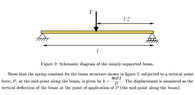
The discussion revolves around deriving the deflection formula for a beam subjected to a central load. Participants explore the theoretical foundations, including the application of beam bending theory and the use of differential equations, while seeking guidance on the derivation process.
Discussion Character
- Exploratory
- Technical explanation
- Homework-related
- Mathematical reasoning
Main Points Raised
- One participant expresses uncertainty about how to start deriving the deflection formula for a beam.
- Another participant cites a formula for elastic deflection from Wikipedia, providing the variables involved.
- A participant acknowledges understanding the formula but seeks clarification on the derivation process.
- Questions are raised about whether an initial value problem (IVP) or ordinary differential equation (ODE) is provided in the problem statement.
- One participant suggests that a free body diagram and reaction forces may be necessary to begin the derivation.
- Another participant mentions that a 4th order homogeneous IVP can be obtained but admits uncertainty about its derivation.
- A later reply introduces the bending moment equation and encourages finding the bending moment at a distance along the beam, suggesting that solving the resulting differential equation is the next step.
Areas of Agreement / Disagreement
Participants do not reach a consensus on the derivation process, with multiple approaches and uncertainties expressed throughout the discussion.
Contextual Notes
Limitations include the lack of specific initial conditions or equations provided in the problem, as well as the dependence on understanding beam bending theory and differential equations.
Who May Find This Useful
Students or individuals interested in mechanics, structural engineering, or those seeking to understand beam deflection and its derivation.

Similar threads
- · Replies 13 ·
- · Replies 2 ·
- · Replies 4 ·
- · Replies 2 ·
- · Replies 4 ·
- · Replies 15 ·
- · Replies 1 ·
- · Replies 27 ·