The Wave Equation and Traveling Waves

Click For Summary
SUMMARY

The discussion focuses on the wave equation in one dimension and its solutions, particularly traveling waves expressed as sinusoidal functions. The general solution for a wave traveling to the right is given by the equation y=A cos(kx−ωt)+B sin(kx−ωt)=C cos(kx−ωt−ϕ), where C=√(A²+B²) and ϕ=tan⁻¹(B/A). It is established that while sine and cosine functions are solutions to the wave equation, they do not encompass all possible wave forms, as any continuous and differentiable function can satisfy the wave equation. Additionally, the discussion highlights the existence of traveling waves in three dimensions and the limitations of certain wave types, such as ocean waves, which do not conform to the standard wave behavior.

PREREQUISITES
  • Understanding of the wave equation and its mathematical formulation
  • Familiarity with trigonometric identities and their applications in wave functions
  • Knowledge of Fourier series and their role in wave analysis
  • Basic concepts of partial differential equations and their solutions
NEXT STEPS
  • Study the derivation and applications of the wave equation in different dimensions
  • Explore Fourier series and integrals for constructing complex waveforms
  • Learn about the implications of initial conditions on wave solutions
  • Investigate the behavior of non-linear waves and their deviations from standard wave equations
USEFUL FOR

Physicists, mathematicians, and engineering students interested in wave mechanics, as well as anyone studying the mathematical modeling of wave phenomena.
harambe
Messages
50
Reaction score
10
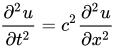
The wave equation in one space dimension can be written as follows:
a49c4fa438fe817377e12de4a139de17730387f1
.A traveling wave which is confined to one plane in space and varies sinusoidally in both space and time can be expressed as combinations of

wsol13.gif
What is the difference between these two wave equations?? And is traveling wave always sinusoidially vary
 

Attachments

  • wsol13.gif
    wsol13.gif
    1.9 KB · Views: 1,539
Physics news on Phys.org
harambe said:
The wave equation in one space dimension can be written as follows:
a49c4fa438fe817377e12de4a139de17730387f1
.A traveling wave which is confined to one plane in space and varies sinusoidally in both space and time can be expressed as combinations of

View attachment 222954What is the difference between these two wave equations?? And is traveling wave always sinusoidially vary
The general solution of the wave traveling to the right is ## y=A \cos(kx-\omega t)+B \sin(kx-\omega t)=C \cos(kx-\omega t -\phi) ## where ## C=\sqrt{A^2+B^2} ## and ## \phi=\tan^{-1}(\frac{B}{A}) ##. Factoring out ## \sqrt{A^2+B^2} ## and using the trigonometric identity for ## \cos(\theta-\phi) ## will show this result.
 
  • Like
Likes   Reactions: harambe
Charles Link said:
The general solution of the wave traveling to the right is y=Acos(kx−ωt)+Bsin(kx−ωt)=Ccos(kx−ωt−ϕ)y=Acos⁡(kx−ωt)+Bsin⁡(kx−ωt)=Ccos⁡(kx−ωt−ϕ) y=A \cos(kx-\omega t)+B \sin(kx-\omega t)=C \cos(kx-\omega t -\phi) where C=√A2+B2C=A2+B2 C=\sqrt{A^2+B^2} and ϕ=tan−1(BA)ϕ=tan−1⁡(BA) \phi=\tan^{-1}(\frac{B}{A}) . Factoring out √A2+B2A2+B2 \sqrt{A^2+B^2} and using the trigonometric identity for cos(θ−ϕ)cos⁡(θ−ϕ) \cos(\theta-\phi) will show this result.

Is this the general form for a traveling wave varying sinysodially in one plane...what about the partial differential equation?
 
The traveling wave can have any continuous and differentiable shape, as can be shown by checking that the general function ##f(x-ct)## satisfies the wave equation (as does the one moving to opposite direction, ##f(x+ct)##).

The sine and cosine solutions are useful just because a wave of any shape can be constructed by summing an appropriate set of them together, as in Fourier series/integral.
 
  • Like
Likes   Reactions: harambe and Charles Link
So the sine and cos function waves are solutions of the wave equation..right?
 
Yes, they represent one kind of a solution, but not the only one. When it's a partial differential equation, it's not possible to write a simple formula that represents every possible solution, as is possible with an ordinary differential equation like

##\frac{dy}{dx}=ky##,

for which all solutions are of the form ##y(x)=Ae^{kx}## with ##A## a constant number.
 
  • Like
Likes   Reactions: harambe
I got that .Thanks

Like traveling waves ,are there any other special category of waves which satisfy the wave motion. Wave motion should apply to every type of wave,right
 
If you define an initial condition like ##u(x,0)=Ae^{-kx^2}## and ##\left.\frac{\partial u}{\partial t}\right|_{t=0} = 0##, you will get a solution that is not a traveling wave.
 
  • Like
Likes   Reactions: harambe
The wave f(x-ct).Can this wave travel in any plane
 
  • #10
harambe said:
The wave f(x-ct).Can this wave travel in any plane

If you have a 3D scalar wave equation ##\frac{\partial^2 u(x,y,z,t)}{\partial t^2} = c^2 \nabla^2 u(x,y,z,t)##, you can make traveling wave solutions like

##u(x,y,z,t) = A\sin(\mathbf{k}\cdot \mathbf{x} - ct)##,

where ##\mathbf{k}## is a wavevector with any direction and ##\mathbf{x} = (x,y,z)## is a vector position coordinate. So in 3D the traveling waves can move to any direction. If it's not a scalar wave and the function ##u## is also a vector, then the constant ##A## in the solution is a vector too and does not necessarily have the same direction as the wave vector ##\mathbf{k}##
 
  • Like
Likes   Reactions: harambe
  • #11
harambe said:
I got that .Thanks

Like traveling waves ,are there any other special category of waves which satisfy the wave motion. Wave motion should apply to every type of wave,right
Several common types of waves do not (even approximately) follow the behavior described by solutions like ##\frac{1}{2}f(x-ct) + \frac{1}{2}f(x+ct)##. For example, think of an ocean wave that gradually steepens before it breaks in the surf zone.
 

Similar threads

  • · Replies 27 ·
Replies
27
Views
4K
  • · Replies 4 ·
Replies
4
Views
9K
  • · Replies 50 ·
2
Replies
50
Views
19K
  • · Replies 7 ·
Replies
7
Views
3K
  • · Replies 4 ·
Replies
4
Views
2K
  • · Replies 8 ·
Replies
8
Views
2K
  • · Replies 19 ·
Replies
19
Views
2K
  • · Replies 8 ·
Replies
8
Views
2K
  • · Replies 3 ·
Replies
3
Views
2K
  • · Replies 4 ·
Replies
4
Views
1K