The Wave Equation and Traveling Waves

Click For Summary

Discussion Overview

The discussion centers on the wave equation in one dimension and the characteristics of traveling waves, including their mathematical representations and the nature of their solutions. Participants explore the differences between various forms of wave equations, the conditions under which different types of waves exist, and the implications of initial conditions on wave behavior.

Discussion Character

  • Technical explanation
  • Conceptual clarification
  • Debate/contested
  • Mathematical reasoning

Main Points Raised

  • Some participants inquire about the difference between various wave equations and whether traveling waves always vary sinusoidally.
  • Others present the general solution for a traveling wave and discuss its representation in terms of sine and cosine functions.
  • It is noted that while sine and cosine functions are solutions to the wave equation, they do not encompass all possible solutions, particularly in the context of partial differential equations.
  • One participant suggests that traveling waves can take on any continuous and differentiable shape, referencing the ability to construct complex waves using Fourier series.
  • Another participant raises the question of whether wave motion applies to all types of waves, indicating a curiosity about other categories of waves beyond traveling waves.
  • Concerns are expressed regarding specific initial conditions that yield solutions not classified as traveling waves.
  • A later reply discusses the nature of traveling waves in three dimensions and the implications of vector quantities in wave equations.
  • Some participants highlight that certain common wave types, such as ocean waves, do not conform to the behavior described by standard wave solutions.

Areas of Agreement / Disagreement

Participants express a range of views on the nature of traveling waves and their mathematical representations. There is no consensus on whether all waves can be classified under the same principles, and the discussion remains unresolved regarding the applicability of wave motion to various wave types.

Contextual Notes

Limitations include the dependence on specific definitions of wave types and the unresolved nature of how initial conditions affect wave behavior. The discussion also reflects the complexity of solutions to partial differential equations compared to ordinary differential equations.

harambe
Messages
50
Reaction score
10
The wave equation in one space dimension can be written as follows:
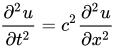
a49c4fa438fe817377e12de4a139de17730387f1
.A traveling wave which is confined to one plane in space and varies sinusoidally in both space and time can be expressed as combinations of

wsol13.gif
What is the difference between these two wave equations?? And is traveling wave always sinusoidially vary
 

Attachments

  • wsol13.gif
    wsol13.gif
    1.9 KB · Views: 1,556
Physics news on Phys.org
harambe said:
The wave equation in one space dimension can be written as follows:
a49c4fa438fe817377e12de4a139de17730387f1
.A traveling wave which is confined to one plane in space and varies sinusoidally in both space and time can be expressed as combinations of

View attachment 222954What is the difference between these two wave equations?? And is traveling wave always sinusoidially vary
The general solution of the wave traveling to the right is ## y=A \cos(kx-\omega t)+B \sin(kx-\omega t)=C \cos(kx-\omega t -\phi) ## where ## C=\sqrt{A^2+B^2} ## and ## \phi=\tan^{-1}(\frac{B}{A}) ##. Factoring out ## \sqrt{A^2+B^2} ## and using the trigonometric identity for ## \cos(\theta-\phi) ## will show this result.
 
  • Like
Likes   Reactions: harambe
Charles Link said:
The general solution of the wave traveling to the right is y=Acos(kx−ωt)+Bsin(kx−ωt)=Ccos(kx−ωt−ϕ)y=Acos⁡(kx−ωt)+Bsin⁡(kx−ωt)=Ccos⁡(kx−ωt−ϕ) y=A \cos(kx-\omega t)+B \sin(kx-\omega t)=C \cos(kx-\omega t -\phi) where C=√A2+B2C=A2+B2 C=\sqrt{A^2+B^2} and ϕ=tan−1(BA)ϕ=tan−1⁡(BA) \phi=\tan^{-1}(\frac{B}{A}) . Factoring out √A2+B2A2+B2 \sqrt{A^2+B^2} and using the trigonometric identity for cos(θ−ϕ)cos⁡(θ−ϕ) \cos(\theta-\phi) will show this result.

Is this the general form for a traveling wave varying sinysodially in one plane...what about the partial differential equation?
 
The traveling wave can have any continuous and differentiable shape, as can be shown by checking that the general function ##f(x-ct)## satisfies the wave equation (as does the one moving to opposite direction, ##f(x+ct)##).

The sine and cosine solutions are useful just because a wave of any shape can be constructed by summing an appropriate set of them together, as in Fourier series/integral.
 
  • Like
Likes   Reactions: harambe and Charles Link
So the sine and cos function waves are solutions of the wave equation..right?
 
Yes, they represent one kind of a solution, but not the only one. When it's a partial differential equation, it's not possible to write a simple formula that represents every possible solution, as is possible with an ordinary differential equation like

##\frac{dy}{dx}=ky##,

for which all solutions are of the form ##y(x)=Ae^{kx}## with ##A## a constant number.
 
  • Like
Likes   Reactions: harambe
I got that .Thanks

Like traveling waves ,are there any other special category of waves which satisfy the wave motion. Wave motion should apply to every type of wave,right
 
If you define an initial condition like ##u(x,0)=Ae^{-kx^2}## and ##\left.\frac{\partial u}{\partial t}\right|_{t=0} = 0##, you will get a solution that is not a traveling wave.
 
  • Like
Likes   Reactions: harambe
The wave f(x-ct).Can this wave travel in any plane
 
  • #10
harambe said:
The wave f(x-ct).Can this wave travel in any plane

If you have a 3D scalar wave equation ##\frac{\partial^2 u(x,y,z,t)}{\partial t^2} = c^2 \nabla^2 u(x,y,z,t)##, you can make traveling wave solutions like

##u(x,y,z,t) = A\sin(\mathbf{k}\cdot \mathbf{x} - ct)##,

where ##\mathbf{k}## is a wavevector with any direction and ##\mathbf{x} = (x,y,z)## is a vector position coordinate. So in 3D the traveling waves can move to any direction. If it's not a scalar wave and the function ##u## is also a vector, then the constant ##A## in the solution is a vector too and does not necessarily have the same direction as the wave vector ##\mathbf{k}##
 
  • Like
Likes   Reactions: harambe
  • #11
harambe said:
I got that .Thanks

Like traveling waves ,are there any other special category of waves which satisfy the wave motion. Wave motion should apply to every type of wave,right
Several common types of waves do not (even approximately) follow the behavior described by solutions like ##\frac{1}{2}f(x-ct) + \frac{1}{2}f(x+ct)##. For example, think of an ocean wave that gradually steepens before it breaks in the surf zone.
 

Similar threads

  • · Replies 27 ·
Replies
27
Views
4K
  • · Replies 4 ·
Replies
4
Views
9K
  • · Replies 50 ·
2
Replies
50
Views
20K
  • · Replies 7 ·
Replies
7
Views
3K
  • · Replies 4 ·
Replies
4
Views
2K
  • · Replies 8 ·
Replies
8
Views
2K
  • · Replies 19 ·
Replies
19
Views
2K
  • · Replies 8 ·
Replies
8
Views
3K
  • · Replies 3 ·
Replies
3
Views
2K
  • · Replies 4 ·
Replies
4
Views
2K