"The wavefunction never collapses"

  • Context: Undergrad 
  • Thread starter Thread starter sevensages
  • Start date Start date
  • #121
PeterDonis said:
As far as their claims about "what is really happening", yes. Of course they all make the same predictions for what we can test by experiment, but they don't limit themselves to that.

For example, the MWI says measurements have all possible outcomes, but other interpretations say measurements have single outcomes. Those are incompatible statements; they can't both be true. They both make the same predictions for what we can test by experiment, but their claims go beyond what we can test by experiment, and they do so in incompatible ways.
I would say, "their claims go beyond what we can test by experiment now". For instance with MWI, one could conceivably devise an experiment to measure the gravitational effect of the different worlds which would prove or it. But of course. We don't believe we have a complete theory of gravity compatible with QM so there is your out.
 
Physics news on Phys.org
  • #122
jbergman said:
with MWI, one could conceivably devise an experiment to measure the gravitational effect of the different worlds
No, you couldn't, because any such effects would just end up being entangled with everything else, and in any given branch, there would be just one gravitational effect, and the branches are decohered so they don't interfere with each other, so there's no experiment that could detect the presence of more than one branch.
 
  • Like
Likes   Reactions: bhobba, gentzen and javisot
  • #123
Let me clarify: either
(a) the outcome was already assigned to each branch before measurement; natural, but operationally a hidden variable;
(b) the branches form at measurement and "decide" their outcomes at that moment, correlated with each other (one gets 0 because the other gets 1).
In case (b), this seems like an "entangled" collapse.
I don't see a third option, but I'm open to one.
 
  • #124
Roberto Pavani said:
But we are always observers inside one branch, and from that perspective, it is operationally indistinguishable from a hidden variable.
A change to this paragraph:

"we are always observers inside one branch, and from that perspective, it is operationally indistinguishable from Copenhagen."

and, Copenhagen≠hidden variable
 
  • #125
Roberto Pavani said:
(a) the outcome was already assigned to each branch before measurement; natural, but operationally a hidden variable;
I don't even know what this means.

Roberto Pavani said:
(b) the branches form at measurement
In the sense that the measurement interaction is what entangles the particles with the measuring devices and the environment, and that entanglement, spreading among a very large number of untrackable degrees of freedom in the environment is what leads to decoherence, yes.

Roberto Pavani said:
and "decide" their outcomes at that moment, correlated with each other (one gets 0 because the other gets 1).
No, there is no "decision" involved. The wave function already contains all the outcomes and the correlations between them. There's nothing to decide.

Roberto Pavani said:
I don't see a third option, but I'm open to one.
I think you need to stop waving your hands and write down some actual math. If you write down the actual math, the things I've been saying should be obvious, and it should also be obvious why things like your a) are just meaningless noise, since as far as I can see your a) doesn't correspond to anything in the actual math.
 
  • Like
Likes   Reactions: bhobba and gentzen
  • #126
Roberto Pavani said:
If nothing in the theory determines which branch you end up in, yet you end up in one, isn't that precisely the definition of "incomplete" in the EPR sense?
I would recommend you to actually read the original EPR paper! It is eminently readable!

In EPR they define a necessary (not sufficient) condition for completeness as "...every element of the physical reality must have a counterpart in the physical theory."

But they are quite specific on what they mean by "element of reality" as it pertains to that paper. A sufficient (not necessary) requirement is: "If, without in any way disturbing a system, we can predict with certainty (i.e., with probability equal to unity) the value of a physical quantity, then there exists an element of physical reality corresponding to this physical quantity."

They were quite focused on position and momentum as their "element(s) of reality" which QM had no "corresponding object" -- (I.e. standard QM has only a probability distribution for them before any measurement is made and can not tell you what they "really are" in the sense of a hidden/extra variable). It was later Bohm who expanded the EPR to spin to make the example easier to deal with.

Same as PeroK, I see no way where MWI branching fits this definition of aspect of reality and therefore I see no way to directly use EPR argument to say MWI is incomplete.
 
  • Like
Likes   Reactions: PeroK, javisot, gentzen and 1 other person
  • #127
Roberto Pavani said:
you end up in one
No, you end up in all branches. You do not end up in just one. So there can't be any "hidden variable" that "determines" that you end up in a certain branch--because you don't.
 
  • Like
Likes   Reactions: javisot and gentzen
  • #128
Thank you for clarifying that it is (b). I accept the correction on EPR.

But I still have a question about the mechanism in (b): you said "the wave function already contains all outcomes and correlations, there is nothing to decide."

If everything was already there before the measurement, what does the measurement actually do? Does it spawn two worlds, one with 0 and one with 1? And from the perspective of World_0: wasn't the outcome already determined? This brings me back to the same question, just without the EPR label.
Sorry for my naive quesitons but i'm trying to be as much rigorous as i can in order to understand the process.
 
  • #129
Roberto Pavani said:
If everything was already there before the measurement, what does the measurement actually do?
It entangles the measured system with the measuring device and the environment, as I said in post #125. And this would be obvious to you if you looked at the math.

Roberto Pavani said:
i'm trying to be as much rigorous as i can
No, you're not, if you're not looking at the actual math. Please go do that before posting any further in this thread.
 
  • Like
Likes   Reactions: bhobba
  • #130
Thank you, I'll study the math and will do some simulations with qiskit. I appreciate everyone's patience with my questions.
 
  • #131
Roberto Pavani said:
will do some simulations with qiskit
Please note that you should not require any simulations in order to see the basic idea in the math; for a simplified scenario like measuring two entangled qubits, which is what we've been discussing, everything can be written out in closed form and doesn't require any numerical analysis.
 
  • Like
Likes   Reactions: bhobba
  • #133
PeroK said:
MWI has no satisfactory answer for the Born rule, except where the branching is equally likely.

That's why almost all presentations of MWI assume a simple 50-50 branch.
Thank you for suggesting I look at the math. Revisiting the thread and PeroK's comment #10, it occurred to me that this might connect to information theory. So I did some calculations (possibly wrong, I studied Shannon 40 years ago, so please correct me if needed).

For a process with ##p \neq \frac{1}{2}## and ##N## measurements, Shannon's Asymptotic Equipartition Property states that the "typical" sequences (those consistent with the Born Rule) number only ##2^{N H(p)}## out of ##2^N## total possible sequences, where

##H(p) = -p\log_2 p - (1-p)\log_2(1-p)##

is the binary entropy. The fraction of typical sequences is therefore

##\frac{S}{2^N} \approx 2^{-N(1-H(p))}##

which goes to zero exponentially with ##N##.

For example, with ##p = 1/8##: ##H(p) \approx 0.544## , so the typical fraction ##\approx 2^{-0.456\,N}##.

If MWI branch counting treats all ##2^N## sequences as equally real branches, then picking one observer from a random branch, the probability of finding him with a Born-Rule-compatible sequence goes to zero exponentially. Yet we always observe Born-Rule-compatible statistics.

If the above calculations do apply, it seems to me that (A) equal branch counting is incompatible with Shannon's AEP. Or (B) we are simply always lucky enough to find ourselves in the exponentially rare branches that happen to be consistent with the Born Rule, and the longer the experiment, the luckier we are (exponentially so)
I have nothing further to add on this point. I'll limit myself to answering specific questions about this last post.
 
  • #134
Roberto Pavani said:
If the above calculations do apply, it seems to me that (A) equal branch counting is incompatible with Shannon's AEP. Or (B) we are simply always lucky enough to find ourselves in the exponentially rare branches that happen to be consistent with the Born Rule, and the longer the experiment, the luckier we are (exponentially so)
I have nothing further to add on this point. I'll limit myself to answering specific questions about this last post.
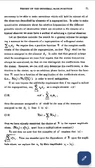
You have to be careful with branch counting and then assigning them probabilities. Branches in MWI are not given uniform probability. In fact, you use a probability measure that matches exactly the Born rule. Everett derives the Born rule as the only measure satisfying his additivity and phase invariance requirements.

See my screenshot. Page 71 in Everett's original thesis.

Now to address your specific concern about violation of Born rule, see this quote from the thesis:

Thus, in particular, if we consider the sequences to become longer
and longer (more and more observations performed) each memory sequence
of the final superposition will satisfy any given criterion for a randomly
generated sequence, generated by the independent probabilities aiai' ex-
cept for a set of total measure which tends toward zero as the number of
observations becomes unlimited. Hence all averages of functions over
any memory sequence, including the special case of frequencies, can be
computed from the probabilities aiai' except for a set of memory sequen-
ces of measure zero. We have therefore shown that the statistical asser-
tions of Process 1 will appear to be valid to almost all observers de-
scrlbed by separate elements of the superposition (2.6), in the limit as
the number of observations goes to infinity.
(aiai' is the square amplitude, process one is Copenhagen wave function collapse. Everett is saying here that his setup reproduces the predictions of Copenhagen except for within a set of branches of measure zero. So we are not "lucky", we just don't occupy one of the branches in this set of measure zero)

Now, what this probability measure really means in MWI is a difficult question. One which I am not equipped to answer satisfactorily.
 

Attachments

  • Screenshot_20260706_012428_Chrome.webp
    Screenshot_20260706_012428_Chrome.webp
    40.8 KB · Views: 1
Last edited:
  • Like
  • Informative
Likes   Reactions: PeroK and Roberto Pavani
  • #135
Matterwave said:
Matterwave said:
Now, what this probability measure really means in MWI is a difficult question. One which I am not equipped to answer satisfactorily.
Thank you, this is very helpful. I agree that for p = 1/2, branch counting and Born Rule coincide.

I note that with p = 1/2, the "set of measure zero" are the extremes (all-0 and all-1 sequences).

But for p ≠ 1/2, Shannon's AEP tells us the scenarios invert: with branch counting, it is the Born-Rule-compatible sequences that become the exponentially rare set.

As you honestly noted, "what this probability measure really means in MWI is a difficult question."
One way to restore agreement is to assign a different number of copies to each outcome, so that the probability of picking a Born-Rule-compatible branch matches the expectations. But then the number of copies for each outcome is itself determined by the Born Rule,
which is the quantity we were trying to derive. I'm not saying that this is the case, it could be there are other possibilities.
 
Last edited:
  • #136
I think you are implicitly imposing a frequentist viewpoint into the branching and assuming we can resolve things via counting.

The mathematics in my post shows that instead you need to assign a probability measure to the (branching of the) wave function which is in direct agreement with the Born rule. And this means that given enough observations "almost every branch" *with respect to this probability measure* obeys the born rule.

It doesn't say anything about *number of branches* (as far as I can tell).

Note also that just because I have difficulty in interpreting such a probability measure does not mean there's something actually wrong with it. I am not a strong MWI proponent myself.

MWI proponents often bring up self-locating probability and decision theory to "explain" or "interpret" (what have you), this probability measure. You may want to look into that if it interests you.
 

Similar threads

  • · Replies 11 ·
Replies
11
Views
1K
  • · Replies 8 ·
Replies
8
Views
673
  • · Replies 12 ·
Replies
12
Views
2K
  • · Replies 5 ·
Replies
5
Views
4K
  • · Replies 13 ·
Replies
13
Views
2K
  • · Replies 69 ·
3
Replies
69
Views
8K
  • · Replies 8 ·
Replies
8
Views
3K
  • · Replies 32 ·
2
Replies
32
Views
4K
  • · Replies 8 ·
Replies
8
Views
3K
  • · Replies 4 ·
Replies
4
Views
2K