Thin-Film Interference: Coating a Lens - Answers found, explanation needed

Click For Summary
SUMMARY

This discussion focuses on the principles of thin-film interference in lens coatings, specifically addressing the equations for constructive and destructive interference. The key equations are 2L=(m+1/2)(λ/n) for constructive interference and 2L=(m)(λ/n) for destructive interference, where L is the film thickness, m is the fringe count, λ is the wavelength of light, and n is the refractive index. The participants clarify the phase changes occurring at boundaries with different refractive indices, emphasizing that a phase change of λ/2 occurs when light reflects from a higher to a lower refractive index. This understanding is crucial for correctly applying the equations to achieve maximum and minimum reflection in practical scenarios.

PREREQUISITES
  • Understanding of thin-film interference principles
  • Familiarity with the equations for constructive and destructive interference
  • Knowledge of refractive indices and their effects on light behavior
  • Basic grasp of optical path differences and phase changes in light
NEXT STEPS
  • Study the derivation of the thin-film interference equations in detail
  • Learn about the impact of varying refractive indices on light reflection
  • Explore practical applications of thin-film coatings in optics
  • Investigate advanced topics like multi-layer thin-film interference
USEFUL FOR

Students and professionals in optics, physicists, and engineers involved in lens design and coating applications will benefit from this discussion, particularly those focused on maximizing optical performance through thin-film interference techniques.

FishStik
Messages
5
Reaction score
0
Thin-Film Interference: Coating a Lens -- Answers found, explanation needed!
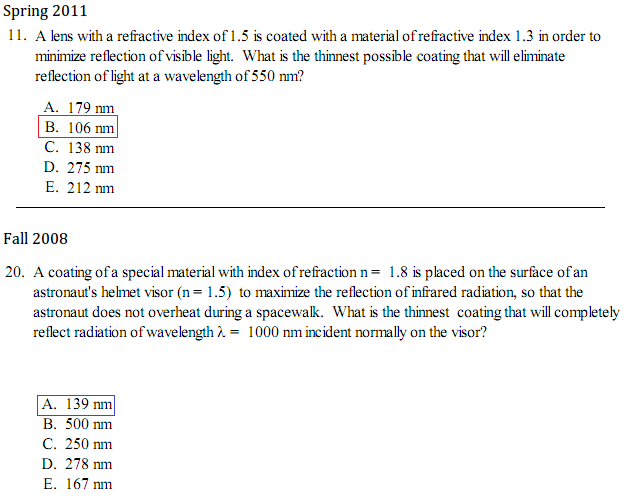
Homework Statement


YZm3a.png

Boxed answers are the correct ones.

Homework Equations


2L=(m+1/2)(λ/n) for constructive interference (maximum reflection, bright film)
2L=(m)(λ/n) for destructive interference (minimum reflection, dark film)

Where:
L = thickness of film
m = fringe count (for m=0,1,2,3,4...)
λ = wavelength of light
n = refractive index of coating

The Attempt at a Solution


I got the correct answer (a) for Fall2008 #20 by using the equation for constructive interference, plugging in 0 for m, 1000 nm for λ, and 1.8 for n.
Now for Sp2011 #11, I took it as essentially the same question except this one is asking for minimum reflection, so I should use the equation for destructive interference. Doing that gets me (e), which is incorrect. The correct answer is (b), which is half of (e), implying that I should use the equation for constructive interference.

Am I missing a fundamental difference between the two problems besides one asking for minimum and another asking for maximum reflection? Thanks for the help.
 
Last edited:
Physics news on Phys.org


The λ of the light in the coating is 550/n. The light must travel a distance of λ/2 in the coating to emerge from the coating out of phase with the reflected light byλ/2 and cause destructive interference. In the first example this means that the coating needs to be λ/4 thick.(106nm)
In the second example the logic is exactly the same but this time a phase change of λ/2 occurs at the junction of the coating and the visor of the helmet. A phase change of λ/2 occurs when there is reflection from a boundary when the light passes from high refractive index (1.8) into low refractive index (1.5). The wavelength of the light in the coating is 1000/n
A phase change of 0.5 of this wavelength occurs at the coating/visor junction. To MAXIMISE the reflection the 2 waves should emerge in phase therefore the path difference through the coating (2 x thickness) needs to be λ/2 giving a total phase difference of 1λ
In the first example there is no λ/2 phase difference at the junction between the coating and the lens because the refractive index of the lens is greater than the refractive index of the coating.


technician said:
In the second example the logic is exactly the same but this time a phase change of λ/2 occurs at the junction of the coating and the visor of the helmet. A phase change of λ/2 occurs when there is reflection from a boundary when the light passes from high refractive index (1.8) into low refractive index (1.5).

The opposite is true: There is no phase change when the light reflects from a lower-index medium, and the phase of the reflected wave changes by pi when the light enters from a lower index medium to the boundary with a higher index one.

The pi phase change corresponds to half-wavelength optical path difference.

ehild


ehild... you are correct, I have checked my notes and got it the wrong way round!
I think that in the first question there is a phase change of pi at both surfaces but in the second question there is only 1 phase change of pi at the air/coating surface.
I think it makes no difference to the answers but what I wrote was confusing.
Apologies to FishStik and to you... and thanks.


You are welcome :smile:

ehild
 

Similar threads

Replies
3
Views
3K
Replies
1
Views
3K
  • · Replies 1 ·
Replies
1
Views
4K
  • · Replies 6 ·
Replies
6
Views
5K
  • · Replies 5 ·
Replies
5
Views
9K
  • · Replies 3 ·
Replies
3
Views
4K
Replies
12
Views
2K
  • · Replies 3 ·
Replies
3
Views
3K
Replies
7
Views
6K
  • · Replies 3 ·
Replies
3
Views
4K