Third Invariant expressed with Cayley-Hamilton Theorem

Click For Summary
SUMMARY

The discussion centers on the application of the Cayley-Hamilton Theorem to express the third invariant of the characteristic polynomial derived from the Eigenvector/Eigenvalue problem. The proof referenced from Chaves – Notes on Continuum Mechanics leads to a critical equation involving the traces of tensors, specifically Tr(T) and Tr(T^2). The participants clarify that the right-hand sides of the equations in question are equal, confirming the validity of the theorem's application in this context.

PREREQUISITES
  • Cayley-Hamilton Theorem
  • Eigenvector/Eigenvalue problem
  • Characteristic polynomial
  • Tensor calculus
NEXT STEPS
  • Study the implications of the Cayley-Hamilton Theorem in continuum mechanics
  • Explore advanced tensor calculus techniques
  • Investigate the relationship between invariants and eigenvalues
  • Review proofs related to characteristic polynomials in linear algebra
USEFUL FOR

Mathematicians, physicists, and engineers working with continuum mechanics, particularly those focusing on tensor analysis and eigenvalue problems.

FluidStu
Messages
25
Reaction score
3
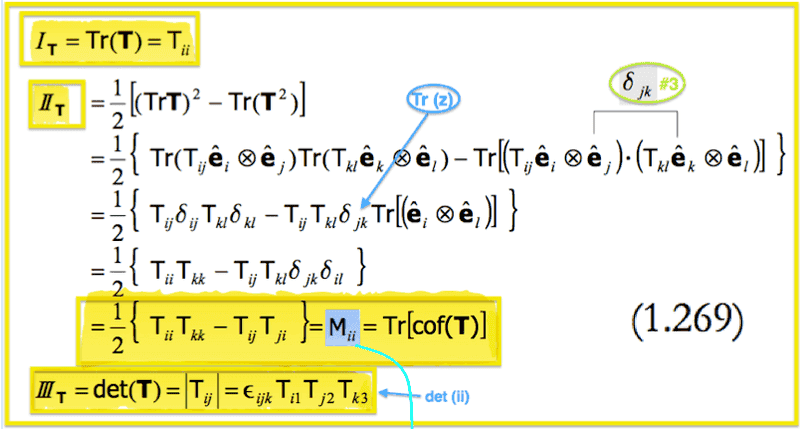
The Cayley-Hamilton Theorem can be used to express the third invariant of the characteristic polynomial obtained from the non-trivial solution of the Eigenvector/Eigenvalue problem. I follow the proof (in Chaves – Notes on Continuum Mechanics) down to the following equation, then get stuck at "Replacing the values of IT and IIT with those in 1.269. Could someone please explain? Thanks


upload_2016-4-11_9-14-6.png
upload_2016-4-11_9-17-24.png
upload_2016-4-11_9-17-35.png

with 1.269 being:
upload_2016-4-11_9-14-51.png
 
Physics news on Phys.org
We need to show that the RHS of the equations in the first two boxes are equal. To minimise the latex coding I'll write ##A## for ##Tr(T)## and ##B## for ##Tr(T^2)##. Then subtract the RHS of the second from the RHS of the first and multiply the result by 2 to get:
$$2II_TA-2I_TB-A^3+3AB=2II_TA-2AB-A^3+3AB=A\left(2II_T-2B-A^2+3B\right)=A\left(2II_T+B-A^2\right)=2A\left(II_T-0.5(A^2-B)\right)
=2A\left(II_T-II_T\right)=0$$
So twice the difference is zero.
So the two RHSs are equal.
 
  • Like
Likes   Reactions: FluidStu
Great! Thanks Andrew.
 

Similar threads

  • · Replies 6 ·
Replies
6
Views
6K
  • · Replies 10 ·
Replies
10
Views
4K
  • · Replies 3 ·
Replies
3
Views
5K
  • · Replies 2 ·
Replies
2
Views
4K
  • · Replies 2 ·
Replies
2
Views
2K
  • · Replies 1 ·
Replies
1
Views
2K
  • · Replies 6 ·
Replies
6
Views
3K
  • · Replies 1 ·
Replies
1
Views
2K
  • · Replies 27 ·
Replies
27
Views
4K
  • · Replies 7 ·
Replies
7
Views
7K