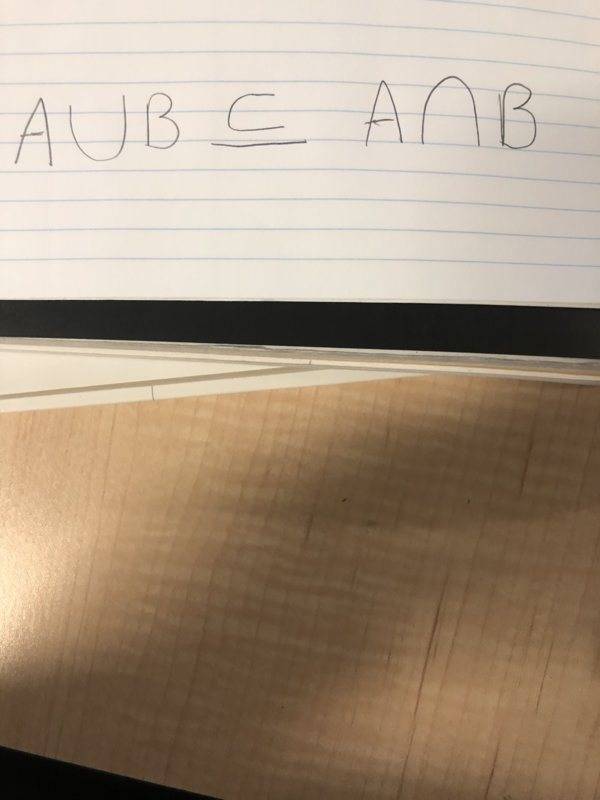
This would be a false statement, correct?

  • Context: Undergrad 
  • Thread starter Thread starter EchoRush
  • Start date Start date
  • Tags Tags
    Abstract algebra Set
Click For Summary

Discussion Overview

The discussion revolves around the truth value of the statement "A ∪ B ⊆ A ∩ B" in set theory, exploring the implications of union and intersection of sets. Participants examine the conditions under which this statement may be considered false or true, including the use of quantifiers in propositional functions.

Discussion Character

  • Debate/contested
  • Mathematical reasoning

Main Points Raised

  • Some participants argue that the statement "A ∪ B ⊆ A ∩ B" must be false, citing that the union of two sets cannot be a subset of their intersection.
  • Others point out that while the statement is generally false, there are specific cases where it can hold true, such as when A and B are equal.
  • A participant emphasizes the distinction between a "statement" and a "propositional function," noting that the truth value can depend on the context and quantifiers used.
  • Some participants suggest that the phrase can be interpreted with universal quantifiers, leading to a false statement, while existential quantifiers could yield a true statement.

Areas of Agreement / Disagreement

Participants generally disagree on the unconditional truth value of the statement, with multiple competing views on its validity depending on the context and definitions used.

Contextual Notes

The discussion highlights the importance of specifying quantifiers in mathematical statements, as the lack of clarity can lead to different interpretations and conclusions.

EchoRush
Messages
9
Reaction score
1
TL;DR
A quick question about sets and intersection/unions
I believe that I am correct, the following statement here must be FALSE, right? It has to be false because A union B is like the two entire circles of the Venn diagram and that cannot be a subset of the intersection area, right? Now if this statement was flipped, then it would be true?

31826703-6ACD-452A-94E8-02CDF6802FFF.jpeg
 
Physics news on Phys.org
Correct :wink: !
 
By the way PF would really appreciate typed posts instead of disk-space wasting big pictures !

If you type
##A\cup B \subseteq A\cap B## then you get ##A\cup B \subseteq A\cap B## (in-line math), and if you type
$$A\cup B \subseteq A\cap B$$ then you get $$A\cup B \subseteq A\cap B$$
('displayed math').

##LaTeX## is fun, fairly easy to start with and extremely useful
 
  • Like
Likes   Reactions: Mark44 and Dale
Yes correct. For example take ##A = \{0\}, B = \{1\}##. Then ##A\cup B = \{0,1\}## yet ##A \cap B = \emptyset##.

The other inclusion, that is ##A \cap B \subseteq A \cup B##, is trivially true.
 
EchoRush said:
Summary:: A quick question about sets and intersection/unions

I believe that I am correct, the following statement here must be FALSE, right? It has to be false because A union B is like the two entire circles of the Venn diagram and that cannot be a subset of the intersection area, right? Now if this statement was flipped, then it would be true?

You can, however, have ##A \cup B = A \cap B##, so it's not always false. Can you see when you have this equality?

It is correct that ##A \cup B## can never be a proper subset of ##A \cap B##.
 
  • Like
Likes   Reactions: FactChecker and pbuk
PeroK said:
You can, however, have ##A \cup B = A \cap B##, so it's not always false. Can you see when you have this equality?
Yes, absolutely, it is NOT correct to say that the statement is unconditionally false.
 
EchoRush said:
I believe that I am correct, the following statement here must be FALSE, right?
To reinforce what others have said, there is a difference between talking about a "statement" versus taking about a "propositional function".

If you utter a phrase like "If x > 7 then x > 1" , it is technically a "propositional function", which cannot be assigned a truth value ( True vs False) until "x" is defined to be something specific. In common speech and in informal mathematical writing, it is usually understood that phrases like "If x >7 then x > 1" are intended to have the "universal quantifier" given by the phrase "for each". So the reader interprets the claim "If x > 7 then x > 1" to mean "For each number x, if x >7 then x > 1". With this interpretation, the phrase becomes a statement which can be assigned a truth value.

The other commonly used quantifier is "there exists". Someone writing hasty notes might jot down the phrase "x > 1" intending it to mean "There exists a number x such that x > 1". However, this is not a clear style of writing.

Your question about "##A \cup B \subseteq A \cap B##" is technically a question about a propositional function, so it cannot be assigned a single truth value. You probably intended some universal quantifiers to be supplied, so the phrase would become the statement "For each set ##A## and for each set ##B##, ## A \cup B \subseteq A \cap B##". With the universal quantifiers, the propositional function is converted into a False statement. However, if we supply existential quantifiers, we get "There exists a set ##A## and there exists a set ##B## such that ## A \cup B \subseteq A \cap B##". This converts the propositional function into a True statement.
 
  • Like
  • Informative
Likes   Reactions: PeroK and pbuk

Similar threads

  • · Replies 8 ·
Replies
8
Views
2K
  • · Replies 54 ·
2
Replies
54
Views
7K
  • · Replies 18 ·
Replies
18
Views
2K
Replies
1
Views
2K
  • · Replies 40 ·
2
Replies
40
Views
9K
  • · Replies 10 ·
Replies
10
Views
3K
  • · Replies 1 ·
Replies
1
Views
2K
  • · Replies 2 ·
Replies
2
Views
2K
  • · Replies 7 ·
Replies
7
Views
15K
  • · Replies 16 ·
Replies
16
Views
2K