Tight Binding Model: mathematics

3 replies · 2K views · last reply
Waxterzz
Messages
82
Reaction score
0
From the textbook of Omar:

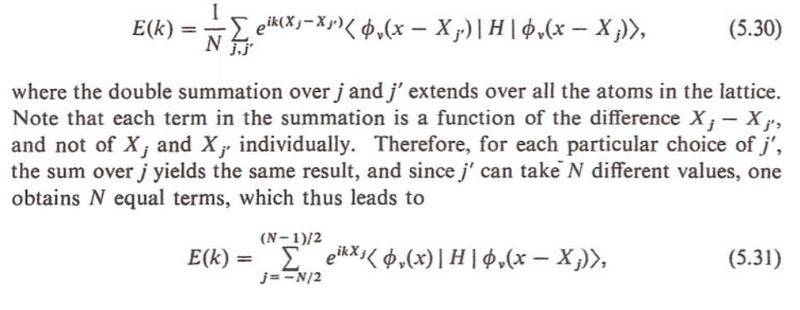
Two displayed equations from a solid-state text: E(k) = (1/N) times the double sum over j and j' of e^{ik(Xj - Xj')} times <phi_v(x - Xj') | H | phi_v(x - Xj)> (5.30), and E(k) = sum from j = -(N-1)/2 to (N-1)/2 of e^{ikXj} times <phi_v(x) | H | phi_v(x - Xj)> (5.31).


Can someone explain me the summation of this? I simply don't get it?

Thanks in advance.
 
Which summation do you mean?
The second equation is the first one with the argument that the sum over j' looks like "something"+"something"+...+"something" (N times the same summand) = N*"something".
 
mfb said:
Which summation do you mean?
The second equation is the first one with the argument that the sum over j' looks like "something"+"something"+...+"something" (N times the same summand) = N*"something".

I don't get how you go from the double summation to the new one with the new index etc.

Oh yeah i forgot to say: in the new expression they put Xj' = 0.

It's a function of the difference, Xj-Xj'. For each choice of j',the sum over j yields the same result. => I don't get it.

Also I don't get why you start from -N/2 and end with (N-1)/2