Tight Binding Model: mathematics

Click For Summary
The discussion centers on understanding a specific summation in the context of the Tight Binding Model from Omar's textbook. Participants seek clarification on the transition from a double summation to a new expression involving a different index, with one contributor noting that Xj' is set to zero. The conversation highlights confusion regarding the mathematical reasoning behind the summation, particularly the implications of treating the sum over j' as identical summands. Additionally, there is uncertainty about the starting and ending values of the summation, prompting a suggestion to illustrate the process with an example for N=5. Overall, the thread reveals a collective struggle to grasp the mathematical concepts involved in the summation.
Waxterzz
Messages
82
Reaction score
0
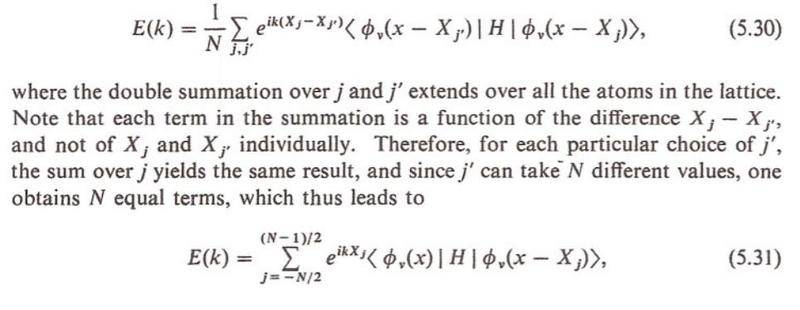
From the textbook of Omar:

nkIVr83.jpg


Can someone explain me the summation of this? I simply don't get it?

Thanks in advance.
 
Physics news on Phys.org
Which summation do you mean?
The second equation is the first one with the argument that the sum over j' looks like "something"+"something"+...+"something" (N times the same summand) = N*"something".
 
mfb said:
Which summation do you mean?
The second equation is the first one with the argument that the sum over j' looks like "something"+"something"+...+"something" (N times the same summand) = N*"something".

I don't get how you go from the double summation to the new one with the new index etc.

Oh yeah i forgot to say: in the new expression they put Xj' = 0.

It's a function of the difference, Xj-Xj'. For each choice of j',the sum over j yields the same result. => I don't get it.

Also I don't get why you start from -N/2 and end with (N-1)/2
 
Make an example. Write down all summands for N=5 and see how it works out.
 
Thread 'Unexpected irregular reflection signal from a high-finesse cavity'
I am observing an irregular, aperiodic noise pattern in the reflection signal of a high-finesse optical cavity (finesse ≈ 20,000). The cavity is normally operated using a standard Pound–Drever–Hall (PDH) locking configuration, where an EOM provides phase modulation. The signals shown in the attached figures were recorded with the modulation turned off. Under these conditions, when scanning the laser frequency across a cavity resonance, I expected to observe a simple reflection dip. Instead...

Similar threads

  • · Replies 0 ·
Replies
0
Views
2K
  • · Replies 10 ·
Replies
10
Views
4K
  • · Replies 2 ·
Replies
2
Views
2K
  • · Replies 1 ·
Replies
1
Views
2K
Replies
4
Views
3K
  • · Replies 1 ·
Replies
1
Views
2K
  • · Replies 7 ·
Replies
7
Views
2K
  • · Replies 1 ·
Replies
1
Views
3K
  • · Replies 12 ·
Replies
12
Views
3K
  • · Replies 6 ·
Replies
6
Views
4K