RandomUserName
- 6
- 0
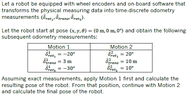
Hello, I have another question regarding my cognitive robotics class. Here is my current task:
View attachment 6205
And this is the slide from the lecture about this topic:
View attachment 6206
Now just plugging in everything I know into the formulas, I get this:
$$\boxed{3 = \sqrt{x'^{2} + y'^{2}}\\
-20 = atan2(y',x')\\
-30 = \theta' - 20}\\
\boxed{y' = \sqrt{9-x'^{2}}\\
-20 = atan2(\sqrt{9-x'^{2}},x')\\
\theta' = -10}\\
\boxed{y \approx 1.026\\
x = 3 \cos(20) \approx 2.819\\
\theta' = -10}$$
But then, when I try to perform the second motion, I get the following:
$$\boxed{10 \approx \sqrt{(x' - 2.189)^{2} + (y' - 1.026)^{2}}\\
20 \approx atan2(y' - 1.026, x' - 2.819) + 10\\
10 = \theta' + 10 - 20}$$
which is just way too complicated for me to solve (and we are supposed to solve this by hand).
Am I doing this right at all? Or is there some other formula that I should use? I haven't been able to find anything that helps me using Google :(
View attachment 6205
And this is the slide from the lecture about this topic:
View attachment 6206
Now just plugging in everything I know into the formulas, I get this:
$$\boxed{3 = \sqrt{x'^{2} + y'^{2}}\\
-20 = atan2(y',x')\\
-30 = \theta' - 20}\\
\boxed{y' = \sqrt{9-x'^{2}}\\
-20 = atan2(\sqrt{9-x'^{2}},x')\\
\theta' = -10}\\
\boxed{y \approx 1.026\\
x = 3 \cos(20) \approx 2.819\\
\theta' = -10}$$
But then, when I try to perform the second motion, I get the following:
$$\boxed{10 \approx \sqrt{(x' - 2.189)^{2} + (y' - 1.026)^{2}}\\
20 \approx atan2(y' - 1.026, x' - 2.819) + 10\\
10 = \theta' + 10 - 20}$$
which is just way too complicated for me to solve (and we are supposed to solve this by hand).
Am I doing this right at all? Or is there some other formula that I should use? I haven't been able to find anything that helps me using Google :(
Attachments