gnits
- 137
- 46
- Homework Statement
- To find the time taken for one vessel to reach another
- Relevant Equations
- d=st
Could I please ask for help regarding my answer to the following question?
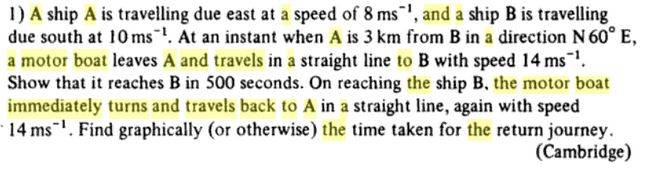
I've done the first part and get the answer of 500 seconds.
I anticipated no problem with the second part, it is the same problem with different inputs, but I have disagreed with the provided answer of 1754 seconds. I get 1283 seconds. My method for this part is the same as for the first.
My reasoning was that after the 500 seconds has elapsed, A will have moved on a further 8 * 500 = 4000 metres and B will have moved on a further 10 * 500 = 5000 metres and the starting position will be as in the diagram below:
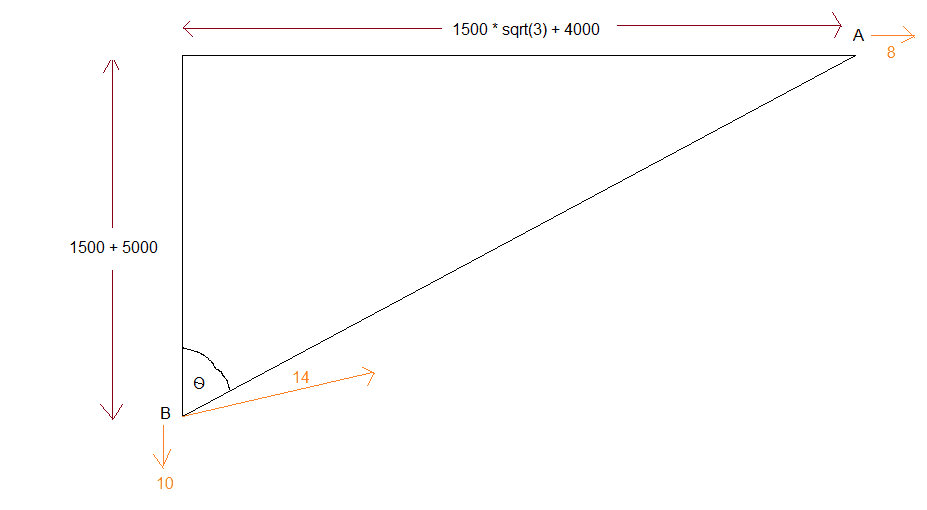
So the angle ##\theta## is given by ##atan(\frac{1500\sqrt{3}+4000}{6500}) = 45.43^\circ##
Let the speed of the motor boat in the northerly direction (i) be ##M_x## and in the easterly direction (j) be ##M_y##, we know that ##M_x^2+M_y^2=14^2=196##
Finally, let ##V_{MA}=V_M-V_A## be the velocity of the motor boat relative to A. Then we have:
##V_{MA}=(M_x-8)\,i + M_y\,j##
Now, in order to intercept A, ##V_{MA}## must be parallel to the initial displacement of A from B. Thus we have (for a certain scalar K):
##(M_x-8)\,i + M_y\,j\,=\,sin(45.43^\circ)K\,i + cos(45.43^\circ)K\,j##
so
##(M_x-8)\,i + M_y\,j\,=\,0.7124K\,i + 0.7018K\,j##
And so ##M_x-8=0.7124K##
and ##M_y = 0.7018K##
which gives:
##(0.7124K+8)^2+(0.7018K)^2=196##
This is solved for K, I take positive root to give correct direction of travel parallel tp AB of K = 7.12574 and this leads to:
##M_y=0.7018*7.12574=5.065##
And so time taken to reach A is ##6500/5.065=1283 ##
Thanks for any help,
Mitch.
I've done the first part and get the answer of 500 seconds.
I anticipated no problem with the second part, it is the same problem with different inputs, but I have disagreed with the provided answer of 1754 seconds. I get 1283 seconds. My method for this part is the same as for the first.
My reasoning was that after the 500 seconds has elapsed, A will have moved on a further 8 * 500 = 4000 metres and B will have moved on a further 10 * 500 = 5000 metres and the starting position will be as in the diagram below:
So the angle ##\theta## is given by ##atan(\frac{1500\sqrt{3}+4000}{6500}) = 45.43^\circ##
Let the speed of the motor boat in the northerly direction (i) be ##M_x## and in the easterly direction (j) be ##M_y##, we know that ##M_x^2+M_y^2=14^2=196##
Finally, let ##V_{MA}=V_M-V_A## be the velocity of the motor boat relative to A. Then we have:
##V_{MA}=(M_x-8)\,i + M_y\,j##
Now, in order to intercept A, ##V_{MA}## must be parallel to the initial displacement of A from B. Thus we have (for a certain scalar K):
##(M_x-8)\,i + M_y\,j\,=\,sin(45.43^\circ)K\,i + cos(45.43^\circ)K\,j##
so
##(M_x-8)\,i + M_y\,j\,=\,0.7124K\,i + 0.7018K\,j##
And so ##M_x-8=0.7124K##
and ##M_y = 0.7018K##
which gives:
##(0.7124K+8)^2+(0.7018K)^2=196##
This is solved for K, I take positive root to give correct direction of travel parallel tp AB of K = 7.12574 and this leads to:
##M_y=0.7018*7.12574=5.065##
And so time taken to reach A is ##6500/5.065=1283 ##
Thanks for any help,
Mitch.