To get the complete Radial Wavefunction, why do we multiply by Y(l,m)?

Click For Summary
SUMMARY

The discussion centers on the necessity of multiplying the radial eigenfunction by the spherical harmonics, denoted as Y(l,m), to obtain a complete wavefunction in quantum mechanics. This process is essential for normalizing the eigenfunction and calculating mean values in three-dimensional space, as derived from the 3D time-independent Schrödinger equation for the Coulomb potential. The separation of variables technique is employed to derive both radial and angular solutions, which must be combined to form a complete set of solutions. The user also encounters issues while calculating the radial function for specific quantum numbers, leading to discrepancies with established results.

PREREQUISITES
  • Understanding of quantum mechanics principles, specifically the Schrödinger equation.
  • Familiarity with spherical harmonics and their role in quantum systems.
  • Knowledge of radial eigenfunctions and their normalization.
  • Experience with mathematical techniques such as separation of variables and integration factors.
NEXT STEPS
  • Study the derivation of the 3D time-independent Schrödinger equation for the Coulomb potential.
  • Learn about the properties and applications of spherical harmonics in quantum mechanics.
  • Explore normalization techniques for quantum wavefunctions, focusing on radial eigenfunctions.
  • Review examples of solving differential equations using the integration factor method in quantum contexts.
USEFUL FOR

Students and professionals in quantum mechanics, particularly those studying atomic structures and wavefunction calculations, as well as educators teaching advanced quantum theory concepts.

unscientific
Messages
1,728
Reaction score
13
Hi guys, I'm doing a quantum course at the moment, and there's one thing in Binney's book which I don't really understand:

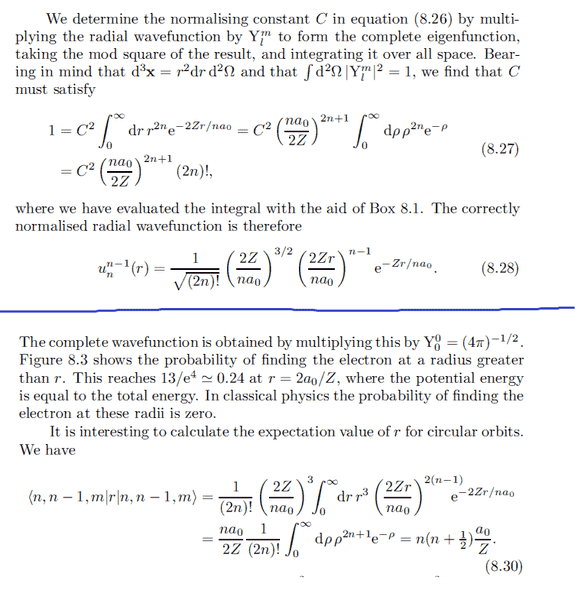
Why must you multiply the radial eigenfunction by ##Y_l^m## to get the "complete wavefunction" ?

They do this to normalize the eigenfunction, and to do things like calculate mean energies and mean distance from the nucleus:

j12f6g.png
 
Last edited:
Physics news on Phys.org
Because you need a 3-dimensional wavefunction because objects move in 3 dimensions.
 
Vanadium 50 said:
Because you need a 3-dimensional wavefunction because objects move in 3 dimensions.

Why does multiplying ##Y_l^m## to eigenfunction ##u_n## make it a 3-dimensional wavefunction?

The "1-D" eigenfunction is obtained by solving:

33c659v.png
 
You need the energy eigenfunctions to form a complete set. You need to include the spherical harmonics in the radial eigenfunctions in order to make sure these eigenfunctions do form a complete set. All of this just comes from solving the 3D time-independent Schrödinger equation for the Coulomb potential. What we do is use separation of variables to break the eigenvalue equation down into a radial equation, giving us the solutions you cited, and an angular equation that gives us spherical harmonics. In the end multiply the radial solutions and the spherical harmonics together to get the complete set of solutions just like for all separation of variables problems.
 
  • Like
Likes   Reactions: 1 person
The complete radial function is made up of 2 completely different parts, the part for the discrete energy spectrum and the part of the continuous energy spectrum. For a certain spectral value of the Hamiltonian, you can write down the full wavefunction of the H-atom as a product of the radial eigenfunction and the spherical harmonic. Check out formulas 4.12 and 4.13 of Bethe and Salpeter.
 
  • Like
Likes   Reactions: 1 person
WannabeNewton said:
You need the energy eigenfunctions to form a complete set. You need to include the spherical harmonics in the radial eigenfunctions in order to make sure these eigenfunctions do form a complete set. All of this just comes from solving the 3D time-independent Schrödinger equation for the Coulomb potential. What we do is use separation of variables to break the eigenvalue equation down into a radial equation, giving us the solutions you cited, and an angular equation that gives us spherical harmonics. In the end multiply the radial solutions and the spherical harmonics together to get the complete set of solutions just like for all separation of variables problems.

Thanks I got it. But when i try to calculate ##u_{n}^{l=n-2}##, something goes wrong:

Starting, we define operator A by:

A_{n-2} = \frac{a_0}{\sqrt 2}\left(\frac{i}{\hbar}p_r + \frac{1-n}{r} + \frac{Z}{(n-1)a_0}\right)

Substituting ##p_r = -i\hbar (\frac{\partial}{\partial r} + \frac{1}{r})##:

A_{n-2} = \frac{a_0}{\sqrt 2}\left( \frac{\partial}{\partial r} + \frac{2-n}{r} + \frac{Z}{(n-1)a_0}\right)

Thus, we want to solve:

\left(\frac{\partial}{\partial r} + \frac{2-n}{r} + \frac{Z}{(n-1)a_0} \right) u_{n}^{l=n-2} = 0

Solving by integrating factor method, we obtain:

u_n^{l=n-2} = A r^{n-2} e^{\frac{Z}{(n-1)a_0}r}

Normalizing,

u_n^{l=n-2} = \frac{1}{\sqrt{[2(n-1)]!}} \left(\frac{2Z}{(n-1)a_0}\right)^{\frac{3}{2}} \left(\frac{2Z}{(n-1)a_0}\right)^{n-2} e^{-\frac{Z}{(n-1)a_0}r}

This is similar to ##u_n^{l=n-1}##, simply replace n by n-1:

ajx85d.png


But when I substitute n = 2, so l = 0, I get ##u_2^0 = \frac{1}{\sqrt 2} \left(\frac{2Z}{a_0}\right)^{\frac{3}{2}} e^{-\frac{Z}{a_0}r}##

I get a completely different result from the book:

1ftl6a.png


I'm not sure what's wrong with my derivation?
 
Last edited:

Similar threads

  • · Replies 2 ·
Replies
2
Views
2K
Replies
1
Views
2K
  • · Replies 6 ·
Replies
6
Views
5K
  • · Replies 4 ·
Replies
4
Views
2K
  • · Replies 7 ·
Replies
7
Views
2K
  • · Replies 7 ·
Replies
7
Views
8K
  • · Replies 2 ·
Replies
2
Views
2K
  • · Replies 3 ·
Replies
3
Views
4K
  • · Replies 4 ·
Replies
4
Views
3K
  • · Replies 5 ·
Replies
5
Views
2K