Torsion Scalar and Symmetries of Torsion Tensor

Click For Summary
The discussion revolves around the properties of the torsion scalar in Teleparallel theories and the behavior of the torsion tensor. A key point is the distinction between the antisymmetry of the torsion tensor in certain indices and its overall symmetry properties, which are not totally antisymmetric. The participants analyze the multiplication of tensors and derive identities that clarify how specific terms vanish in calculations involving the torsion scalar. They explore the implications of these identities on the expressions for the torsion scalar and the resulting terms. The conversation emphasizes the mathematical intricacies of torsion tensors and their significance in f(T) theory.
nanuba
Messages
3
Reaction score
0
I've started f(T) theory but I have a simple question like something that i couldn't see straightforwardly.
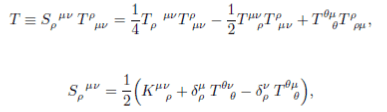
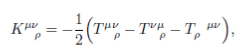
In Teleparallel theories one has the torsion scalar:

upload_2015-7-13_15-26-12.png

upload_2015-7-13_15-27-27.png

And if you take the product you should obtain
upload_2015-7-13_15-29-31.png

But there seems to be the terms like
upload_2015-7-13_15-31-56.png
upload_2015-7-13_15-32-16.png
upload_2015-7-13_15-32-48.png
.
How does this one vanish?
because we know that Torsion tensor is not symmetric in first two indices but antisymmetric in the last two indices.
 
Physics news on Phys.org
Often one is interested in torsion tensors that are totally antisymmetric. Is that the case here?
 
Oscillatory behavior
 
bcrowell said:
Often one is interested in torsion tensors that are totally antisymmetric. Is that the case here?
Nope. These are defined in terms of Wietzenböck konnections:
upload_2015-7-14_9-59-32.png
and are not totally antisymmetric.
 
nanuba said:
I've started f(T) theory but I have a simple question like something that i couldn't see straightforwardly.
In Teleparallel theories one has the torsion scalar:

View attachment 85890
View attachment 85891
And if you take the product you should obtain
View attachment 85892
But there seems to be the terms like
View attachment 85893View attachment 85894View attachment 85895.
How does this one vanish?
because we know that Torsion tensor is not symmetric in first two indices but antisymmetric in the last two indices.

Will you buy me strong black coffee if I do it for you? Okay, start by multiplying the two tensor
S^{\rho\mu\nu}T_{\rho\mu\nu} = A + B , \ \ \ \ \ (1)
where
A = \frac{1}{4} T^{\rho\mu\nu}T_{\rho\mu\nu} + \frac{1}{4} T^{\mu\rho\nu}T_{\rho\mu\nu} - \frac{1}{4} T^{\nu\rho\mu}T_{\rho\mu\nu} , \ \ \ \ (2) and B = -\frac{1}{2}T_{\alpha}{}^{\mu\alpha} \ T^{\rho}{}_{\mu\rho} + \frac{1}{2}T_{\alpha}{}^{\nu\alpha} \ T^{\rho}{}_{\rho\nu} , or
B = -\frac{1}{2}T_{\alpha}{}^{\mu\alpha} \ T^{\rho}{}_{\mu\rho} - \frac{1}{2}T_{\alpha}{}^{\mu\alpha} \ T^{\rho}{}_{\mu\rho} = - T_{\alpha}{}^{\mu\alpha} \ T^{\rho}{}_{\mu\rho} , which is the same as
B = T_{\alpha}{}^{\mu\alpha} \ T^{\rho}{}_{\rho\mu} = T^{\alpha\mu}{}_{\alpha} \ T^{\rho}{}_{\rho\mu} . \ \ \ \ \ (3) That is all for B. To work on A, we start with the identity
T^{\mu\nu}{}_{\rho} \left( T^{\rho}{}_{\nu\mu} + T^{\rho}{}_{\mu\nu} \right) = 0 . In the first term, if we make \rho \to \nu, \mu \to \rho and \nu \to \mu, we find
T^{\rho\mu}{}_{\nu} \ T^{\nu}{}_{\mu\rho} + T^{\mu\nu}{}_{\rho} \ T^{\rho}{}_{\mu\nu} = 0 . Let us rewrite this as
T^{\rho\mu\nu} \ T_{\nu\mu\rho} + T_{\mu\nu\rho} \ T^{\rho\mu\nu} = 0 . Using the antisymmetry in the second term, we get
T^{\rho\mu\nu} \ T_{\nu\mu\rho} = T^{\rho\mu\nu} \ T_{\mu\rho\nu} . Now, on the RHS we make \rho \leftrightarrow \mu and get
T^{\rho\mu\nu} \ T_{\nu\mu\rho} = T^{\mu\rho\nu} \ T_{\rho\mu\nu} . Add T^{\rho\mu\nu}T_{\nu\mu\rho} to both sides,
T^{\rho\mu\nu} \ T_{\nu\mu\rho} = \frac{1}{2}\left( T^{\mu\rho\nu} \ T_{\rho\mu\nu} + T^{\rho\mu\nu} \ T_{\nu\mu\rho} \right) . In the second term on the RHS, lower the indices on the first tensor and raise them on the second tensor
T^{\rho\mu\nu} \ T_{\nu\mu\rho} = \frac{1}{2}\left( T^{\mu\rho\nu} \ T_{\rho\mu\nu} + T_{\rho\mu\nu} \ T^{\nu\mu\rho} \right) . Using the antisymmetry and dividing by 2, we obtain
\frac{1}{4} T^{\mu\rho\nu} T_{\rho\mu\nu} - \frac{1}{4} T^{\nu\rho\mu} T_{\rho\mu\nu} = \frac{1}{2} T^{\rho\mu\nu}T_{\nu\mu\rho} = - \frac{1}{2} T^{\rho\mu\nu} T_{\nu\rho\mu}. And finally, we rewrite this identity in the form
\frac{1}{4} T^{\mu\rho\nu} T_{\rho\mu\nu} - \frac{1}{4} T^{\nu\rho\mu} T_{\rho\mu\nu} = - \frac{1}{2} T^{\rho\mu}{}_{\nu} \ T^{\nu}{}_{\rho\mu} . Now, substituting this identity in (2) leads to A = \frac{1}{4} T^{\rho\mu\nu} T_{\rho\mu\nu} - \frac{1}{2} T^{\rho\mu}{}_{\nu} \ T^{\nu}{}_{\rho\mu} . \ \ \ (4) Now, put (3) and (4) in (1), you get
S^{\rho\mu\nu}T_{\rho\mu\nu} = \frac{1}{4} T^{\rho\mu\nu} T_{\rho\mu\nu} - \frac{1}{2} T^{\rho\mu}{}_{\nu} \ T^{\nu}{}_{\rho\mu} + T^{\alpha\mu}{}_{\alpha} \ T^{\rho}{}_{\rho\mu} .
Okay, don’t forget my coffee.
Sam
 
  • Like
Likes PWiz, nanuba, vanhees71 and 1 other person
samalkhaiat said:
Will you buy me strong black coffee if I do it for you? Okay, start by multiplying the two tensor
S^{\rho\mu\nu}T_{\rho\mu\nu} = A + B , \ \ \ \ \ (1)
where
A = \frac{1}{4} T^{\rho\mu\nu}T_{\rho\mu\nu} + \frac{1}{4} T^{\mu\rho\nu}T_{\rho\mu\nu} - \frac{1}{4} T^{\nu\rho\mu}T_{\rho\mu\nu} , \ \ \ \ (2) and B = -\frac{1}{2}T_{\alpha}{}^{\mu\alpha} \ T^{\rho}{}_{\mu\rho} + \frac{1}{2}T_{\alpha}{}^{\nu\alpha} \ T^{\rho}{}_{\rho\nu} , or
B = -\frac{1}{2}T_{\alpha}{}^{\mu\alpha} \ T^{\rho}{}_{\mu\rho} - \frac{1}{2}T_{\alpha}{}^{\mu\alpha} \ T^{\rho}{}_{\mu\rho} = - T_{\alpha}{}^{\mu\alpha} \ T^{\rho}{}_{\mu\rho} , which is the same as
B = T_{\alpha}{}^{\mu\alpha} \ T^{\rho}{}_{\rho\mu} = T^{\alpha\mu}{}_{\alpha} \ T^{\rho}{}_{\rho\mu} . \ \ \ \ \ (3) That is all for B. To work on A, we start with the identity
T^{\mu\nu}{}_{\rho} \left( T^{\rho}{}_{\nu\mu} + T^{\rho}{}_{\mu\nu} \right) = 0 . In the first term, if we make \rho \to \nu, \mu \to \rho and \nu \to \mu, we find
T^{\rho\mu}{}_{\nu} \ T^{\nu}{}_{\mu\rho} + T^{\mu\nu}{}_{\rho} \ T^{\rho}{}_{\mu\nu} = 0 . Let us rewrite this as
T^{\rho\mu\nu} \ T_{\nu\mu\rho} + T_{\mu\nu\rho} \ T^{\rho\mu\nu} = 0 . Using the antisymmetry in the second term, we get
T^{\rho\mu\nu} \ T_{\nu\mu\rho} = T^{\rho\mu\nu} \ T_{\mu\rho\nu} . Now, on the RHS we make \rho \leftrightarrow \mu and get
T^{\rho\mu\nu} \ T_{\nu\mu\rho} = T^{\mu\rho\nu} \ T_{\rho\mu\nu} . Add T^{\rho\mu\nu}T_{\nu\mu\rho} to both sides,
T^{\rho\mu\nu} \ T_{\nu\mu\rho} = \frac{1}{2}\left( T^{\mu\rho\nu} \ T_{\rho\mu\nu} + T^{\rho\mu\nu} \ T_{\nu\mu\rho} \right) . In the second term on the RHS, lower the indices on the first tensor and raise them on the second tensor
T^{\rho\mu\nu} \ T_{\nu\mu\rho} = \frac{1}{2}\left( T^{\mu\rho\nu} \ T_{\rho\mu\nu} + T_{\rho\mu\nu} \ T^{\nu\mu\rho} \right) . Using the antisymmetry and dividing by 2, we obtain
\frac{1}{4} T^{\mu\rho\nu} T_{\rho\mu\nu} - \frac{1}{4} T^{\nu\rho\mu} T_{\rho\mu\nu} = \frac{1}{2} T^{\rho\mu\nu}T_{\nu\mu\rho} = - \frac{1}{2} T^{\rho\mu\nu} T_{\nu\rho\mu}. And finally, we rewrite this identity in the form
\frac{1}{4} T^{\mu\rho\nu} T_{\rho\mu\nu} - \frac{1}{4} T^{\nu\rho\mu} T_{\rho\mu\nu} = - \frac{1}{2} T^{\rho\mu}{}_{\nu} \ T^{\nu}{}_{\rho\mu} . Now, substituting this identity in (2) leads to A = \frac{1}{4} T^{\rho\mu\nu} T_{\rho\mu\nu} - \frac{1}{2} T^{\rho\mu}{}_{\nu} \ T^{\nu}{}_{\rho\mu} . \ \ \ (4) Now, put (3) and (4) in (1), you get
S^{\rho\mu\nu}T_{\rho\mu\nu} = \frac{1}{4} T^{\rho\mu\nu} T_{\rho\mu\nu} - \frac{1}{2} T^{\rho\mu}{}_{\nu} \ T^{\nu}{}_{\rho\mu} + T^{\alpha\mu}{}_{\alpha} \ T^{\rho}{}_{\rho\mu} .
Okay, don’t forget my coffee.
Sam

I owe you a black coffee :)
 
In this video I can see a person walking around lines of curvature on a sphere with an arrow strapped to his waist. His task is to keep the arrow pointed in the same direction How does he do this ? Does he use a reference point like the stars? (that only move very slowly) If that is how he keeps the arrow pointing in the same direction, is that equivalent to saying that he orients the arrow wrt the 3d space that the sphere is embedded in? So ,although one refers to intrinsic curvature...

Similar threads

  • · Replies 6 ·
Replies
6
Views
6K
  • · Replies 7 ·
Replies
7
Views
675
  • · Replies 1 ·
Replies
1
Views
1K
Replies
19
Views
2K
  • · Replies 6 ·
Replies
6
Views
1K
  • · Replies 22 ·
Replies
22
Views
3K
  • · Replies 1 ·
Replies
1
Views
1K
  • · Replies 10 ·
Replies
10
Views
3K
  • · Replies 8 ·
Replies
8
Views
3K
  • · Replies 1 ·
Replies
1
Views
2K
