Total energy of the normal mode on a string

Click For Summary

Homework Help Overview

The discussion revolves around the total energy of normal modes on a string, specifically focusing on the relationship between kinetic energy and displacement in simple harmonic motion (SHM).

Discussion Character

  • Conceptual clarification, Assumption checking

Approaches and Questions Raised

  • Participants express confusion regarding the timing of maximum kinetic energy in relation to displacement. Some attempt to clarify the relationship between velocity and displacement in SHM, while others question the assumptions made in the problem setup.

Discussion Status

The discussion is active, with participants exploring different interpretations of the problem. Some guidance has been offered regarding the timing of maximum kinetic energy and displacement, but there is no explicit consensus on the initial assumptions.

Contextual Notes

There appears to be some ambiguity regarding the definitions and relationships in the context of SHM, particularly concerning the timing of maximum values for kinetic energy and displacement.

LCSphysicist
Messages
644
Reaction score
163
Homework Statement
All below
Relevant Equations
All below
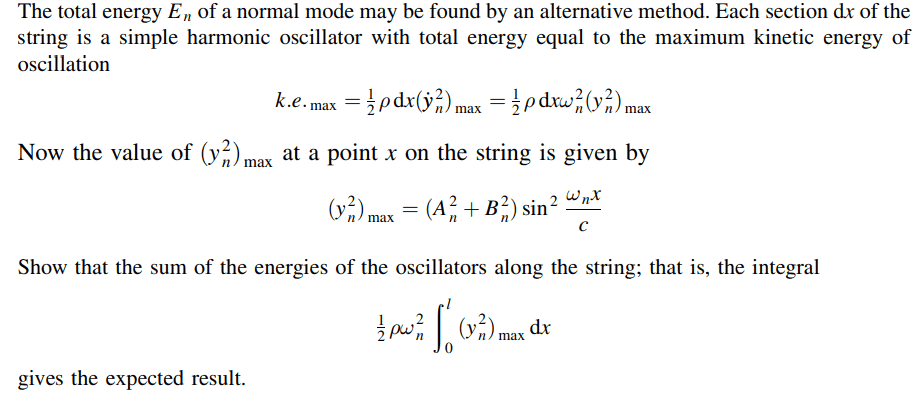
What you think about this question?
1596162654748.png

Seems a little strange to me, that is, it considers the maximum kinetic energy when the displacement of the oscillators is maximum, i don't think this is right.
 
Physics news on Phys.org
Anyway, we could solve it by:
1596165399621.png

1596165505043.png

Just take theta equal zero (it doesn't matter) and
1596165608678.png

(omega n is just one thing, i don't know how to write the little n)
BTW, this will implies y = 0, where AFAIK is the true position where v is maximum
...
 
LCSphysicist said:
1596166738151.png

Seems a little strange to me, that is, it considers the maximum kinetic energy when the displacement of the oscillators is maximum, i don't think this is right.

The max KE occurs when the velocity ##\dot y_n## is max. So, the first equality in the equation is correct. For SHM ## (\dot y_n)_{\rm max}## has a value equal to ##\omega_n (y_n)_{\rm max}##. So, you get the second equality. The relation ## (\dot y_n)_{\rm max} = \omega_n (y_n)_{\rm max} ## is not meant to imply that the maximum value of ##\dot y_n## occurs at the same instant of time as the maximum value of ##y_n##.
 
  • Informative
Likes   Reactions: LCSphysicist
TSny said:
The max KE occurs when the velocity ##\dot y_n## is max. So, the first equality in the equation is correct. For SHM ## (\dot y_n)_{\rm max}## has a value equal to ##\omega_n (y_n)_{\rm max}##. So, you get the second equality. The relation ## (\dot y_n)_{\rm max} = \omega_n (y_n)_{\rm max} ## is not meant to imply that the maximum value of ##\dot y_n## occurs at the same instant of time as the maximum value of ##y_n##.
Yeh...You are right, thank you.
 

Similar threads

  • · Replies 8 ·
Replies
8
Views
5K
Replies
17
Views
2K
  • · Replies 17 ·
Replies
17
Views
3K
Replies
4
Views
2K
  • · Replies 2 ·
Replies
2
Views
768
  • · Replies 16 ·
Replies
16
Views
1K
  • · Replies 2 ·
Replies
2
Views
1K
Replies
43
Views
5K
  • · Replies 3 ·
Replies
3
Views
2K