Transfer function of the state space model

Click For Summary
To find the transfer function connecting the reference (r) to the output (y) in a state space model with an observer, the ss2tf function in MATLAB can be used, utilizing the A, B, C, and D matrices. The observer's transfer function can be derived using the observer equation, x_head' = (A-LC)x_head + Bu + Ly, where the matrices remain consistent with the original model. The poles of the system can be determined by analyzing the eigenvalues of the modified A matrix, A-BK, after applying state feedback. For the observer, the poles can be similarly derived from the eigenvalues of the adjusted A matrix. Understanding these relationships is crucial for effectively analyzing the system's dynamics.
zoom1
Messages
63
Reaction score
0
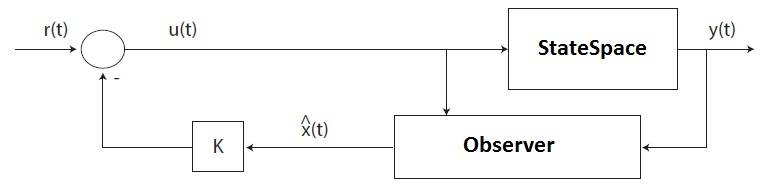
I have a state space model along with an observer and state feedback.
hpstg7v.jpg

I need to find the transfer function connecting the r (reference) to the y (output)

I have this model on simulink. I know the A,B,C,D matrices. So, I can get the TF for the stateSpace with ss2tf function of matlab. However, I couldn't find a way to obtain the TF of the observer.

Actually I am interested in the poles and zeros of the system. I though if I find the TF, I can get them. But if there is another way around for this, I would also welcome this method.

Thanks
 
Engineering news on Phys.org
ok, so first what is the equation for a state observer?
 
donpacino said:
ok, so first what is the equation for a state observer?

x_head' = (A-LC)x_head + Bu + Ly

Where x_head is the estimated state array
 
right...

So use that equation to get the transfer function.

so your A,B,C,D matrixs are the same in the observer as they are in the regular model (at least typically they are)
You should have chosen your L matrix (measurement vs model accuracy).

remember the observer is a MIMO system (multi input multi output)
so to find y/r there is no one simple command, you will have to be smart about how you use matlabas for any easy of finding the poles i'll give you this hint...in the regular state space model X'=AX+Bu
with direct state feedback, the new model is

X'=AX+B(u-KX)

X'=(A-BK)X+Bu

The old poles of the system were the eigenvalues of A. The new poles are the eigenvalues of A-BK
__________________________________________

knowing that, is there an easy way to find the poles of the observer
 
I am trying to understand how transferring electric from the powerplant to my house is more effective using high voltage. The suggested explanation that the current is equal to the power supply divided by the voltage, and hence higher voltage leads to lower current and as a result to a lower power loss on the conductives is very confusing me. I know that the current is determined by the voltage and the resistance, and not by a power capability - which defines a limit to the allowable...

Similar threads

  • · Replies 13 ·
Replies
13
Views
6K
  • · Replies 12 ·
Replies
12
Views
3K
Replies
1
Views
2K
  • · Replies 2 ·
Replies
2
Views
2K
  • · Replies 1 ·
Replies
1
Views
4K
Replies
1
Views
3K
  • · Replies 2 ·
Replies
2
Views
6K
  • · Replies 4 ·
Replies
4
Views
2K
Replies
20
Views
2K
Replies
10
Views
3K