Transformation of the Christoffel Symbols

Click For Summary
SUMMARY

The transformation of Christoffel symbols is derived from the covariant derivative's transformation rules as outlined in Landau's "Classical Field Theory & Relativity." The covariant derivative of a covariant tensor is defined as $$\nabla_k A_i=\frac{∂A_i}{∂x^k} - \Gamma^l_{ik}A_l$$, while for a contravariant tensor, it is $$\nabla_k A^i=\frac{∂A^i}{∂x^k} + \Gamma^i_{lk}A^l$$. The transformation of the Christoffel symbols can be expressed as $$\Gamma^k_{ij} = \frac{\partial \vec{x}_i}{\partial x^j} \cdot \vec{x}^k$$, ensuring that the covariant derivative behaves consistently across coordinate systems. Understanding these transformations is crucial for proving the transformation rules for Christoffel symbols.

PREREQUISITES
  • Understanding of covariant derivatives and their definitions
  • Familiarity with tensor analysis, particularly covariant and contravariant tensors
  • Knowledge of transformation rules in differential geometry
  • Basic proficiency in mathematical notation and manipulation of equations
NEXT STEPS
  • Study the derivation of the covariant derivative in various coordinate systems
  • Explore the implications of Christoffel symbols in general relativity
  • Learn about the geometric interpretation of covariant derivatives and tensors
  • Investigate the relationship between Christoffel symbols and geodesics
USEFUL FOR

Mathematicians, physicists, and students of general relativity or differential geometry who seek to deepen their understanding of tensor calculus and the transformation properties of Christoffel symbols.

Luke Tan
Messages
29
Reaction score
2
TL;DR
Derivation of the transformation rules for the Christoffel symbols.
In Landau Book 2 (Classical Field Theory & Relativity), he mentions that the transformation rules of the christoffel symbols can be gotten by "comparing the laws of transformation of the two sides of the equation governing the covariant derivative"
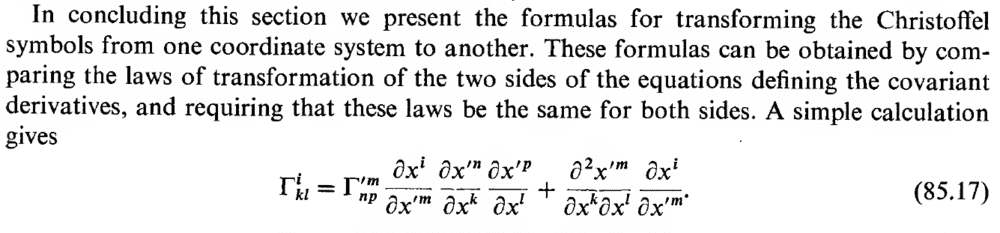
Screenshot_638.png


I would believe that by the equations defining the covariant derivative, he means
$$DA^i = (\frac{\partial A^i}{\partial x^l} + \Gamma^i_{kl}A^k)dx^l$$
$$DA_i = (\frac{\partial A_i}{\partial x^k} + \Gamma^k_{il}A_k)dx^l$$

In addition, I would believe that he wants me to use the transformation rules
$$A^i = \frac{\partial x^i}{\partial {x'}^k}{A'}^k$$
$$A_i = \frac{\partial {x'}^k}{\partial x^i}{A'}_k$$However, when attempting to transform the definitions of the covariant derivative from one coordinate system to another, I ran into the following problem - how does the covariant derivative transform? It clearly transforms like a tensor, but does it transform like a covariant tensor, a contravariant tensor, or a mixed one?

So, my questions are:
1. How does a covariant derivative transform? Is it possible to use this to prove the statement that Landau wants to prove?
2. If not, how else would I show this transformation rule for the Christoffel symbols?
 
Physics news on Phys.org
Luke Tan said:
Summary: Derivation of the transformation rules for the Christoffel symbols.

It clearly transforms like a tensor, but does it transform like a covariant tensor, a contravariant tensor, or a mixed one?
It depends on what you are taking the derivative of. As the name suggests, the covariant derivative adds one covariant index.

I would believe that by the equations defining the covariant derivative, he means
Careful with the signs!
 
Luke Tan said:
$$DA_i=(\frac{∂A_i}{∂x^k}+ \Gamma^k_{il}A_k)dx^l$$

This sign is wrong and one index (probably a typo). In Pavel Grinfeld's Introduction to Tensor Analysis and the Calculus of Moving Surfaces, the covariant derivative of a covariant tensor is:

$$\nabla_k A_i=\frac{∂A_i}{∂x^k} - \Gamma^l_{ik}A_l$$

The covariant derivative of a contravariant tensor is:

$$\nabla_k A^i=\frac{∂A^i}{∂x^k} + \Gamma^i_{lk}A^l$$

The covariant derivative ## \nabla_k ## acts exactly as a covariant tensor. The contravariant derivative ## \nabla^k ## is defined as

$$\nabla^k= g^{kj} \nabla_j$$

and acts as a contravariant tensor.

The transformation rule of the Christoffel Symbol in a flat space can be derived from the identity:

$$ \Gamma^k_{ij} = \frac{\partial \vec{x}_i}{\partial x^j} \cdot \vec{x}^k $$

by applying the change of coordinates and the product rule.
 
Last edited:
So far, I have the definition of the covariant derivative in both the primed and unprimed coordinate systems
$$A_{i;l}'=\frac{\partial {A'}_i}{\partial {x'}^l}-{\Gamma'}^k_{il}{A'}_k$$
$$A_{i;l}=\frac{\partial A_i}{\partial x^l}-{\Gamma'}^k_{il}A_k$$

On the left hand side, we use the transformation rules for a covariant tensor

$$A_{i;l}=\frac{\partial {x'}^l}{\partial x^i}\frac{\partial {x'}^m}{\partial x^k}{A'}_{l;m}$$

On the right hand side, we can have similar transformation rules
$$\frac{\partial A_i}{\partial x^l} = \frac{\partial {x'}^l}{\partial x^i}\frac{\partial {x'}^m}{\partial x^k}\frac{\partial {A'}_l}{\partial {x'}^m}$$

$${\Gamma'}^k_{il}{A'}_k=\frac{\partial {x'}^l}{\partial x^i}\frac{\partial {x'}^m}{\partial x^k}{\Gamma'}^k_{lm}A_k$$

However,when equating these two it seems like the ##\frac{\partial {x'}^l}{\partial x^i}\frac{\partial {x'}^m}{\partial x^k}## terms can just be factorised and cancelled, to give the definition of the covariant derivative in the unprimed coordinates. I don't seem to be getting any closer to the answer that i want.

Can someone give me a hint please?

Thanks!
 
Your problem is that you think partial derivative of a vector field, transforms the same as (1,1) tensor field(or (0,2) in case vector field was covariant vector field), which is wrong. In fact that would be the reason we introduce covariant derivative in the first place.
So to correct you, we have:
$$\frac{\partial A'_i}{\partial x'^j} = \frac{\partial x^k}{\partial x'^j} \frac{\partial}{\partial x^k}A'_i = \frac{\partial x^k}{\partial x'^j} \frac{\partial}{\partial x^k}\left(\frac{\partial x^l}{\partial x'^i}A_l\right)$$

Now you see when you act with that partial derivative above, you will get, not just the normal tensor transformation law, but also the extra term. When we introduce Christoffel symbols, their transformation is designed so that covariant derivative would actually transform like you assumed normal partial derivatives do. So in their transformation law, they compensate for this extra term. Hope that helps some.
 
  • Like
Likes   Reactions: pellis

Similar threads

  • · Replies 11 ·
Replies
11
Views
2K
  • · Replies 7 ·
Replies
7
Views
2K
  • · Replies 19 ·
Replies
19
Views
2K
Replies
5
Views
2K
  • · Replies 19 ·
Replies
19
Views
4K
  • · Replies 2 ·
Replies
2
Views
2K
  • · Replies 6 ·
Replies
6
Views
5K
  • · Replies 19 ·
Replies
19
Views
6K
  • · Replies 8 ·
Replies
8
Views
3K
  • · Replies 16 ·
Replies
16
Views
4K