Difference of Christoffel Symbols Transforms as Tensor

Click For Summary

Discussion Overview

The discussion revolves around the transformation properties of the difference of Christoffel symbols and their relation to covariant derivatives. Participants explore the implications of different connections and metrics in the context of general relativity and the mathematical framework of tensor calculus.

Discussion Character

  • Technical explanation
  • Debate/contested

Main Points Raised

  • One participant notes that the difference of two Christoffel symbols retains partial derivatives, raising questions about its tensorial nature.
  • Another participant argues that having two connections does not imply different indices, as this would violate index laws, and provides a mathematical expression to illustrate their point.
  • A question is posed about whether two connections imply two different metrics, leading to a clarification that connections do not necessarily relate to metrics, although in the context of general relativity, the Levi-Civita connection is associated with the metric.
  • Further discussion highlights that while not every connection requires a metric, every metric can define a connection, emphasizing the distinction between general connections and the specific case of the Levi-Civita connection.
  • A participant questions how the final expression derived from the difference of covariant derivatives transforms like a tensor, prompting a response that asserts its tensorial nature based on its derivation.

Areas of Agreement / Disagreement

Participants express differing views on the relationship between connections and metrics, and there is no consensus on the implications of different indices in the context of Christoffel symbols. The discussion remains unresolved regarding the transformation properties of the derived expressions.

Contextual Notes

Participants reference the Levi-Civita connection and its properties, indicating a need for clarity on the definitions and assumptions related to connections and metrics. The discussion includes unresolved questions about the implications of different connections and their mathematical representations.

binbagsss
Messages
1,291
Reaction score
12
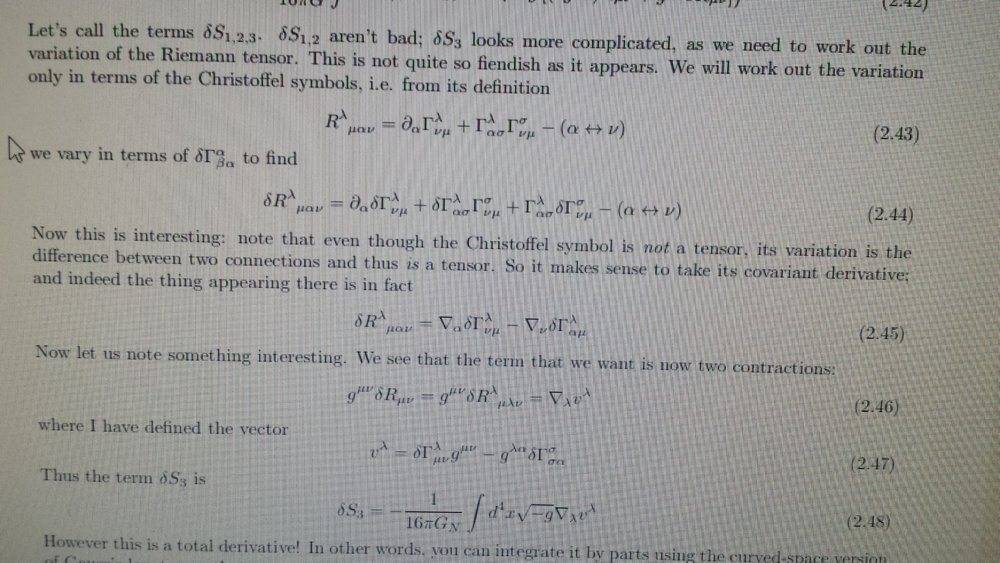
My notes seem to imply this should be obvious :
20200113_145500.jpg

If i consider the covariant deriviative then i get something like

christoffel= nabla ( cov derivative ) - partial

So difference of two of them will stil have the partial derivatuves present ,assuming these are labelled by a different index ? Whereas a difference of cov derivatives would ofc transform as a tensor i don't see how here with the partials
 
Physics news on Phys.org
binbagsss said:
assuming these are labelled by a different index ?
Why would there be a different index? This would violate the index laws. The point is that if you have two connections, ##\nabla## and ##\bar \nabla##, then
$$
\nabla_\mu V - \bar \nabla_\mu V = [\partial_\mu V^\alpha + \Gamma_{\mu \nu}^\alpha V^\nu]\partial_\alpha - [\partial_\mu V^\alpha + \bar\Gamma_{\mu \nu}^\alpha V^\nu]\partial_\alpha
= [\Gamma_{\mu \nu}^\alpha - \bar\Gamma_{\mu \nu}^\alpha] V^\nu \partial_\alpha.
$$
 
Orodruin said:
Why would there be a different index? This would violate the index laws. The point is that if you have two connections, ##\nabla## and ##\bar \nabla##, then
$$
\nabla_\mu V - \bar \nabla_\mu V = [\partial_\mu V^\alpha + \Gamma_{\mu \nu}^\alpha V^\nu]\partial_\alpha - [\partial_\mu V^\alpha + \bar\Gamma_{\mu \nu}^\alpha V^\nu]\partial_\alpha
= [\Gamma_{\mu \nu}^\alpha - \bar\Gamma_{\mu \nu}^\alpha] V^\nu \partial_\alpha.
$$
would two connections imply two different metrics?
 
dsaun777 said:
would two connections imply two different metrics?

In general, a connection does not necessarily have anything to do with a metric (you do not need a metric to define a connection).

However, in the context of GR, where your connection is the Levi-Civita connection, then yes. This is why the connection is varied when you vary the metric components.
 
Orodruin said:
In general, a connection does not necessarily have anything to do with a metric (you do not need a metric to define a connection).

However, in the context of GR, where your connection is the Levi-Civita connection, then yes. This is why the connection is varied when you vary the metric components.
Do you mean You could define the connection only in terms of covariant derivative of basis and not need the metric of levi civita connection. Not every connection needs a metric but every metric can be used to define a connection?
 
dsaun777 said:
Do you mean You could define the connection only in terms of covariant derivative of basis and not need the metric of levi civita connection. Not every connection needs a metric but every metric can be used to define a connection?
Yes. A connection is only a concept of what it means for a field to "change" between points on a manifold. This does not necessarily have anything to do with a metric. There are generally many possible connections on any given manifold. However, once you introduce a metric, there is only one connection that is both metric compatible (##\nabla g = 0##) and torsion free - that is the Levi-Civita connection. (Note that the requirement of being torsion free is also needed, there can generally be several metric compatible connections, but there is only one torsion free connection.)
 
Orodruin said:
Why would there be a different index? This would violate the index laws. The point is that if you have two connections, ##\nabla## and ##\bar \nabla##, then
$$
\nabla_\mu V - \bar \nabla_\mu V = [\partial_\mu V^\alpha + \Gamma_{\mu \nu}^\alpha V^\nu]\partial_\alpha - [\partial_\mu V^\alpha + \bar\Gamma_{\mu \nu}^\alpha V^\nu]\partial_\alpha
= [\Gamma_{\mu \nu}^\alpha - \bar\Gamma_{\mu \nu}^\alpha] V^\nu \partial_\alpha.
$$
And how does that final expression transform like a tensor ?
 
binbagsss said:
And how does that final expression transform like a tensor ?
It should be quite clear that it does from the fact that it is derived from the difference of two covariant derivatives.
 

Similar threads

  • · Replies 4 ·
Replies
4
Views
5K
Replies
5
Views
3K
  • · Replies 19 ·
Replies
19
Views
2K
  • · Replies 11 ·
Replies
11
Views
2K
  • · Replies 26 ·
Replies
26
Views
3K
  • · Replies 19 ·
Replies
19
Views
4K
  • · Replies 16 ·
Replies
16
Views
4K
  • · Replies 2 ·
Replies
2
Views
2K
  • · Replies 16 ·
Replies
16
Views
4K
  • · Replies 19 ·
Replies
19
Views
7K