gnits
- 137
- 46
- Homework Statement
- To find the time of travel of a particle on an elastic string
- Relevant Equations
- F=ma
Hi,
Can anyone please help me with the following:

I have found the velocity of projection, no problem, it is v = 2*sqrt(10)
Also, in obtaining this value, I have also found the extension in the string when in equilibrium, it is x = 2
Now on to the time of flight.
The given answer is: t = ( PI/(2 * sqrt(40) ) + sqrt(2)/sqrt(10)
So the motion is in two parts, one when the string is stretched and so pulling on the mass, and one where the string is unstretched and so the mass is simply a projectile.
I am going to try to calculate the time taken to rise from 1m below A to A. This is the part of the motion which is that of a projectile. And I believe form the given answer that I zshould expect to obtain sqrt(2)/sqrt(10). I do not.
Hopefully, someone can show me where this method is in error:
Here's a diagram:
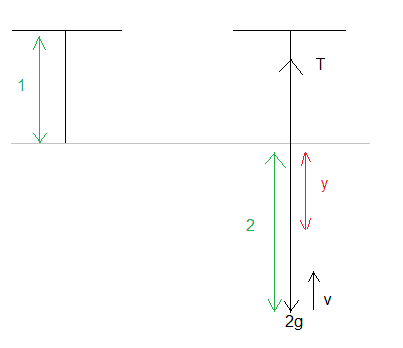
On the left is just the string, on the right is the string stretched by the 2g weight.
Let the general position of the particle be y below the unstretched level. The tension in the string is T. Hookes law gives T = Kx/a where K is the modulus of elasticity (here = 10), a is the natural length (here = 1), and the extention is x (in the diagram this is equal to y).
So we have T = 10y
Now equating forces gives (F = ma):
10y - 2g = 2 * acceleration
And so we have: acceleration = 5y - g = 5y - 10
Now, as accerleration = dv/dt = (ds/dt)(dv/ds)=v (dv/ds) we have:
v dv/dy = 5y - 10 and so separating variables gives:
integral(v dv) = integral(5y-10 dy) and so we have:
(1/2)v^2 = (5/2)y^2 - 10y + c
And using v = 2*sqrt(10) when y = 2 leads to c = 30
and so we have (1/2)v^2 = (5/2)y^2 - 10y + 30 which is
v^2 = 5y^2 - 20y + 60
So we can now put in y = 0 to obtain the speed of the mass at the moment that the string becomes slack. From here I use v = u - gt to obtain t - the time to go from slack to A. This leads to a different answer from the book.
Thanks for any help in pointing out my error,
Mitch.
Can anyone please help me with the following:
I have found the velocity of projection, no problem, it is v = 2*sqrt(10)
Also, in obtaining this value, I have also found the extension in the string when in equilibrium, it is x = 2
Now on to the time of flight.
The given answer is: t = ( PI/(2 * sqrt(40) ) + sqrt(2)/sqrt(10)
So the motion is in two parts, one when the string is stretched and so pulling on the mass, and one where the string is unstretched and so the mass is simply a projectile.
I am going to try to calculate the time taken to rise from 1m below A to A. This is the part of the motion which is that of a projectile. And I believe form the given answer that I zshould expect to obtain sqrt(2)/sqrt(10). I do not.
Hopefully, someone can show me where this method is in error:
Here's a diagram:
On the left is just the string, on the right is the string stretched by the 2g weight.
Let the general position of the particle be y below the unstretched level. The tension in the string is T. Hookes law gives T = Kx/a where K is the modulus of elasticity (here = 10), a is the natural length (here = 1), and the extention is x (in the diagram this is equal to y).
So we have T = 10y
Now equating forces gives (F = ma):
10y - 2g = 2 * acceleration
And so we have: acceleration = 5y - g = 5y - 10
Now, as accerleration = dv/dt = (ds/dt)(dv/ds)=v (dv/ds) we have:
v dv/dy = 5y - 10 and so separating variables gives:
integral(v dv) = integral(5y-10 dy) and so we have:
(1/2)v^2 = (5/2)y^2 - 10y + c
And using v = 2*sqrt(10) when y = 2 leads to c = 30
and so we have (1/2)v^2 = (5/2)y^2 - 10y + 30 which is
v^2 = 5y^2 - 20y + 60
So we can now put in y = 0 to obtain the speed of the mass at the moment that the string becomes slack. From here I use v = u - gt to obtain t - the time to go from slack to A. This leads to a different answer from the book.
Thanks for any help in pointing out my error,
Mitch.