Triangle inequality for standard metric on C^d in Garling 11.1.5

  • Level: Undergrad 
  • Thread starter Thread starter Math Amateur
  • Start date Start date
  • Tags Tags
    Metric Standard
Join the discussion
Registration is free. Start your own thread to ask a follow-up.
9 replies · 3K views
Math Amateur
Gold Member
MHB
Messages
3,920
Reaction score
48
I am reading D. J. H. Garling's book: "A Course in Mathematical Analysis: Volume II: Metric and Topological Spaces, Functions of a Vector Variable" ... ...

I am focused on Chapter 11: Metric Spaces and Normed Spaces ... ...

I need some help with Corollary 11.1.5 ...

Corollary 11.1.5 reads as follows:
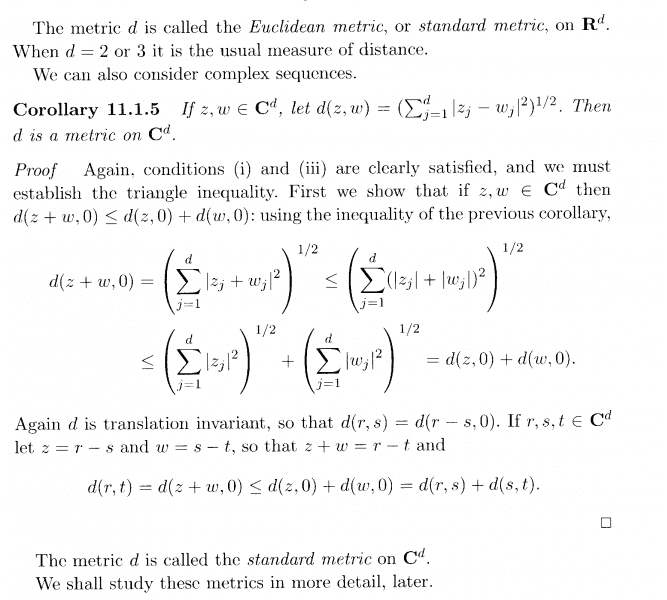
Garling - Corollary 11.1.5 ... .png


In the above proof by Garling we read the following:

" ... ... : using the inequality of the previous corollary,##d( z + w , 0 ) = \left( \sum_{ j = 1 }^d \mid z_j + w_j \mid^2 \right)^{ \frac{1}{2} } \le \left( \sum_{ j = 1}^d ( \mid z_j \mid + \mid w_j \mid )^2 \right)^{ \frac{1}{2} } ####\le \left( \sum_{ j = 1 }^d \mid z_j \mid^2 \right)^{ \frac{1}{2} } + \left( \sum_{ j = 1 }^d \mid w_j \mid^2 \right)^{ \frac{1}{2} }= d(z,0) + d(w,0) ##
My questions are as follows:Question 1

Can someone please explain exactly why we have:## d( z + w , 0 ) = \left( \sum_{ j = 1 }^d \mid z_j + w_j \mid^2 \right)^{ \frac{1}{2} } \le \left( \sum_{ j = 1}^d ( \mid z_j \mid + \mid w_j \mid )^2 \right)^{ \frac{1}{2} } ##How/why does this hold true?
Question 2

Can someone please explain exactly why we have: ## \left( \sum_{ j = 1}^d ( \mid z_j \mid + \mid w_j \mid )^2 \right)^{ \frac{1}{2} } \le \left( \sum_{ j = 1 }^d \mid z_j \mid^2 \right)^{ \frac{1}{2} } + \left( \sum_{ j = 1 }^d \mid w_j \mid^2 \right)^{ \frac{1}{2} }= d(z,0) + d(w,0) ##How/why does this hold true?
Help will be appreciated ...

Peter========================================================================================Relevant to the above post is Proposition 11.2.3 and Corollary 11.1.4 ... so I am providing both ... as follows:
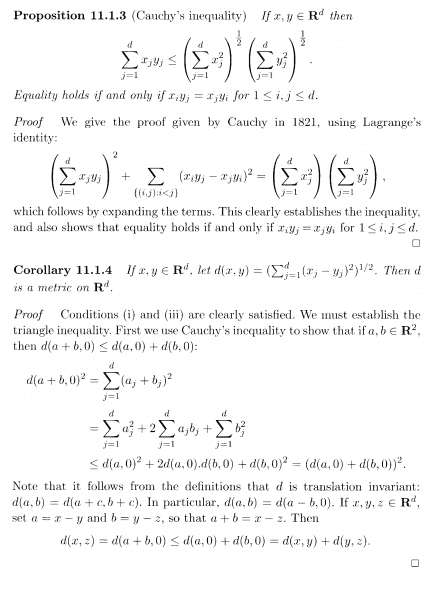
Garling - Proposition 11.1.3 and Corollary 11.1.4 ... .png

Hope the above scanned text helps readers understand the post ...

Peter
 
Attachments
  • Garling - Corollary 11.1.5 ... .png
    Garling - Corollary 11.1.5 ... .png
    35.9 KB · Views: 772
  • Garling - Proposition 11.1.3 and Corollary 11.1.4 ... .png
    Garling - Proposition 11.1.3 and Corollary 11.1.4 ... .png
    30.5 KB · Views: 649
Physics news on Phys.org
What do you know about the relation between ##|a+b|## and ##|a|+|b|\,##?
And for the second question: square it and try to prove it by induction.
 
  • Like
Likes   Reactions: Math Amateur
Math Amateur said:
Question 1

Can someone please explain exactly why we have:## d( z + w , 0 ) = \left( \sum_{ j = 1 }^d \mid z_j + w_j \mid^2 \right)^{ \frac{1}{2} } \le \left( \sum_{ j = 1}^d ( \mid z_j \mid + \mid w_j \mid )^2 \right)^{ \frac{1}{2} } ##How/why does this hold true?
It is sufficient to prove that, for any ##j##,
$$ \mid z_j + w_j \mid^2 \le ( \mid z_j \mid + \mid w_j \mid )^2 $$
which is equivalent to
$$ \mid z_j + w_j \mid \le \mid z_j \mid + \mid w_j \mid $$

We can prove that by cases, as is often best with absolute values. Because things are squared, there are only two cases that need considering, where the signs of ##z_j## and ##w_j## are the same, and where they are different. Each case is easy to prove.
 
  • Like
Likes   Reactions: Math Amateur
The second one can be reduced to an instance of the Cauchy-Schwarz inequality by squaring both sides, then expanding the square inside the summation on the LHS, then cancelling terms that occur on both sides.
 
  • Like
Likes   Reactions: Math Amateur
Thanks Andrew and fresh_42 ...

Appreciate your help as always ...

Hmm ... should have remembered that for ##z_1, z_2 \in \mathbb{C}## we have ##\mid z_1 + z_2 \mid \le \mid z_1 \mid + \mid z_2 \mid## ...

But ... still reflecting on your posts ...

Peter
 
Last edited:
Math Amateur said:
Thanks Andrew and fresh_42 ...

Appreciate your help as always ...

Hmm ... should have remembers that for ##z_1, z_2 \in \mathbb{C}## we have ##\mid z_1 + z_2 \mid \le \mid z_1 \mid + \mid z_2 \mid## ...

But ... still reflecting on your posts ...

Peter
fresh_42, Andrew

Just a thought regarding Question 2 ... Garling suggests we use the previous Corollary (which is Corollary 11.1.4) ... but how do we use Corollary 11.1.4 to answer Question 2 ... ...

Peter
 
Math Amateur said:
fresh_42, Andrew

Just a thought regarding Question 2 ... Garling suggests we use the previous Corollary (which is Corollary 11.1.4) ... but how do we use Corollary 11.1.4 to answer Question 2 ... ...

Peter
I only see that it gives you the equations for the ##d(0,a)## terms. The inequalities are the triangle inequality for question 1 and squaring the second should give you the one for question 2 by the help of Cauchy-Schwarz as @andrewkirk mentioned. It might be a little work to actually prove it, but it's a good exercise (you may assume Cauchy-Schwarz as given, as the Wiki link contains a proof):
$$
\left( \sum_{ j = 1}^n ( \mid z_j \mid + \mid w_j \mid )^2 \right)^{ \frac{1}{2} } \le \left( \sum_{ j = 1 }^n \mid z_j \mid^2 \right)^{ \frac{1}{2} } + \left( \sum_{ j = 1 }^n \mid w_j \mid^2 \right)^{ \frac{1}{2} }
$$
Try it for ##n=2,3## and you should see how it works.
 
  • Like
Likes   Reactions: Math Amateur
Hi fresh_42, Andrew ...

... taking your advice regarding Question 2 ...

We have to show that ... :##\left( \sum_{ j = 1}^d ( \mid z_j \mid + \mid w_j \mid )^2 \right)^{ \frac{1}{2} } \le \left( \sum_{ j = 1 }^d \mid z_j \mid^2 \right)^{ \frac{1}{2} } + \left( \sum_{ j = 1 }^d \mid w_j \mid^2 \right)^{ \frac{1}{2} }## ... ... ... ... ... (1)Squaring both sides of (1) we get ...

##\sum_{ j = 1}^d ( \mid z_j \mid + \mid w_j \mid )^2 = \sum_{ j = 1}^d \mid z_j \mid^2 + \sum_{ j = 1}^d \mid w_j \mid^2 + 2 \left( \sum_{ j = 1 }^d \mid z_j \mid^2 \right)^{ \frac{1}{2} } \left( \sum_{ j = 1 }^d \mid w_j \mid^2 \right)^{ \frac{1}{2} }## ... ... ... ... ... (2)Now ... expanding the LHS of (2) we get

##\sum_{ j = 1}^d ( \mid z_j \mid + \mid w_j \mid )^2 = \sum_{ j = 1}^d \mid z_j \mid^2 + 2 \sum_{ j = 1}^d \mid z_j \mid \mid w_j \mid + \sum_{ j = 1}^d \mid w_j \mid^2## ... ... ... ... ... (3)Substituting (3) into (2) we get ...:

##\sum_{ j = 1}^d \mid z_j \mid^2 + 2 \sum_{ j = 1}^d \mid z_j \mid \mid w_j \mid + \sum_{ j = 1}^d \mid w_j \mid^2 \ \le \ \sum_{ j = 1}^d \mid z_j \mid^2 + \sum_{ j = 1}^d \mid w_j \mid^2 + 2 \left( \sum_{ j = 1 }^d \mid z_j \mid^2 \right)^{ \frac{1}{2} } \left( \sum_{ j = 1 }^d \mid w_j \mid^2 \right)^{ \frac{1}{2} }####\Longrightarrow \ \ \sum_{ j = 1}^d \mid z_j \mid \mid w_j \mid \ \le \ \left( \sum_{ j = 1 }^d \mid z_j \mid^2 \right)^{ \frac{1}{2} } \left( \sum_{ j = 1 }^d \mid w_j \mid^2 \right)^{ \frac{1}{2} }## ...

... BUT ... this is just Cauchy's Inequality! ... QED ...Is the above correct ... ?

Peter
 
  • Like
Likes   Reactions: WWGD and fresh_42
FWIW, note that question 2 really is triangle inequality as well.

Consider two vectors ##\mathbf a## and ##\mathbf x##, where ##\mathbf a## has the magnitude of the components of ##\mathbf z## and ##\mathbf x## has the magnitude of the components of ##\mathbf w##

(alternatively work directly with ##\mathbf z## and ##\mathbf w## and assume WLOG that components are real non-negative)

##
\left( \sum_{ j = 1}^d ( \mid z_j \mid + \mid w_j \mid )^2 \right)^{ \frac{1}{2} } =
\big \Vert \mathbf a + \mathbf x\big \Vert_2 \leq \big \Vert \mathbf a \big \Vert_2 +\big \Vert \mathbf x \big \Vert_2 = \left( \sum_{ j = 1 }^d \mid z_j \mid^2 \right)^{ \frac{1}{2} } + \left( \sum_{ j = 1 }^d \mid w_j \mid^2 \right)^{ \frac{1}{2} }##

by triangle inequality.
 
  • Like
Likes   Reactions: Math Amateur