Trouble with cubical cavity radiation

  • Context: Undergrad 
  • Thread starter Thread starter GhostLoveScore
  • Start date Start date
  • Tags Tags
    Cavity Radiation
Click For Summary

Discussion Overview

The discussion revolves around the understanding of radiation within a cubical cavity, specifically focusing on the quantization conditions for the wavelengths and the relationship between the components of radiation in three-dimensional space. Participants explore the implications of these conditions on the integers associated with the wavelengths and their components.

Discussion Character

  • Exploratory
  • Technical explanation
  • Conceptual clarification
  • Debate/contested

Main Points Raised

  • One participant expresses confusion regarding the condition that 2a/λ should be an integer and how this relates to the integers nx, ny, and nz.
  • Another participant clarifies that the cubic box with conducting walls leads to quantization in the x, y, and z directions, resulting in nx, ny, and nz being integers, while 2a/λ does not necessarily have to be an integer.
  • A later reply confirms that while the x, y, and z components must satisfy specific relationships, the overall condition 2a/λ does not have to be an integer.
  • Participants discuss whether the components can have different integer values (nx, ny, nz) and conclude that any combination is allowed, which affects the direction of radiation propagation.

Areas of Agreement / Disagreement

Participants generally agree on the quantization conditions for the x, y, and z components, but there is some uncertainty regarding the implications of these conditions on the overall wavelength and whether the integers must be equal.

Contextual Notes

The discussion includes assumptions about the alignment of the coordinate system and the nature of the cavity, which may not be universally applicable. The relationship between the integers and the wavelengths is not fully resolved, leaving open questions about the implications for different propagation directions.

GhostLoveScore
Messages
149
Reaction score
9
Hi everyone

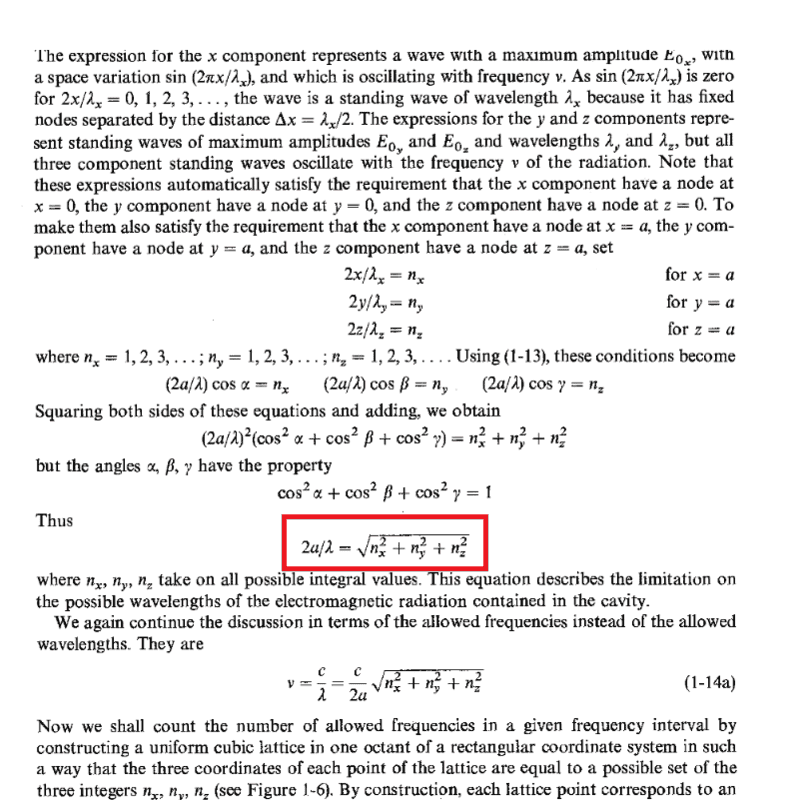
I have some trouble understanding quantum physics. Here is a scan from the book from Eisberg and Resnick
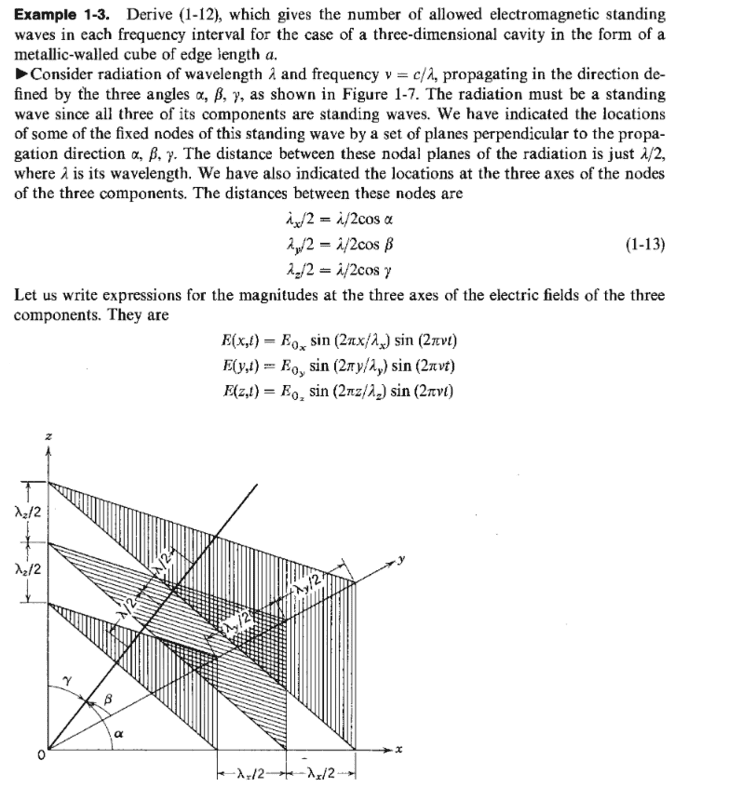
Here is how much I understand. This is radiation inside cubical cavity, λx/2 is distance from two nodes of component x of the radiation.
Same goes for y and z components. In the picture they've connected the nodes together to make a plane. I understand that.
Next if you could take a look at the equation below, that I marked in red.
2a/λ should be an integer number, isn't it? If that's so, how can we have nx, ny, nz also integers?What is the reason that we didn't choose 2a/λx, 2a/λy, 2a/λz to be integer value instead of 2a/λ?
240847

240848
 
Physics news on Phys.org
GhostLoveScore said:
2a/λ should be an integer number, isn't it? If that's so, how can we have nx, ny, nz also integers?
The system of coordinates is aligned with the edges of the box. The fact that it is a cubic box with conducting walls results in a quantisation condition in x, y and z, hence x, ny, and nz are integers. For an arbitrary direction, not all values of 2a/λ are allowed, but 2a/λ is not necessarily an integer.
 
  • Like
Likes   Reactions: vanhees71
DrClaude said:
The system of coordinates is aligned with the edges of the box. The fact that it is a cubic box with conducting walls results in a quantisation condition in x, y and z, hence x, ny, and nz are integers. For an arbitrary direction, not all values of 2a/λ are allowed, but 2a/λ is not necessarily an integer.

OK, I just want to confirm if I understand this correctly.

For some radiation propagating inside the cavity, only its x, y and z components need to satisfy the requirement

2a/λx=nx
2a/λy=ny
2a/λz=nz

where nx, ny, nz is 1, 2, 3...

and then
2a/λ=√(nx2+ny2+nz2)
doesn't have to be integer?Can each x, y, z component have different n (different wavelength)? Or are nx=ny= nz?
 
GhostLoveScore said:
For some radiation propagating inside the cavity, only its x, y and z components need to satisfy the requirement

2a/λx=nx
2a/λy=ny
2a/λz=nz

where nx, ny, nz is 1, 2, 3...

and then
2a/λ=√(nx2+ny2+nz2)
doesn't have to be integer?
Correct.

GhostLoveScore said:
Can each x, y, z component have different n (different wavelength)? Or are nx=ny= nz?
Any combination is allowed. Note that this restricts the possible direction of propagation of the radiation, as the n's also affect the angles.
 
  • Like
Likes   Reactions: GhostLoveScore

Similar threads

  • · Replies 9 ·
Replies
9
Views
4K
  • · Replies 1 ·
Replies
1
Views
2K
  • · Replies 2 ·
Replies
2
Views
3K
  • · Replies 8 ·
Replies
8
Views
6K
  • · Replies 4 ·
Replies
4
Views
2K
  • · Replies 1 ·
Replies
1
Views
5K
  • · Replies 5 ·
Replies
5
Views
5K