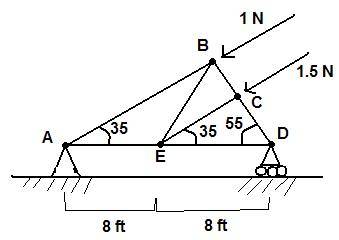
Truss Analysis: Find Forces on Members

Click For Summary
SUMMARY

The discussion focuses on solving a truss analysis problem involving the calculation of forces on members and determining whether they are in tension or compression. Key equations used include the moment equation M = fd and the equilibrium conditions ∑Fx = 0 and ∑Fy = 0. The user initially calculated the reaction force at point A as 2.0075 N upward but faced confusion regarding the equilibrium of the system. Participants advised using free body diagrams and correcting mathematical errors, particularly in summing forces in the y-direction and moments about point A to find the correct reactions at points A and D.

PREREQUISITES
  • Understanding of static equilibrium principles in mechanics
  • Familiarity with free body diagrams
  • Knowledge of trigonometric functions and their application in physics
  • Ability to solve linear equations and apply moment equations
NEXT STEPS
  • Review the method for constructing free body diagrams for truss analysis
  • Learn how to apply the equations of equilibrium to solve for unknown forces
  • Study the concept of tension and compression in structural members
  • Practice solving truss problems using the method of joints and the method of sections
USEFUL FOR

Students in civil or mechanical engineering, structural analysts, and anyone involved in static analysis of structures will benefit from this discussion.

FairyChatMan
Messages
9
Reaction score
0
Truss Analysis :(

Homework Statement


truss.jpg


Find the force on each of the members and tell if it is tension of compression.

Homework Equations


M = fd \sumFx and Fy = 0

The Attempt at a Solution


Well, my professor said to us that the first thing to do is to compute for the reactions on the pin. After that, start using Free body diagram on one of the pin, and continue to complete the truss.

Here's what I did...

I set point D as pivot... then
\sumM = 8A - 16cos55 - 12cos55 = 0
A = 2.0075 N upward

But shouldn't the summation of all forces be zero? By having A = 2.0075 and an unknown Rxn on D (which obviously will point upward), the system won't be in equilibrium because cos35 + 1.5cos35 = 2.0479 N.

Just help me getting the correct Reactions on point A and D and i'll be able to solve this problem.. thanks..

=================================
 
Physics news on Phys.org


How many reaction components are there at A?


FairyChatMan said:

Homework Statement


truss.jpg


Find the force on each of the members and tell if it is tension of compression.

Homework Equations


M = fd \sumFx and Fy = 0

The Attempt at a Solution


Well, my professor said to us that the first thing to do is to compute for the reactions on the pin. After that, start using Free body diagram on one of the pin, and continue to complete the truss.

Here's what I did...

I set point D as pivot... then
\sumM = 8A - 16cos55 - 12cos55 = 0
A = 2.0075 N upward
that should be M = 16A[/color] - ...etc
But shouldn't the summation of all forces be zero? By having A = 2.0075 and an unknown Rxn on D (which obviously will point upward), the system won't be in equilibrium because cos35 + 1.5cos35 = 2.0479 N.
if you sum forces in y direction, A_y -1(sin35) -1.5(sin35) +D_y =0, plug in value for A_y and solve for D_y.
Just help me getting the correct Reactions on point A and D and i'll be able to solve this problem.. thanks..

=================================
looks like you had a math typo, some trig errors,and you missed a variable when summing y forces = 0. You can check your work by summing moments about A to solve for D_y.
 

Similar threads

  • · Replies 2 ·
Replies
2
Views
2K
  • · Replies 2 ·
Replies
2
Views
2K
  • · Replies 1 ·
Replies
1
Views
2K
  • · Replies 2 ·
Replies
2
Views
3K
  • · Replies 1 ·
Replies
1
Views
3K
Replies
3
Views
2K
  • · Replies 1 ·
Replies
1
Views
2K
  • · Replies 2 ·
Replies
2
Views
2K
Replies
1
Views
2K
  • · Replies 2 ·
Replies
2
Views
2K