Trying to understand the WKB approximation

Click For Summary

Discussion Overview

The discussion revolves around the WKB approximation in the context of a particle in a potential described by the Mathieu equation. Participants explore the conditions under which the WKB method is expected to work and why it appears to fail in certain scenarios, particularly when dealing with parametric resonance.

Discussion Character

  • Exploratory
  • Technical explanation
  • Debate/contested
  • Mathematical reasoning

Main Points Raised

  • One participant questions the validity of the WKB approximation in the context of the Mathieu equation, noting that it produces oscillating solutions with constant amplitude, contrary to the expected exponential growth due to parametric resonance.
  • Another participant challenges the assumption that the WKB approximation is at fault, suggesting that the numerical solution may be the issue instead.
  • Some participants highlight that the exponential growth in amplitude is a global effect that may not be captured by the local validity of the WKB approximation, which is valid for one cycle but not necessarily over many cycles.
  • There is a suggestion to consider higher-order WKB corrections, as the traditional WKB method is the first term in a series expansion.
  • One participant notes that when the energy is chosen outside the instability band, the WKB approximation provides an excellent fit, raising questions about the conditions under which WKB can be trusted.
  • Another participant discusses the challenges of estimating corrections when perturbing around the zeroth-order solution, indicating that linearization may not be effective due to the nature of the exact solution.

Areas of Agreement / Disagreement

Participants express differing views on the reliability of the WKB approximation in specific cases, particularly regarding the energy levels chosen. There is no consensus on whether the WKB method is fundamentally flawed in this scenario or if the issue lies elsewhere.

Contextual Notes

Participants mention that the conditions for the validity of the WKB approximation involve local criteria, which may not account for global effects such as exponential growth in amplitude. The discussion also touches on the complexity of iterative solutions and the difficulties in estimating corrections.

phsopher
Messages
180
Reaction score
4
I'm trying to understand why the WKB approximation doesn't seem to work in the following case.

Suppose you have a particle of mass ##m## in a potential ##V(x)=q m\cos(2mx/\hbar)##, where ##q\ll 1##. Consider then the stationary solution with energy ##E=m/2##. The Schroedinger equation is then

\psi'' + (1-2q\cos 2z)\psi = 0 \qquad (1)

where I defined a dimensionless variable ##z=mx/\hbar##. With the ansatz ##\psi(z) = A(z)e^{iS(z)}## this reduces to

W^2\left[1-\frac{3}{4}\left(\frac{W'}{W^2}\right)^2 + \frac{1}{2}\frac{W''}{W^3}\right] = 1-2q\cos 2z \equiv \omega^2(z)

where I have also used the conservation of the Wronskian (current) which gives ##(S'/W)'=0##.

Now, if the latter two terms in the square brackets are small then I should be able to solve this iteratively with the leading solution simply being ##W=\omega## so the solution is

\psi = \frac{1}{\sqrt{2\omega}}e^{i\int\omega\mathrm dz}

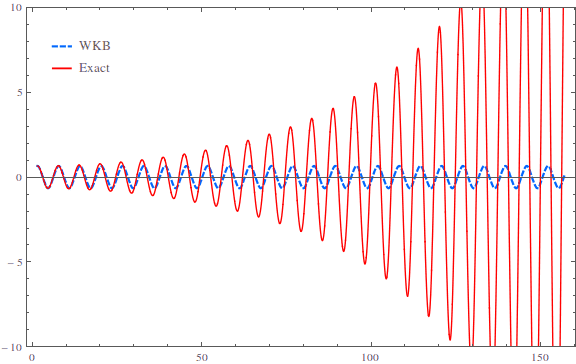
This is the gist of the WKB approximation as I understand it. In this case indeed ##\omega'/\omega^2, \omega''/\omega^3 \ll 1## so I don't see why this wouldn't work. However, this produces an oscillating solution with a constant amplitude. In reality, Equation (1) is the Mathieu equation and the amplitude of the oscillations is known to be amplified exponentially (parametric resonance).

I don't quite get why the WKB approximation fails here. Below is a numerical comparison between second order WKB solution and the exact numerical solution of (1).
mathieu.png
 
Last edited:
Physics news on Phys.org
What makes you think that it is the WKB approximation that fails rather than your numerical solution?
 
Orodruin said:
What makes you think that it is the WKB approximation that fails rather than your numerical solution?

The Mathieu equation has been studied for over a hundred years. It is known that for certain parameter values there is a parametric resonance where the solutions get exponentially amplified.
 
That's an interesting paper; however, I don't think it quite answers my question as far as I've been able to tell. What they appear to be considering is a solution which passes through the resonance region, which in the above case would correspond to x-dipendent energy ##E(x)##.

What I want to know is why WKB method doesn't produce the solution despite ##\omega'/\omega^2, \omega''/\omega^3\ll1## when we are inside the resonance band.

I also found the following paper:

http://scitation.aip.org/content/aapt/journal/ajp/39/5/10.1119/1.1986212

which sketches out how to draw the instability chart for the Mathieu equation using the WKB approximation but I don't think it answers my question either as far as I'm able to tell.
 
phsopher said:
What I want to know is why WKB method doesn't produce the solution despite ##\omega'/\omega^2, \omega''/\omega^3\ll1## when we are inside the resonance band.
Those conditions insure that the WKB approximation will be valid locally, e.g. one cycle, but maybe not globally. The exponential growth in amplitude is a global effect, taking place gradually over many cycles.

Another idea - traditional WKB is the first term in a series. You might try including the next term. ("Higher-order WKB")
 
Bill_K said:
Those conditions insure that the WKB approximation will be valid locally, e.g. one cycle, but maybe not globally. The exponential growth in amplitude is a global effect, taking place gradually over many cycles.

If I choose the energy to be ##E=m## (outside the instability band) instead of ##E=m/2## (inside the instability band) then the WKB gives an excellent fit over many cycles:

mathieunoresonance.png


With respect to the various time scales of the system the two cases are pretty much the same. So my question is how I would know that I can trust WKB in the case ##E=m## but not ##E=m/2##.

Another idea - traditional WKB is the first term in a series. You might try including the next term. ("Higher-order WKB")

I did do that by considering iterative solutions, i.e.,

<br /> \begin{eqnarray}<br /> W_0^2 &amp; = &amp; \omega^2 \\<br /> W_1^2 &amp; = &amp; \omega^2 + \frac{3}{4}\left(\frac{\omega&#039;}{\omega}\right)^2 - \frac{1}{2}\frac{\omega&#039;&#039;}{\omega} \\<br /> W_2^2 &amp; = &amp; W_1^2 + \frac{3}{4}\left(\frac{W_1&#039;}{W_1}\right)^2 - \frac{1}{2}\frac{W_1&#039;&#039;}{W_1}<br /> \end{eqnarray}<br />

It is this last second order term that is plotted in the Figure in my original post. Is this sort of iterative solution not the way to go? If so, why?

On the other hand if I consider a small perturbation around the "zeroth order" ##W=\omega(1+\xi)## I get a very complicated equation that I don't know how to estimate. Even if linearizing in ##\xi## doesn't help and is doomed to fail anyway because I know from the exact solution that the correction will grow exponentially to much larger values.

So my question is really: how can I know from the equation that I can't trust WKB for ##E=m/2## but can trust it for ##E=m##.
 

Similar threads

  • · Replies 5 ·
Replies
5
Views
2K
  • · Replies 6 ·
Replies
6
Views
2K
  • · Replies 2 ·
Replies
2
Views
2K
  • · Replies 2 ·
Replies
2
Views
2K
  • · Replies 2 ·
Replies
2
Views
1K
Replies
2
Views
1K
  • · Replies 1 ·
Replies
1
Views
2K
  • · Replies 29 ·
Replies
29
Views
6K
  • · Replies 17 ·
Replies
17
Views
3K
  • · Replies 1 ·
Replies
1
Views
2K