Two-point source interference pattern

Click For Summary
The discussion revolves around calculating the angles of nodal lines in a two-point source interference pattern, specifically using the formula dsinθn = (n - 0.5)λ. Participants are unsure whether to solve for multiple values of n and how many nodal lines to consider, with one user successfully calculating the first two angles but encountering a domain error when attempting to find the third. This error suggests that the third nodal line exceeds 90°, indicating it does not reach the screen. There is also confusion regarding the relevance of frequency in the calculations, with no clear consensus on its purpose. Overall, the focus is on understanding the nodal line calculations and the implications of the results.
benca
Messages
19
Reaction score
0
Homework Statement
A two-point source operates at a frequency of 1.0 Hz to produce an interference pattern in a ripple tank. The sources are 2.5 cm apart and the wavelength of the waves is 1.2 cm.

Calculate the angles at which the nodal lines in the pattern are located far from the sources. (Assume the angles are measured from the central line of the pattern.)
Relevant Equations
λ = (xn/L)[d/(n - 0.5)]
dsinθn= (n - 0.5)λ
xn = perpendicular distance from the right bisector t o the point Pn on the nodal line
L = distance from midpoint between the two sources to the point Pn
n = number of the nodal line
d= separation of the sources
I'm having trouble understanding what it's asking me. "Calculate the angles at which the nodal lines in the pattern are located far from the sources." I assume they are very far away, making lines PnS1 and PnC parallel. Is the question asking me to calculate θ' in the example?

"nodal lines" should I solve for several different values of n? I was thinking of using dsinθn= (n - 0.5)λ to solve for θn since θn = θ' If that's right, for how many nodal lines do I do this? Also why would they provide the frequency? Attached in a diagram from a previous example.
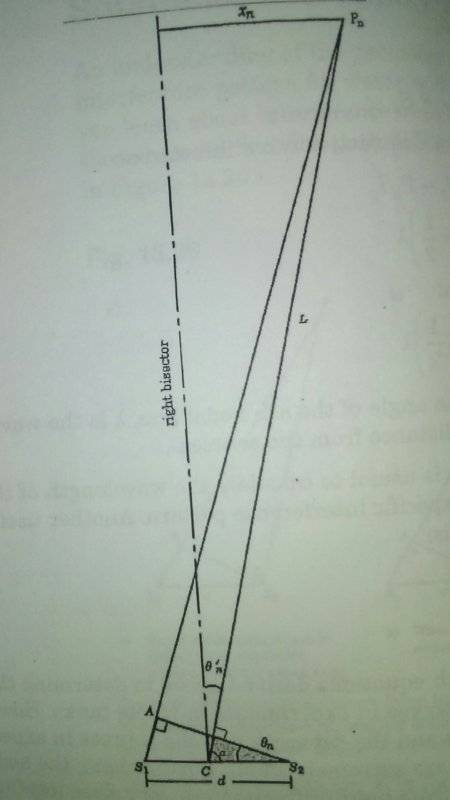
20191116_130741.jpg
 
Physics news on Phys.org
RippleNodes.png

Do some web research. There is a lot of useful stuff out there.
 
So I used dsinθn= (n - 0.5)λ to solve for the first two nodal lines and got 13.8° for the first and 46° for the second. When I tried to to input 3 for n I got a domain error. Does that mean the third nodal line is greater than 90° and didn't strike the screen?

I also still don't know the reason why frequency is provided.
 
Last edited:
benca said:
Does that mean the third nodal line is greater than 90° and didn't strike the screen?
What do you think? Calculate sinθ3 and see what you get.
benca said:
I also still don't know the reason why frequency is provided.
I don't know either.
 
The book claims the answer is that all the magnitudes are the same because "the gravitational force on the penguin is the same". I'm having trouble understanding this. I thought the buoyant force was equal to the weight of the fluid displaced. Weight depends on mass which depends on density. Therefore, due to the differing densities the buoyant force will be different in each case? Is this incorrect?

Similar threads

Replies
11
Views
3K
  • · Replies 3 ·
Replies
3
Views
4K
  • · Replies 12 ·
Replies
12
Views
9K
Replies
1
Views
1K
  • · Replies 2 ·
Replies
2
Views
2K
  • · Replies 2 ·
Replies
2
Views
3K
  • · Replies 1 ·
Replies
1
Views
2K
  • · Replies 2 ·
Replies
2
Views
3K
  • · Replies 4 ·
Replies
4
Views
5K
Replies
6
Views
7K