Two strings supporting a block at an angle

  • Thread starter TomPag
  • Start date
2 replies · 2K views · last reply
TomPag
Messages
1
Reaction score
0
Homework Statement
Mechanics homework
Relevant Equations
123
I have been given the following homework:
Figure P5.104: rotating horizontal rod with two attachment points 2.00 m apart, two strings of length 1.25 m each running down to a 4.00 kg block, the block hanging below the rod.

For the first question a), I am not sure if i should create 2 right triangles for the strings as drawn in the picture, where the sum of the sides opposing the block are not equal to 2, or if i should say the strings go into the block and touch each other, so that the right triangles created have sides opposing the block equal to 2. If i choose the first option, which makes the most sense, the length 2 m becomes useless, and im not sure how i would solve it. Does anyone have any ideas?
Thank you in advance.
 
Attachments
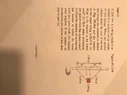
  • Free-body style diagram of a rod rotating about its axis, with a 4.00 kg block hanging from two strings attached at points on the rod spaced 2.00 m apart; the strings are 1.25 m long and the block hangs below.
    image2 (3).webp
    36.4 KB · Views: 44
Welcome!
I believe that you can consider a triangle of sides 1.25-2-1.25, assuming that the two strings coincide with the center of mass of the block, and that the opposite ends coincide with the axis of rotation (since there is no given information that contradicts those assumptions).

Diagrams are usually drawn by other than the problem creator, reason for which can be confusing.

Textbook figure P5.104: a vertical rod with a 4.00 kg block attached by two strings, upper and lower, with labelled lengths 1.25 m, 1.25 m and 2.00 m and string tensions X1 and X2.
 
TomPag said:
For the first question a), I am not sure if i should create 2 right triangles for the strings as drawn in the picture, where the sum of the sides opposing the block are not equal to 2, or if i should say the strings go into the block and touch each other, so that the right triangles created have sides opposing the block equal to 2. If i choose the first option, which makes the most sense, the length 2 m becomes useless, and im not sure how i would solve it. Does anyone have any ideas?
You could:

a) State that you believe the question posed can’t be answered and briefly explain why.

b) Propose a revision to make answers possible. E.g. replace the 4 kg ‘rectangular’ mass with a 4 kg point mass*.

c) Provide answers based on b).

It may be worth noting that a right-angled triangle with hypotenuse 1.25 m and another side 1.00 m is, in fact, a ‘3-4-5’ triangle.

*Edit: I originally typed '5 kg' but I meant '4 kg'.
 
Last edited: