UK Power Refunds: Halifax & Newcastle Postcodes Receive 13-Figure Sums

  • Thread starter Thread starter anorlunda
  • Start date Start date
  • Tags Tags
    Power Uk
Click For Summary
SUMMARY

Northern Powergrid mistakenly issued cheques for 13-figure sums to customers in Halifax and Newcastle due to a clerical error. This incident highlights a significant flaw in the cheque printing system, which lacks safeguards against excessively large amounts. The error arose from mixing up meter serial numbers with monetary values, raising concerns about risk management protocols in automated systems. The discussion also touches on the historical context of number naming conventions in English.

PREREQUISITES
  • Understanding of cheque processing systems
  • Familiarity with risk management in automated financial systems
  • Knowledge of programming concepts related to data validation
  • Awareness of historical number naming conventions in English
NEXT STEPS
  • Research cheque processing protocols and error prevention mechanisms
  • Explore risk management strategies in automated financial systems
  • Learn about programming techniques for data validation and error handling
  • Investigate the evolution of number naming systems in different cultures
USEFUL FOR

This discussion is beneficial for financial system developers, risk management professionals, and anyone interested in the intersection of technology and historical linguistics.

anorlunda
Staff Emeritus
Science Advisor
Homework Helper
Insights Author
Messages
11,326
Reaction score
8,754
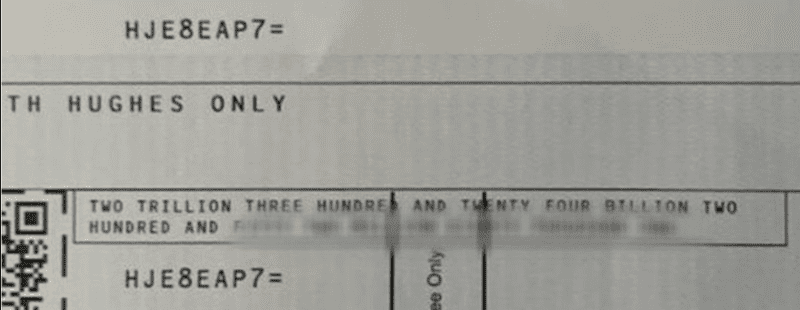
I would like to share this, just because it is so funny.

https://www.bbc.com/news/uk-england-tyne-60369098

1645301125628.png
Northern Powergrid is paying tens of thousands of pounds to customers hit by days of outages in November.
But a number with Halifax and Newcastle postcodes received cheques made out for 13-figure sums.
Northern Powergrid said a clerical error was to blame.

If any PF members got this refund in the mail, please let us know.
 
  • Wow
  • Haha
Likes   Reactions: berkeman and hutchphd
Physics news on Phys.org
Are we in the early 20th century or am I crazy?
 
anorlunda said:
I would like to share this, just because it is so funny.

https://www.bbc.com/news/uk-england-tyne-60369098

View attachment 297333

If any PF members got this refund in the mail, please let us know.
It's interesting that the system has no fail safe to prevent excessively large cheques being printed. A cheque for, say, £20,000 might be more problematic, as it would be harder to detect after the event. And could be cashed.
 
  • Like
Likes   Reactions: anorlunda
nuuskur said:
Are we in the early 20th century or am I crazy?
Worse, it's the UK.

UK friends please forgive me. That was not deserved, but I just couldn't resist the temptation. :biggrin:
 
  • Haha
Likes   Reactions: nuuskur
Maybe they devaluated their currency post Brexit? :wink:
 
Last edited:
  • Haha
Likes   Reactions: anorlunda
PeroK said:
It's interesting that the system has no fail safe to prevent excessively large cheques being printed. A cheque for, say, £20,000 might be more problematic, as it would be harder to detect after the event. And could be cashed.

What makes you think these couldn't be cashed?
 
Office_Shredder said:
What makes you think these couldn't be cashed?
I doubt that Northern Powergrid has 2 trillion pounds in its account.
 
PeroK said:
I doubt that Northern Powergrid has 2 trillion pounds in its account.
And especially not 2 trillion pounds per customer.
 
I wouldn't mind that much money!
 
  • Haha
Likes   Reactions: anorlunda
  • #10
StevieTNZ said:
I wouldn't mind that much money!
Just put it into my interest bearing account for a few minutes, please.
 
  • Haha
Likes   Reactions: anorlunda
  • #11
anorlunda said:
And especially not 2 trillion pounds per customer.

Seems like the bank's problem when the check bounces :)
 
  • Like
Likes   Reactions: Bystander
  • #12
Why would the character string 'trillion' be available to the program? Would 'octillion' be available too? What's up with that?
 
Last edited:
  • #13
sysprog said:
Why would the character string 'trillion' be available to the program? Would 'octillion' be available too? What's up with that?
If one is writing a generic routine to convert a 64 bit signed integer scaled by a factor of 100 (hypothetically) to a text string, then one would want to go up to quadrillions. It is someone else's job to sanity-check the numbers.
 
  • Like
Likes   Reactions: sysprog
  • #14
jbriggs444 said:
If one is writing a generic routine to convert a 64 bit signed integer scaled by a factor of 100 (hypothetically) to a text string, then one would want to go up to quadrillions. It is someone else's job to sanity-check the numbers.
Way back when ('80s) I wrote a program that included printing a word version of counting numbers, and it stopped at 'ten thousand' ##-## in the US, for a bank, that number triggers a lot of reporting requirements.

In the '90s I did data security work for a major bank that did DP (data processing) for over 700 other banks, and I can say with confidence that their automated systems at that time could not have written a check with the word 'billion' or the word 'trillion' on it ##-## the word 'million' presented the greatest lexical order of magnitude available for such a purpose.

I acknowledge that some general-purpose routine could go into 'trillion' or 'quadrillion'; however, 'risk management' routines should/would flag such an egregious amount, and because the words for an amount on a check are supposed to be a validator for the digits, it is not reasonable for a programmer to allow 'billion' or 'trillion' in an automated check printing routine.
 
Last edited:
  • Like
Likes   Reactions: PeroK
  • #15
The article said that the root of the error was that the power company mixed up the meter serial number field with the money amount field. If they did that, then maybe the sanity tests would have looked at the wrong field. We'll never know for sure.
 
  • #16
sysprog said:
Why would the character string 'trillion' be available to the program? Would 'octillion' be available too? What's up with that?
Never underestimate programmers.

http://catless.ncl.ac.uk/Risks/33/7#subj1 by Steve Bacher <sebmb1@verizon.net>
Common Lisp, for example, has the numeric-to-English-output feature built in
to the standard format function.I wrote code to implement this in the Lisp
system that I built for the IBM mainframe in the 1980s, so I know how it
would work. Once you have established the algorithm to handle thousand,
million and billion, it is fairly straightforward to extend that to trillion
and up. My code was written to handle amounts up to a vigintillion [?],
with little effort.
He expanded my vocabulary too -- vigintillion !
 
  • Like
Likes   Reactions: sysprog
  • #17
anorlunda said:
Never underestimate programmers.He expanded my vocabulary too -- vigintillion !
Are you a 63 or 120 person?

I was surprised to find different naming systems of numbers in English.
https://www.merriam-webster.com/dictionary/number#table
Check out the above-one-million section.
 
Last edited:
  • Like
Likes   Reactions: sysprog
  • #18
  • Like
Likes   Reactions: sysprog