Why Is the Uncertainty in a Cat's Weight Considered 1lb and Not 2lb?

Click For Summary
SUMMARY

The discussion centers on the uncertainty in measuring a cat's weight, specifically why it is considered to have a 1lb uncertainty instead of 2lb. The original authors of Halliday et al Physics 4e suggest a method that leads to a fractional error of 11%, while the user calculates a 22% error using their own method. The conversation highlights the importance of understanding error propagation, particularly in the context of quantization errors versus independent, normally distributed errors. A recommended resource for proper error analysis is provided, emphasizing the need for accurate measurement techniques.

PREREQUISITES
  • Understanding of error propagation in measurements
  • Familiarity with quantization errors and their implications
  • Basic knowledge of statistical analysis in physics
  • Experience with measurement techniques and calibration procedures
NEXT STEPS
  • Study the document on error propagation from Harvard University: Error Propagation Guide
  • Learn about quantization errors and their impact on measurements
  • Explore statistical methods for combining independent measurement errors
  • Practice error analysis with real-world measurement scenarios
USEFUL FOR

Undergraduate physics students, educators teaching measurement techniques, and anyone interested in mastering error analysis in experimental physics.
walking
Messages
73
Reaction score
8
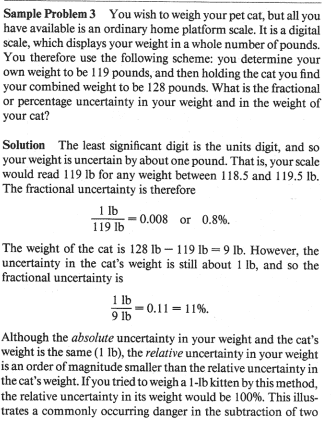
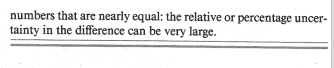
This is from Halliday et al Physics 4e, p9, sample problem 3.

Problem:

PHWar.png

X3lK2.png


My question: Why do the authors say that the weight of the cat has 1lb uncertainty rather than 2lb? Isn't it between 127.5-119.5=8lb, and 10lb, hence 9lb+-1lb ie uncertainty of $$\frac{2}{9}\times 100 = 22\%$$ rather than 11%?
 
  • Like
Likes   Reactions: Delta2
Physics news on Phys.org
To be honest, I'm not sure if any of that is right. Reading to the nearest whole number of ##\text{lb}## implies that your measurements are ##m_1 = (119 \pm 0.5) \text{lb}## and ##m_2 = (128 \pm 0.5) \text{lb}##. Since ##m_c = m_2 - m_1##, the error in ##m_c## is$$\Delta m_c = \sqrt{(0.5 \text{lb})^2 + (0.5 \text{lb})^2} \approx 0.7 \text{lb}$$and the fractional error is then ##\frac{\Delta m_c}{m_c} \approx 8\%##
 
  • Like
Likes   Reactions: vanhees71
etotheipi said:
To be honest, I'm not sure if any of that is right. Reading to the nearest whole number of ##\text{lb}## implies that your measurements are ##m_1 = (119 \pm 0.5) \text{lb}## and ##m_2 = (128 \pm 0.5) \text{lb}##. Since ##m_c = m_2 - m_1##, the error in ##m_c## is$$\Delta m_c = \sqrt{(0.5 \text{lb})^2 + (0.5 \text{lb})^2} \approx 0.7 \text{lb}$$and the fractional error is then ##\frac{\Delta m_c}{m_c} \approx 8\%##
Thanks etothepi.

However I was more trying to understand the author's approach (even if not technically correct, as I now understand from your post?). Basically it seems that they used their approach in a wrong way and I was just asking if my method was correct or not. They use a certain approach for the first part to get 8%, but then when I applied it to the second part (the cat's weight) I got 22% instead of the 11% they get.

At this level (beginner level undergraduate physics), would you still recommend that I ignore the author's method altogether and learn how to do it using the method you used? I am happy to dedicate some extra time on the side for learning how to deal with errors properly if you think it would be a good idea at this stage.
 
One can argue that there is actually no inconsistency in the approach taken.

When you weigh yourself on the scale, you read directly from the scale and take the reported value as the measured result. However let us add one step to the procedure. Before you step on the scale, you first twirl a calibration knob so that the scale reading is zeroed.

Now the weight of the man is the difference between two readings. And the weight of the cat is the difference between two readings.

The approach of adding the errors for the two measurements in quadrature (##\sqrt{e_1^2 + e_2^2}##) is misguided in this case. It would be proper for combining independent, normally distributed errors. But in this case we have quantization errors -- independent with a bounded uniform distribution. [I've made some questionable assumptions by idealizing away all other sources of experimental error here]

Edit: I also neglected to specify the knob twirling procedure. You close your eyes, twirl the knob and see whether the result is zero. If not, then you try again. The result should then approximate a uniform distribution of calibrations such that the scale returns an unbiased measurement on average.
 
Last edited:
  • Like
  • Informative
Likes   Reactions: etotheipi and gmax137

Similar threads

  • · Replies 8 ·
Replies
8
Views
2K
  • · Replies 3 ·
Replies
3
Views
3K
  • · Replies 89 ·
3
Replies
89
Views
38K
  • · Replies 1 ·
Replies
1
Views
12K
  • · Replies 13 ·
Replies
13
Views
7K
  • · Replies 1 ·
Replies
1
Views
3K
  • · Replies 8 ·
Replies
8
Views
5K
  • · Replies 1 ·
Replies
1
Views
4K
  • · Replies 2 ·
Replies
2
Views
3K
  • · Replies 2 ·
Replies
2
Views
4K