Hi, and welcome to the forum!
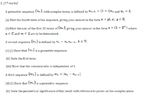
According to the definition of $u_n$,
\[
u_4=(1+i)u_3=(1+i)^2u_2=(1+i)^3u_1=3(1+i)^3=-6+6i.
\]
In general, $u_n=3(1+i)^{n-1}$. From there
\[
v_n=u_nu_{n+k}=3(1+i)^{n-1}\cdot3(1+i)^{n+k-1}=9(1+i)^{2n+k-2}.
\]
In particular,
\[
v_{n+1}=9(1+i)^{2n+k}=(1+i)^2v_n
\]
which means that $v_n$ is also a geometric sequence.
Another way to show this is to note that $\dfrac{u_n}{u_{n-1}}=1+i$ for all $i$. Therefore
\[
\dfrac{v_n}{v_{n-1}}=\dfrac{u_nu_{n+k}}{u_{n-1}u_{n+k-1}}=
\dfrac{u_n}{u_{n-1}}\cdot\dfrac{u_{n+k}}{u_{n+k-1}}=(1+i)(1+i)=(1+i)^2.
\]
The ratio does not depend on $n$; therefore, $v_n$ is a geometric sequence.
To answer other questions, you need to know formulas for the sum of geometric sequences and other information, which you can find in
Wikipedia.
Please also read the http://mathhelpboards.com/rules/, especially rules 8 and 11.