Understanding current measurement on an irregular waveform

Click For Summary
SUMMARY

The discussion centers on using a Keithley 2400 source meter to generate a ~120Hz AC signal for resistance measurement of bulk semiconductor materials. The user measures AC amperage through a 1.01 ohm resistor with a Keithley 2000-20 multimeter, observing a discrepancy where the meter reads .94A AC during a sweep compared to 1.01A DC. The user seeks to understand the impact of non-sine waveforms on measurement accuracy and the potential sources of error, particularly during polarity switching.

PREREQUISITES
  • Understanding of AC measurement techniques
  • Familiarity with Keithley 2400 source meter functionality
  • Knowledge of resistance measurement principles in semiconductor materials
  • Basic concepts of waveform generation and analysis
NEXT STEPS
  • Research how to configure the Keithley 2400 for square wave output
  • Learn about the effects of waveform shape on AC measurement accuracy
  • Investigate timing issues in source meters and their impact on measurements
  • Explore advanced AC measurement techniques for semiconductor applications
USEFUL FOR

Electrical engineers, semiconductor researchers, and technicians involved in precision measurement and waveform generation will benefit from this discussion.

tempneff
Messages
82
Reaction score
3
I hoped to use a Keithley 2400 source meter to generate a ~120Hz AC signal by outputting a 2-point sweep from 1A to -1A on an infinite trigger. The waveform image is attached below.

The end goal is a resistance measurement for bulk semiconductor materials, we prefer AC measurement to avoid thermoelectric drifts. To validate my input current I am measuring AC amperage through a verified 1.01 ohm resistor with a Keithley 2000-20 multimeter.

The meter measures .94A AC during the sweep. If I send 1A without sweeping and read DC current, it measures 1.01A; as expected.

I'd like to better understand the difference in magnitude. How is the measurement impacted by an "AC" current. Is there something problematic math-wise by not sending a sine wave.
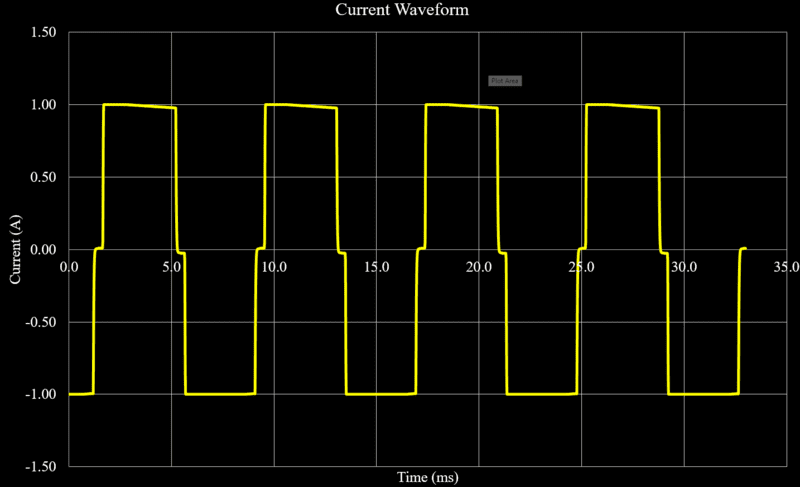
current_waveform.PNG
 

Attachments

  • current_waveform.PNG
    current_waveform.PNG
    10.7 KB · Views: 572
Engineering news on Phys.org
Why are there dwells at 0A when switching polarity? Is that maybe where the 7% error is coming from?
 
Could be. I think it is inherent to the timing of the source meter. I have the delay set to zero, but we know that isn't possible.
 
Is there a way to set the source to be 2App square wave with a -1A offset, instead of it being the two point sweep? I'm not familiar with that generator...
 
I am trying to understand how transferring electric from the powerplant to my house is more effective using high voltage. The suggested explanation that the current is equal to the power supply divided by the voltage, and hence higher voltage leads to lower current and as a result to a lower power loss on the conductives is very confusing me. I know that the current is determined by the voltage and the resistance, and not by a power capability - which defines a limit to the allowable...

Similar threads

  • · Replies 7 ·
Replies
7
Views
10K