Understanding Impulse and Conservation of Energy in Bouncing Ball Collisions

Click For Summary

Homework Help Overview

The discussion revolves around a problem involving impulse and the conservation of energy related to a bouncing ball. The original poster describes a scenario where a ball is dropped from a height and rebounds, seeking to understand the impulse experienced during the collision with the floor.

Discussion Character

  • Exploratory, Conceptual clarification, Assumption checking

Approaches and Questions Raised

  • The original poster attempts to calculate the impulse by determining the ball's momentum before and after the collision but encounters discrepancies in their results. Some participants suggest using the conservation of energy to find the necessary velocities for the calculations.

Discussion Status

The discussion is ongoing, with participants exploring different methods to approach the problem. There is a recognition of potential errors in the original poster's calculations, and guidance has been offered to consider conservation of energy as a viable approach.

Contextual Notes

Participants note that there may be confusion regarding the equations used to find velocity, and there is an acknowledgment of the original poster's struggle with the problem setup.

xrotaryguy
Messages
20
Reaction score
0
I don't know why I'm getting the wrong answer on this one.

A 5.00kg ball is dropped from rest from 1.20m above the floor. The ball rebounds .700m. What are the magnitude, and direction of the impulse or the net force applied to the ball during the collision with the floor?

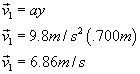
So I started by finding the velocity of the ball just before and just after hitting the floor.
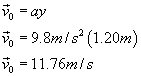
ch7no11c.gif
ch7no11d.gif


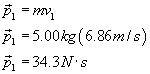
I use that to find the momentum of the ball before and after hitting the floor.
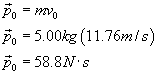
ch7no11e.gif
ch7no11f.gif


I find the diference between the two momentums and viola! Wrong answer :rolleyes: haha.
ch7no11g.gif


The answer is supposed to be 4.28N*s

What am I doing wrong? :cry: :biggrin:
 
Physics news on Phys.org
Oops, I found velocity with a physics equation that doesn't exist. :-D However, using the V=sqrt(2ax) formula, I still get the wrong answer...
 
Last edited:
xrotaryguy said:
Oops, I found velocity with a physics equation that doesn't exist. :-D

Yes, you wrote pretty weird things down. :smile:

Use, for example, conservation of energy to get the velocities you need.
 
radou said:
Yes, you wrote pretty weird things down.

Yeah, and I worked so hard at those images too :P

Ok, I'll try conservation of energy.

Thx
 

Similar threads

  • · Replies 13 ·
Replies
13
Views
9K
Replies
10
Views
1K
Replies
1
Views
2K
Replies
14
Views
3K
  • · Replies 19 ·
Replies
19
Views
3K
Replies
9
Views
4K
  • · Replies 13 ·
Replies
13
Views
1K
  • · Replies 24 ·
Replies
24
Views
4K
  • · Replies 2 ·
Replies
2
Views
3K
  • · Replies 2 ·
Replies
2
Views
3K