Understanding reflecting telescopes?

Click For Summary

Discussion Overview

The discussion revolves around the functioning of reflecting telescopes, specifically addressing the effects of secondary mirrors and obstructions on image formation. Participants explore the optical principles involved in light collection and image clarity, as well as the implications of design choices in telescope construction.

Discussion Character

  • Technical explanation
  • Conceptual clarification
  • Debate/contested

Main Points Raised

  • One participant expresses confusion about why certain telescope designs do not show shadows or obstructions from the secondary mirror, despite having observed through a reflecting telescope without noticing dark spots.
  • Another participant suggests that the diagrams may not fully represent how light forms images, indicating a need for better visual aids.
  • A participant explains that light from different points on an object spreads out in cones, and while the secondary mirror blocks some light, it does not prevent the remaining light from reaching the primary mirror and forming an image.
  • One analogy compares the light-collecting process to multiple cameras capturing images of the same object, where one camera may be obstructed but the others still provide usable information for the final image.
  • A participant describes how the incoming light beam in a reflecting telescope is collimated and how the central hole created by the secondary mirror does not affect the final image, except for reducing brightness.

Areas of Agreement / Disagreement

Participants do not reach a consensus on the clarity of the diagrams or the extent of the impact of the secondary mirror on image quality. Multiple viewpoints on the optical behavior of light in reflecting telescopes are presented, indicating ongoing debate and exploration of the topic.

Contextual Notes

Some participants note that the diagrams may lack detail in representing light rays from various points, which could lead to misunderstandings about how obstructions affect image formation. There is also mention of the dependence on specific assumptions about light behavior and telescope design.

21joanna12
Messages
126
Reaction score
2
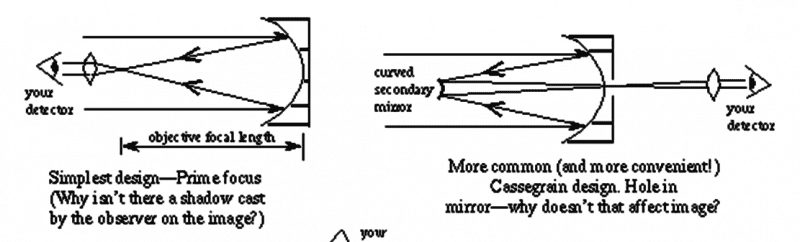
I have been looking at these diagrams:
upload_2015-3-28_8-4-5.png

From the following link http://www.astronomynotes.com/telescop/s3.htm

And I just can't seem to figure out why the first telescope design doesn't show a shadow and in the second why the presence of the secondary mirror, and the hole, do not affect the images formed... I have looked through a reflecting telescope before and I certainly have ever seen any dark spots that would show obstruction by the secondary mirror, or by the eyepiece lens...

Thank you in advance for any help :)
 
Astronomy news on Phys.org
What you're not seeing is the full details of how light is actually used to form the image. Let me see if I can find a good image or something and then I'll get back to you.
 
Well, I can't find a decent picture, but consider the following:

Let's say we have light incident on an object. The light reflected from any single point on this object spreads out in a cone. The light reflected from another nearby point has its own cone. In fact, every point on the object has its own, separate cone. A portion of each of these different cones of light enters the aperture of the telescope. The secondary mirror does, in fact, block out part of all this light. However, it blocks out a portion of the light from each cone. The rest of the light in each cone simply goes around the secondary and hits the primary mirror, where it is reflected and focused. Each cone of light then converges until it reaches the image plane where they are focused back into single points, minus a portion of light that has been lost on the way.

The two rays shown in your images represent two rays from only the point at the very center of the field of view of the telesope. There are, in fact, many other rays from that point that aren't even shown. Critically, the picture doesn't show any light rays from any other points. In other words, the picture is only showing the rays from a single cone of light that emerges from a single point. All the other cones of light from all the other points in the field of view are simply not shown. The rays in the picture don't look like they come from the same point because objects in the sky are so very far away that by the time their light reaches the telescope the rays are very, very close to being parallel.
 
  • Like
Likes   Reactions: 21joanna12
Here's an analogy I found useful, providing you've ever played with image editing software like Photoshop, Gimp or any other with layer support - imagine three cameras side by side aimed at the same faraway object. The cameras represent different parts of the light-collecting mirror. In front of one there's an object obscuring the view, but it's too small to block the line of sight of the other two.
They all take pictures. One will net an empty picture (no light collected), the other two will net the same picture (because the object is so far that parallax effects are insignificant).
What the central lens does then, is act like Photoshop combining the three pictures into one. The resultant picture will be darker than what you'd get without the obstruction in the central camera, but all details will be there, supplied by the other two.
 
Both of your diagrams have something blocking the incoming light. In a reflecting telescope the incoming beam of light from the star is a parallel bundle of rays (it is called collimated). After they hit the primary mirror, the beam will gradually shrink in size until is focused at the image of the star. A cross section of this shrinking bundle will show that there is a hole (no light) in the middle. At the image, all the rays are ideally focused at the same spot and the central hole disappears. Each star inn the image will have its own bundle of rays. Each of those bundles will each have a hole in the center. At focus, each will produce a pinpoint stat image. If the rays are allowed to continue past focus, the bundle will then expand and will again show a hole in the center.

Even though there may be a hole in the center of the beam, it will not affect the image in any way except reduce its brightness. The larger the initial blockage, the more light is blocked, and the dimmer the image. All items in the entire image will get equally dimmer. The eyepiece converts the rays back into collimated beams and your eye converts it back into an focused image on your retina. Thus what you "see" is a focused image on the retina. At any focused image, all the rays combine to form a spot and the central hole disappears. This is also true for refactor type telescope.
 
  • Like
Likes   Reactions: davenn and Drakkith
Thanks, UncleJim. I wish I could have explained it so well with so few words.
 

Similar threads

  • · Replies 7 ·
Replies
7
Views
4K
  • · Replies 25 ·
Replies
25
Views
3K
  • · Replies 10 ·
Replies
10
Views
5K
  • · Replies 3 ·
Replies
3
Views
2K
  • · Replies 2 ·
Replies
2
Views
2K
  • · Replies 9 ·
Replies
9
Views
7K
  • · Replies 17 ·
Replies
17
Views
3K
  • · Replies 14 ·
Replies
14
Views
3K
  • · Replies 13 ·
Replies
13
Views
4K
  • · Replies 27 ·
Replies
27
Views
6K