Understanding Stress and Strain in Springs for Engineers

  • Topic:
  • Thread starter Thread starter Dethrone
  • Start date Start date
Join the discussion
Registration is free. Start your own thread to ask a follow-up.
4 replies · 2K views
Dethrone
Messages
716
Reaction score
0
Attachments
  • cinvv.JPG
    cinvv.JPG
    51.6 KB · Views: 126
Mathematics news on Phys.org
Rido12 said:
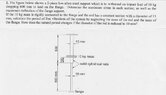
View attachment 3327

Have no clue... :(

What's this, AP physics or some such? (Wondering)

Anyway, to make sense of this, we'll need to make a couple of assumptions, which we may want to reexamine later.

Here are the assumptions I would make - at least at first:
  1. When the mass hits the flange, it remains in contact with the flange up to its maximum deflection.
  2. At all times, the force in the top section is equal to the force in the bottom section.

Hints:

Both sections will deform as per Hooke's law.
The spring constants are given by Young's modulus for low-alloy-steel.
The energy transferred by the mass to achieve maximum deflection, would be given by the kinetic energy of the mass.
 
So I have two methods, not sure which was is right or wrong.

Method 1:

By conservation of energy:

$$mgh=0.5 \sigma_1^2 \frac{V_1}{E}+0.5 \sigma_2^2 \frac{V_2}{E}$$
$$T_1=T_2$$
$$\sigma_1^1A_1=\sigma_2^2A_2$$

Two equations, two unknowns.

Method 2:

http://skule.ca/courses/exams/custom/20099/CIV102_2009__1329360837.pdf

Number two on this document.

About this course...it is hard to explain. It's just a compilation of 3 undergraduate courses in 1. The final exam might give a good indication of what is covered:
http://skule.ca/courses/exams/bulk/20139/CIV102H1F_2013_STRUCTURES%20&%20MATERIALS-AN%20INTRODUCTION%20TO%20ENGINEERING%20DESIGN.PDF

I've been told that the problem set questions (such as this one) are much easier than the ones on the exam.
 
Rido12 said:
By conservation of energy:

$$mgh=0.5 \sigma_1^2 \frac{V_1}{E}+0.5 \sigma_2^2 \frac{V_2}{E}$$
$$T_1=T_2$$
$$\sigma_1^1A_1=\sigma_2^2A_2$$

What do your symbols mean? (Wondering)

Btw, your second link seems to be broken.
 
Starting with:
$$mgh=\frac{1}{2}\sigma_1\epsilon V_1+\frac{1}{2}\sigma_2\epsilon V_2$$

Where sigma is stress, and epsilon is strain. Now we know that strain = stress / Young's modulus, we can make the substitution to get the equation I got in my previous post.

The broken link is:
http://skule.ca/courses/exams/bulk/20139/CIV102H1F_2013_STRUCTURES%20&%20MATERIALS-AN%20INTRODUCTION%20TO%20ENGINEERING%20DESIGN.PDF
The URL doesn't work if you directly click on it, you have to copy + paste from editing my post
 
Last edited: