Discussion Overview
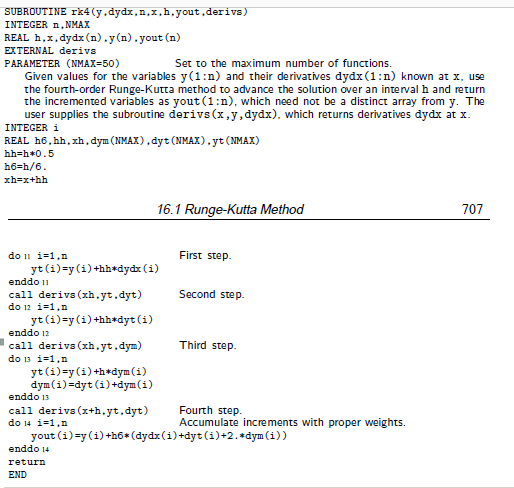
The discussion revolves around understanding the implementation of the Runge-Kutta 4 (RK4) method in numerical recipes, specifically focusing on the subroutine "derivs" and its role in calculating derivatives for a system of ordinary differential equations (ODEs). Participants explore questions related to the structure of the algorithm, the handling of dependent variables, and the conceptual understanding of derivatives in this context.
Discussion Character
- Technical explanation
- Conceptual clarification
- Debate/contested
- Mathematical reasoning
Main Points Raised
- One participant questions why "call derivs" is not included in a loop and seeks clarification on the meaning of "yt" in the context of the RK4 method.
- Another participant explains that the loops in the algorithm iterate over elements in the dependent variable vector rather than the independent variable steps.
- There is a discussion about how the "derivs" subroutine computes derivatives without explicit input for the size of "yt," suggesting that it is generally hard-coded in specific implementations.
- Some participants express confusion about how to derive a single point "yt" and emphasize the need for a differential equation to determine the derivative.
- One participant seeks clarification on the term "pseudo-code" and its implications for understanding the RK4 algorithm.
- Another participant clarifies that "derivs" serves to implement the specific equations of the problem at hand, relating to the differential equation being solved.
- A later reply provides a practical example of how "derivs" relates to the function f(x,y) in the context of a specific ODE.
Areas of Agreement / Disagreement
Participants express varying levels of understanding regarding the implementation details of the RK4 method and the role of the "derivs" subroutine. There is no consensus on the clarity of the algorithm's structure, and multiple viewpoints on the handling of derivatives and the meaning of "yt" remain unresolved.
Contextual Notes
Participants note that the implementation of "derivs" may depend on specific definitions and assumptions about the system of ODEs being solved, which could affect the understanding of its operation.