MHB Understanding Support of Convolution: Does the Equality Hold?

  • Thread starter Thread starter evinda
  • Start date Start date
Click For Summary
The discussion focuses on proving the relationship between the supports of convolutions of distributions, specifically whether the equality \( supp(u \ast v) = supp u + supp v \) holds when at least one distribution has compact support. It is established that \( supp(u \ast v) \subset supp u + supp v \) can be proven by demonstrating that the convolution is zero outside the sum of the supports. The question arises about the closure of the support of the distribution without compact support and the reasoning behind the convolution's restriction being zero in that region. The participants seek clarification on how to show that if \( x+y \) belongs to \( supp u + supp v \), it implies \( x+y \in supp(u \ast v) \). The thread emphasizes understanding the implications of support properties in the context of convolutions of distributions.
evinda
Gold Member
MHB
Messages
3,741
Reaction score
0
Hello! (Wave)

Let $u$ and $v$ be two distributions on $\mathbb{R}^n$, at least one of which has compact support. I have to show that $supp(u \ast v)=supp u + supp v$.

But does the equality hold? Or does it only hold that $supp(u \ast v) \subset supp u + supp v$ ?
 
Physics news on Phys.org
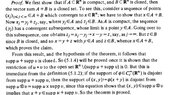
For $supp(u \ast v) \subset supp u + supp v$ I have found the following proof:

View attachment 5401
First of all, we know that one of the $supp u, supp v$ has compact support. How do we know that the other one is closed?Furthermore, why will we have proven that $supp(u \ast v)=supp u+ supp v$, by showing that the restriction of $u \ast v$ to the open set $\mathbb{R}^n \setminus{(supp u+ supp v)}$ is $0$?

Also could you explain to me the explanation why the restriction of $u \ast v$ to the above set is $0$ ? I haven't really understood it.
Also, if equality holds could you give me a hint how to show that $supp u+ supp v \subset supp(u \ast v)$ ?
 

Attachments

  • proof5.JPG
    proof5.JPG
    45.7 KB · Views: 106
Ok, I got it.
But could you explain me the rest, i.e. the part [m] But this is immediate... $x+y \in supp u+ supp v$[/m] ?View attachment 5413
 

Attachments

  • 38509_aCBJ3.jpg
    38509_aCBJ3.jpg
    15.5 KB · Views: 95

Similar threads

  • · Replies 19 ·
Replies
19
Views
4K
  • · Replies 3 ·
Replies
3
Views
2K
  • · Replies 3 ·
Replies
3
Views
2K
  • · Replies 3 ·
Replies
3
Views
2K
  • · Replies 5 ·
Replies
5
Views
875
  • · Replies 2 ·
Replies
2
Views
529
  • · Replies 1 ·
Replies
1
Views
2K
  • · Replies 1 ·
Replies
1
Views
1K
  • · Replies 5 ·
Replies
5
Views
2K
  • · Replies 11 ·
Replies
11
Views
2K
