Understanding the meaning of Unique Solution

  • Context: Undergrad 
  • Thread starter Thread starter 22990atinesh
  • Start date Start date
Click For Summary

Discussion Overview

The discussion revolves around the definition of a system of linear equations, particularly focusing on the conditions under which such a system has a unique solution. Participants explore the implications of independence among equations and challenge the validity of the general definition provided.

Discussion Character

  • Debate/contested
  • Conceptual clarification
  • Mathematical reasoning

Main Points Raised

  • Some participants assert that a unique solution implies an independent set of equations, questioning the validity of this definition when presented with a specific example of dependent equations that yield a unique solution.
  • One participant emphasizes the distinction between definitions and statements, arguing that the assertion about independence is not a definition but a statement that can be false.
  • Another participant expresses uncertainty about the textbook's definition of "independent set of equations," suggesting that linear independence is typically discussed in the context of vectors rather than equations.
  • Some participants propose that the correct condition for a unique solution involves having as many independent equations as unknowns, refining the earlier claims about independence.
  • A later reply acknowledges a misconception regarding the relationship between independence and unique solutions, indicating a shift in understanding based on the discussion.

Areas of Agreement / Disagreement

Participants do not reach a consensus on the definition of independence in the context of linear equations, and multiple competing views remain regarding the implications of the definitions and statements discussed.

Contextual Notes

There are limitations in the definitions provided, particularly regarding the interpretation of independence and the conditions for unique solutions. The discussion highlights the need for clarity in definitions and the potential for misunderstanding based on different contexts.

22990atinesh
Messages
143
Reaction score
1
General definition of System of Linear Equations says that

"If The system has a unique solution, It has independent set of Equations"​

Consider the system of linear equations
##x-2y=-1##
##3x+5y=8##
##4x+3y=7##
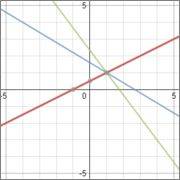
As we can see from the below graph that all the 3 line intersect at a single point ##\implies## System has a unique solution. But at the same time system is not independent as any equation can be derived from the algebraic manipulations of other two equations. So, how definition is true.
Capture.jpg
 
Physics news on Phys.org
22990atinesh said:
General definition of System of Linear Equations says that

"If The system has a unique solution, It has independent set of Equations"​

So, how definition is true.

First, we should deal with the fact that "definitions" cannot be "false". A "conjecture" or "statement" may be true or false. A definition is merely information about how to interpret an undefined phrase in terms of statements that are already defined. So the "definition" of a "system" (of linear equations) should say that it is a set of linear equations in several unknowns. A "solution" to a "system" should also be defined. "Independence" of linear equations must also be defined.

The assertion that "if a system has a unique solution then the equations in it must be independent" is not a definition. It is a statement about things that are already defined. As you showed, it is a false statement. The correct statement is "If a system of linear equations is independent and there are as many equations as unknowns then the system has a unique solution."

It is possible to make definitions that are nonsensical in some way. For example, they might define things that do not exist. If you say "Biggy is defined to be a real number B such that for each real number x, B > x" then you have made a definition. The thing that is defined does not exist. However the definition is not a "false" statement. The statement that "There exists a real number equal to Biggy" is false. That statement is not a definition.
 
22990atinesh said:
General definition of System of Linear Equations says that

"If The system has a unique solution, It has independent set of Equations"​

Consider the system of linear equations
##x-2y=-1##
##3x+5y=8##
##4x+3y=7##
As we can see from the below graph that all the 3 line intersect at a single point ##\implies## System has a unique solution. But at the same time system is not independent as any equation can be derived from the algebraic manipulations of other two equations. So, how definition is true.
Capture.jpg
This question is related to the other one you posted earlier. I'm not sure what your textbook means by "independent set of equations." The concepts of linear independence and linear dependence are usually found in the context of vectors or functions, rather than equations themselves. You should post your book's definition of "independent set of equations."

In any case, the general definition you cite above is not true. Since the third equation can be obtained by adding the first and second equations, the system appears to me to consist of a set of dependent equations. The system does have a unique solution, but also is made up of what appear to be dependent equations.
 
Stephen Tashi said:
The correct statement is "If a system of linear equations is independent and there are as many equations as unknowns then the system has a unique solution."

I'll have to fix my own statement. I should say: if the set of row vectors that give the coefficients of the unknowns in the equations of the system are an independent set of vectors and there are as many equations as unknowns then the system has a unique solution.
 
  • Like
Likes   Reactions: 22990atinesh
Stephen Tashi said:
I'll have to fix my own statement. I should say: if the set of row vectors that give the coefficients of the unknowns in the equations of the system are an independent set of vectors and there are as many equations as unknowns then the system has a unique solution.

Thanx Stephen Tashi, Now I got it. I'd a misconception, You are right.
 

Similar threads

  • · Replies 19 ·
Replies
19
Views
4K
  • · Replies 2 ·
Replies
2
Views
1K
  • · Replies 5 ·
Replies
5
Views
2K
  • · Replies 5 ·
Replies
5
Views
2K
  • · Replies 6 ·
Replies
6
Views
2K
  • · Replies 2 ·
Replies
2
Views
2K
  • · Replies 1 ·
Replies
1
Views
1K
  • · Replies 1 ·
Replies
1
Views
2K
Replies
1
Views
2K
  • · Replies 2 ·
Replies
2
Views
2K