Understanding Trig In Force Diagrams

Click For Summary
The discussion focuses on understanding the application of trigonometry in force diagrams, specifically regarding the use of cosine in calculating force components. The user is reviewing their homework and seeks clarification on how the cosine of 30 degrees is derived in the context of forces acting on a point due to two charges. It is explained that the y-axis is oriented to bisect the charges, and symmetry allows for the resultant forces to be calculated along a specific line. The cosine function arises from the relationship between the forces and their components, emphasizing that the angle is related to the direction of the resultant force. The multiplication by two is justified by the symmetry of the forces involved.
PhysicsReaper
Messages
2
Reaction score
0
Hello,

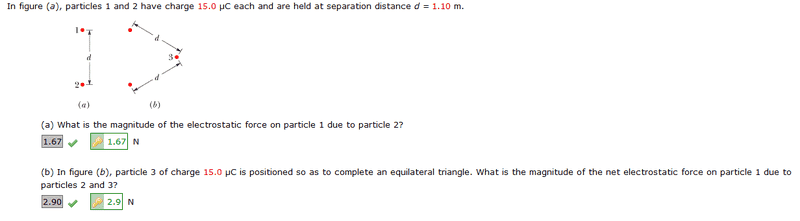
I have the following problem part (b) which I already solved as you can see in the attached image. So I am not asking homework questions, I merely reviewing my homework for a better understanding for the test. I obtained the answer from a friend showing me his method. However, I am studying and a listed solution was the following:

F_y = 2*(k*(q^2/r^2))cos(30)


I've drawn out a force diagram but have no idea how, they have obtained the cosign. In the listed solution they state use oriented the y-axis such that it bisects charges q2 and q3.


2rxb9ef.png
 
Physics news on Phys.org
There are two forces acting on point 1. By symetry the result of these two forces will act along a line drawn through point 1 and a point mid way between 2 and 3. See diagram.

So work out the component of the two forces pointing in that direction.

Consider the triangle on the right.

Cos(30) = Fr/F

so

Fr = F Cos(30)

That's not the whole solution obviously, just where the cos(30) comes from. The angle doesn't come from the direction of the result per se, it comes from the direction of the result in relation to the forces. eg If you rotate the triangle/problem drawing 30 degrees so the resulting force is vertical (on the y-axis) the answer will still contain cos(30).
 

Attachments

  • 2rxb9ef.png
    2rxb9ef.png
    2.9 KB · Views: 562
Last edited:
Thank you very much! And because of symmetry is why it's multiplied by 2?
 
Yes in this case.
 
I do not have a good working knowledge of physics yet. I tried to piece this together but after researching this, I couldn’t figure out the correct laws of physics to combine to develop a formula to answer this question. Ex. 1 - A moving object impacts a static object at a constant velocity. Ex. 2 - A moving object impacts a static object at the same velocity but is accelerating at the moment of impact. Assuming the mass of the objects is the same and the velocity at the moment of impact...

Similar threads

  • · Replies 2 ·
Replies
2
Views
2K
  • · Replies 2 ·
Replies
2
Views
2K
  • · Replies 12 ·
Replies
12
Views
3K
  • · Replies 3 ·
Replies
3
Views
2K
  • · Replies 1 ·
Replies
1
Views
4K
  • · Replies 30 ·
2
Replies
30
Views
27K
  • · Replies 4 ·
Replies
4
Views
2K
Replies
16
Views
29K
  • · Replies 4 ·
Replies
4
Views
2K