Understanding Truss Analysis: Investigating the Accuracy of a Bridge Design App

Click For Summary

Discussion Overview

The discussion revolves around the accuracy of a bridge design applet used for modeling trusses, particularly in the context of high school students designing basswood bridges for a contest. Participants are investigating why certain designs lead to unusually high force readings in the truss members.

Discussion Character

  • Exploratory
  • Technical explanation
  • Debate/contested

Main Points Raised

  • One participant notes that the app reports excessively high forces, such as a 200 load resulting in forces over 500 in multiple members, and questions the underlying calculations of the software.
  • Another participant suggests that matrix truss analysis is a valid technique and recommends comparing results from the app with known sample trusses from textbooks or online resources.
  • A later post presents an extreme case where a 100 load is amplified to billions, indicating potential issues with the app's handling of certain design parameters.
  • Concerns are raised about the app's inability to manage asymmetrically applied loads and its specific requirements regarding the number of members relative to nodes in a structure.
  • One participant advises seeking an alternative app that does not exhibit the same issues as the current one.

Areas of Agreement / Disagreement

Participants express differing views on the reliability of the app, with some suggesting it may not handle complex designs well, while others believe matrix analysis is sound but may require careful validation against known examples. The discussion remains unresolved regarding the app's limitations and the best approach to truss analysis.

Contextual Notes

Participants mention potential prerequisites for the app's calculations that may not be met by certain designs, indicating a need for further exploration of the app's operational parameters.

mishima
Messages
576
Reaction score
43
Hi, my high school students enjoy using the applet found here (http://pages.jh.edu/~virtlab/bridge/truss.htm) to design model (basswood) bridges for our annual regional contest. It seems to require firefox these days.

Recently, some designs have been causing extremely large forces to be reported. For example, a 200 load causing forces of 500+ in multiple members. A screenshot of the design which causes this is below.
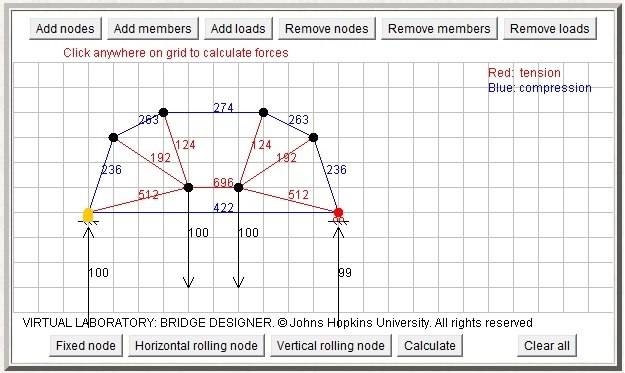
bridge.jpg


So naturally both myself and my students are curious why some designs cause this. I am familiar with truss analysis using the method of joints, but the software appears to use some kind of matrix to do the calculations all at once. I was wondering if anyone had insight into how this software might do its calculations.

My guess is that it can only accurately handle simple trusses.
 
Engineering news on Phys.org
mishima said:
Hi, my high school students enjoy using the applet found here (http://pages.jh.edu/~virtlab/bridge/truss.htm) to design model (basswood) bridges for our annual regional contest. It seems to require firefox these days.

Recently, some designs have been causing extremely large forces to be reported. For example, a 200 load causing forces of 500+ in multiple members. A screenshot of the design which causes this is below.

bridge.jpg


So naturally both myself and my students are curious why some designs cause this. I am familiar with truss analysis using the method of joints, but the software appears to use some kind of matrix to do the calculations all at once. I was wondering if anyone had insight into how this software might do its calculations.

My guess is that it can only accurately handle simple trusses.
Matrix truss analysis is a proven technique. If you have concerns about this particular app., there should be some sample trusses that you can find in a textbook or on the web which has results that you can compare to an analysis of the same structure performed by this app.

After you obtain results, you can still use statics to check them if you question whether they are correct.
 
Well, here is more extreme example showing a 100 load magically amplified into the billions by the same truss. There seems to be some prerequisites to the technique that we are unintentionally breaking.

trussd.jpg
 
Whatever this app is doing, it can't handle asymmetrically applied loads. It also has a peculiar requirement for the number of members a structure must have given a fixed number of nodes.

I recommend you find another app which doesn't have the problems this one has.
 

Similar threads

  • · Replies 34 ·
2
Replies
34
Views
38K
  • · Replies 1 ·
Replies
1
Views
2K
  • · Replies 1 ·
Replies
1
Views
2K
  • · Replies 1 ·
Replies
1
Views
2K
  • · Replies 2 ·
Replies
2
Views
3K
Replies
2
Views
6K
Replies
3
Views
1K
  • · Replies 5 ·
Replies
5
Views
2K
Replies
14
Views
6K