CGandC
- 326
- 34
Homework Statement:: x
Relevant Equations:: x
I stumbled upon the following example in the book - " How to prove it, A structured approach " ( 2nd edition) , Vellerman.
Homework Statement::
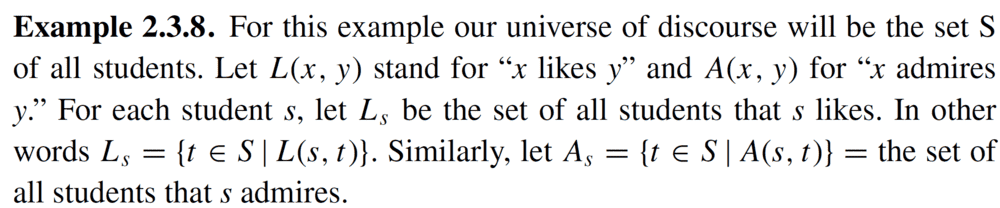
He then asks to describe the set:
## \bigcup_{s \in S} L_{s} \, \backslash \, \bigcup_{s \in S} A_{s} ##
Relevant Equations::
## L_{s} = \{ t \in S | \, L(s,t) \} ##
## A_{s} = \{ t \in S | \, A(s,t) \} ##
and It was also defined beforehand in the book that:
## \bigcup_{s \in S} L_{s} = \{t\,| \exists s \in S \, ( t \in L_{s} ) \} \, = \, \{t \in S | \, \exists s \in S \, L(s,t) \} ##
## \bigcup_{s \in S} A_{s} = \{t\,| \exists s \in S \, ( t \in A_{s} ) \} \, = \, \{t \in S | \, \exists s \in S \, A(s,t) \} ##
Vellerman's answer to the question:
## \bigcup_{s \in S} L_{s} \, \backslash \, \bigcup_{s \in S} A_{s} = \{t\,| t \in \bigcup_{s \in S} L_{s} \, \land \, t \notin \bigcup_{s \in S} A_{s} \} \, ##
- - - - - - - - - - - - - - - - - - - - - - - - - - - - - - - - - - - - - -- - - - - - - - - - - - - -- - - - - - - - - - - - - -
Attempt at a solution::
I have arrived to the same answer, however, I have decided to venture further and write the statement logically in its most concise form,
so the following is my answer, I would highly appreciate if you could tell me if I was correct in my reasoning and my answer as written below:
Given:
## L_{s} = \{ t \in S | \, L(s,t) \} ##
## A_{s} = \{ t \in S | \, A(s,t) \} ##
It is also known that:
## \bigcup_{s \in S} L_{s} = \{t\,| \exists s \in S \, ( t \in L_{s} ) \} \, = \, \{t \in S | \, \exists s \in S \, L(s,t) \} ##
## \bigcup_{s \in S} A_{s} = \{t\,| \exists s \in S \, ( t \in A_{s} ) \} \, = \, \{t \in S | \, \exists s \in S \, A(s,t) \} ##
I write the last statements as:
## \bigcup_{s \in S} L_{s} = \{t\,| ( \exists s \in S \, L(s,t) ) \land ( t \in S ) \} \, ##
## \bigcup_{s \in S} A_{s} = \{t\,| ( \exists s \in S \, A(s,t) ) \land ( t \in S ) \} \, ##
Thus
## \bigcup_{s \in S} L_{s} \, \backslash \, \bigcup_{s \in S} A_{s} = \{t\,| t \in \bigcup_{s \in S} L_{s} \, \land \, t \notin \bigcup_{s \in S} A_{s} \} \, ## = ## \forall t ( t \in \bigcup_{s \in S} L_{s} \, \land \, t \notin \bigcup_{s \in S} A_{s} ) ##
## = \forall t ( [ ( \exists s \in S \, L(s,t) ) \land ( t \in S ) ] \land \neg [( \exists s \in S \, A(s,t) ) \land ( t \in S ) ] ) ##
(changing the bound variable from s to b in the second half of the expression to avoid confusion, thus: ) ## = \forall t ( [ ( \exists s \in S \, L(s,t) ) \land ( t \in S ) ] \land \neg [( \exists b \in S \, A(b,t) ) \land ( t \in S ) ] ) ##
( using the identity ## \neg ( P \land Q ) = \neg P \lor \neg Q ## , thus: )
## = \forall t ( [ ( \exists s \in S \, L(s,t) ) \land ( t \in S ) ] \land [\neg( \exists b \in S \, A(b,t) ) \lor ( t \notin S ) ] ) ##
( using the distributivity property, thus: )
## = \forall t ( [ ( \exists s \in S \, L(s,t) ) \land ( t \in S ) \land \neg( \exists b \in S \, A(b,t) ) ] \lor [ ( \exists s \in S \, L(s,t) ) \land ( t \in S ) \land ( t \notin S ) ] ) ##
## = \forall t ( ( \exists s \in S \, L(s,t) ) \land ( t \in S ) \land \neg( \exists b \in S \, A(b,t) ) ) ##
In english, this means: the set of all students who are liked by at least one student, but are not admired by any students.
----------------
Was I correct in writing the final logical form of the answer? ( I can't verify this as I'm self-studying )
Relevant Equations:: x
I stumbled upon the following example in the book - " How to prove it, A structured approach " ( 2nd edition) , Vellerman.
Homework Statement::
He then asks to describe the set:
## \bigcup_{s \in S} L_{s} \, \backslash \, \bigcup_{s \in S} A_{s} ##
Relevant Equations::
## L_{s} = \{ t \in S | \, L(s,t) \} ##
## A_{s} = \{ t \in S | \, A(s,t) \} ##
and It was also defined beforehand in the book that:
## \bigcup_{s \in S} L_{s} = \{t\,| \exists s \in S \, ( t \in L_{s} ) \} \, = \, \{t \in S | \, \exists s \in S \, L(s,t) \} ##
## \bigcup_{s \in S} A_{s} = \{t\,| \exists s \in S \, ( t \in A_{s} ) \} \, = \, \{t \in S | \, \exists s \in S \, A(s,t) \} ##
Vellerman's answer to the question:
## \bigcup_{s \in S} L_{s} \, \backslash \, \bigcup_{s \in S} A_{s} = \{t\,| t \in \bigcup_{s \in S} L_{s} \, \land \, t \notin \bigcup_{s \in S} A_{s} \} \, ##
- - - - - - - - - - - - - - - - - - - - - - - - - - - - - - - - - - - - - -- - - - - - - - - - - - - -- - - - - - - - - - - - - -
Attempt at a solution::
I have arrived to the same answer, however, I have decided to venture further and write the statement logically in its most concise form,
so the following is my answer, I would highly appreciate if you could tell me if I was correct in my reasoning and my answer as written below:
Given:
## L_{s} = \{ t \in S | \, L(s,t) \} ##
## A_{s} = \{ t \in S | \, A(s,t) \} ##
It is also known that:
## \bigcup_{s \in S} L_{s} = \{t\,| \exists s \in S \, ( t \in L_{s} ) \} \, = \, \{t \in S | \, \exists s \in S \, L(s,t) \} ##
## \bigcup_{s \in S} A_{s} = \{t\,| \exists s \in S \, ( t \in A_{s} ) \} \, = \, \{t \in S | \, \exists s \in S \, A(s,t) \} ##
I write the last statements as:
## \bigcup_{s \in S} L_{s} = \{t\,| ( \exists s \in S \, L(s,t) ) \land ( t \in S ) \} \, ##
## \bigcup_{s \in S} A_{s} = \{t\,| ( \exists s \in S \, A(s,t) ) \land ( t \in S ) \} \, ##
Thus
## \bigcup_{s \in S} L_{s} \, \backslash \, \bigcup_{s \in S} A_{s} = \{t\,| t \in \bigcup_{s \in S} L_{s} \, \land \, t \notin \bigcup_{s \in S} A_{s} \} \, ## = ## \forall t ( t \in \bigcup_{s \in S} L_{s} \, \land \, t \notin \bigcup_{s \in S} A_{s} ) ##
## = \forall t ( [ ( \exists s \in S \, L(s,t) ) \land ( t \in S ) ] \land \neg [( \exists s \in S \, A(s,t) ) \land ( t \in S ) ] ) ##
(changing the bound variable from s to b in the second half of the expression to avoid confusion, thus: ) ## = \forall t ( [ ( \exists s \in S \, L(s,t) ) \land ( t \in S ) ] \land \neg [( \exists b \in S \, A(b,t) ) \land ( t \in S ) ] ) ##
( using the identity ## \neg ( P \land Q ) = \neg P \lor \neg Q ## , thus: )
## = \forall t ( [ ( \exists s \in S \, L(s,t) ) \land ( t \in S ) ] \land [\neg( \exists b \in S \, A(b,t) ) \lor ( t \notin S ) ] ) ##
( using the distributivity property, thus: )
## = \forall t ( [ ( \exists s \in S \, L(s,t) ) \land ( t \in S ) \land \neg( \exists b \in S \, A(b,t) ) ] \lor [ ( \exists s \in S \, L(s,t) ) \land ( t \in S ) \land ( t \notin S ) ] ) ##
## = \forall t ( ( \exists s \in S \, L(s,t) ) \land ( t \in S ) \land \neg( \exists b \in S \, A(b,t) ) ) ##
In english, this means: the set of all students who are liked by at least one student, but are not admired by any students.
----------------
Was I correct in writing the final logical form of the answer? ( I can't verify this as I'm self-studying )