How Is the Unit Normal Derived in an Epicycloid Equation?

  • Context: MHB 
  • Thread starter Thread starter bugatti79
  • Start date Start date
  • Tags Tags
    Normal Unit
Click For Summary
SUMMARY

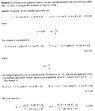
The unit normal in the epicycloid equation is derived using the formula n_x = N_x / |N|, where |N| is the length calculated as |N| = √(|N_x|² + |N_y|²). The term (r + ρ) cancels out during the normalization process. The derivation relies on Pythagorean and sum-difference identities to establish the equality involving sine and cosine functions, specifically: (sin(θ) - m sin(θ + ψ))² + (cos(θ) - m cos(θ + ψ))² = 1 - 2m cos(ψ) + m².

PREREQUISITES
  • Understanding of epicycloid equations and their geometric properties
  • Familiarity with trigonometric identities, particularly sum-difference identities
  • Knowledge of vector normalization techniques
  • Basic calculus concepts related to derivatives and lengths of vectors
NEXT STEPS
  • Study vector normalization methods in detail
  • Explore advanced trigonometric identities and their applications
  • Learn about the geometric properties of epicycloids and their derivatives
  • Investigate the use of computational tools like Wolfram Alpha for simplifying complex equations
USEFUL FOR

Mathematicians, physics students, and engineers interested in advanced geometry, particularly those working with epicycloids and vector calculus.

bugatti79
Messages
786
Reaction score
4
Hi Folks,

I got stuck towards the end where it ask to derive the unit normal. I don't know how they arrived at n_x. I have looked at trig identities...

n_x=\frac{N_x}{|N_x|}=

1) I don't see the (r+p) term anywhere in neither the top nor bottom.

2) Is the bottom just based on simple trig identities? Wolfram didnt simply the denominator
simplify '('sin A -m sin'('A'+'B')'')''^'2 - Wolfram|Alpha
 

Attachments

  • Unit Normal.jpg
    Unit Normal.jpg
    43 KB · Views: 124
Physics news on Phys.org
Hi bugatti79,

The $r+\rho$ term cancels upon dividing $N_x$ by the length $|N|=\sqrt{|N_x|^2+|N_y|^2}$.

As for the second part, Pythagorean and sum-difference identities establish the equality:
$({\sin(\theta)-{m}{\sin(\theta+\psi)}})^2+({\cos(\theta)-{m}{\cos(\theta+\psi)}})^2=1-2{m}{\cos(\psi)}+m^2$
 

Similar threads

  • · Replies 2 ·
Replies
2
Views
1K
  • · Replies 6 ·
Replies
6
Views
2K
  • · Replies 3 ·
Replies
3
Views
3K
Replies
24
Views
3K
  • · Replies 1 ·
Replies
1
Views
4K
  • · Replies 1 ·
Replies
1
Views
1K
  • · Replies 1 ·
Replies
1
Views
2K
  • · Replies 16 ·
Replies
16
Views
3K
  • · Replies 1 ·
Replies
1
Views
2K
  • · Replies 5 ·
Replies
5
Views
3K