Unraveling the Mysteries of Relativistic Strings

  • Context: Graduate 
  • Thread starter Thread starter moriheru
  • Start date Start date
  • Tags Tags
    Relativistic Strings
Click For Summary
SUMMARY

This discussion focuses on deriving the equations of motion for relativistic strings using the Nambu-Goto Lagrangian, specifically referencing Zwiebach's chapter 6. The Lagrangian is expressed as L = - (T_0/c) √(-det γ), where γ is the induced metric. Participants clarify the process of taking derivatives of the Lagrangian with respect to the velocity components, emphasizing the importance of inner products and orthonormality relations in the derivation process.

PREREQUISITES
  • Understanding of the Nambu-Goto Lagrangian
  • Familiarity with inner products in the context of relativistic physics
  • Knowledge of induced metrics in string theory
  • Proficiency in calculus, particularly in taking derivatives of complex functions
NEXT STEPS
  • Study the derivation of the Nambu-Goto Lagrangian in detail
  • Learn about induced metrics and their applications in string theory
  • Explore the concept of orthonormality in the context of relativistic physics
  • Practice taking derivatives of Lagrangians in various physical contexts
USEFUL FOR

Physicists, graduate students in theoretical physics, and researchers interested in string theory and relativistic dynamics will benefit from this discussion.

moriheru
Messages
273
Reaction score
16
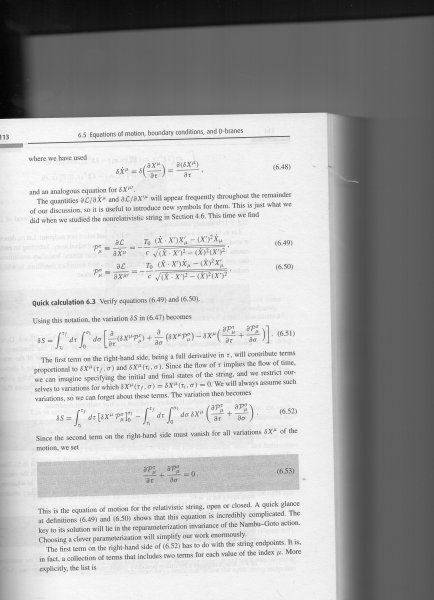
My question concerns motion of relativistic Strings, as the reader with a great a mount of deductive skills can deduce :).
img004.jpg

The question is: How can I derive the P's. More acuratly speaking why is the numerator how it is.
I am referring to Zwiebach chapter 6.
Thanks for any clarifications and sorry about the zoom.
 

Attachments

  • img004.jpg
    img004.jpg
    32.6 KB · Views: 397
  • img004.jpg
    img004.jpg
    33.7 KB · Views: 418
Physics news on Phys.org
Please type your question in, using LaTex if you need to express a formula. That's better than asking us to try and figure out what is in a tiny blurry picture.
 
Take the Lagrangian you have, and find its derivative...
The Nambu Goto lagrangian he has derived is : L = - \frac{T_0}{c} \sqrt{ - det \gamma } = - \frac{T_0}{c} \sqrt{ ( \dot{X} X' )^2 - \dot{X}^2 X'^2 }
Forgeting the prefactor:
\frac{\partial L}{\partial \dot{X}^\rho} \propto \frac{2 ( \dot{X} X' ) X'_\rho - 2 X'^2 \dot{X}_\rho}{2 \sqrt{ ( \dot{X} X' )^2 - \dot{X}^2 X'^2 } }
Similarily for the other...
If you have some problems with these derivatives of inner products:
\frac{\partial }{\partial \dot{X}^\rho} ( \dot{X}^\mu X'_\mu )^2 =\frac{\partial }{\partial \dot{X}^\rho} \dot{X}^\mu X'_\mu \dot{X}^\nu X'_\nu = \delta_{\rho}^{\mu} X'_\mu \dot{X}^\nu X'_\nu + \dot{X}^\mu X'_\mu \delta_{\rho}^{\nu} X'_\nu = X'_\rho \dot{X}^\nu X'_\nu + \dot{X}^\mu X'_\mu X'_\rho =2 (\dot{X}^\nu X'_\nu ) X'_\rho

The only thing you use is the orthonormality relation \frac{\partial x^a}{\partial x^b}= \delta_b^a
 
Last edited:
  • Like
Likes   Reactions: moriheru
ChrisVer said:
Take the Lagrangian you have, and find its derivative...
The Nambu Goto lagrangian he has derived is : L = - \frac{T_0}{c} \sqrt{ - det \gamma } = - \frac{T_0}{c} \sqrt{ ( \dot{X} X' )^2 - \dot{X}^2 X'^2 }
Forgeting the prefactor:
\frac{\partial L}{\partial \dot{X}^\rho} \propto \frac{2 ( \dot{X} X' ) X'_\rho - 2 X'^2 \dot{X}_\rho}{2 \sqrt{ ( \dot{X} X' )^2 - \dot{X}^2 X'^2 } }
Similarily for the other...
If you have some problems with these derivatives of inner products:
\frac{\partial }{\partial \dot{X}^\rho} ( \dot{X}^\mu X'_\mu )^2 =\frac{\partial }{\partial \dot{X}^\rho} \dot{X}^\mu X'_\mu \dot{X}^\nu X'_\nu = \delta_{\rho}^{\mu} X'_\mu \dot{X}^\nu X'_\nu + \dot{X}^\mu X'_\mu \delta_{\rho}^{\nu} X'_\nu = X'_\rho \dot{X}^\nu X'_\nu + \dot{X}^\mu X'_\mu X'_\rho =2 (\dot{X}^\nu X'_\nu ) X'_\rho

The only thing you use is the orthonormality relation \frac{\partial x^a}{\partial x^b}= \delta_b^a

Thanks! A like is yours.
 
ChrisVer said:
Take the Lagrangian you have, and find its derivative...
The Nambu Goto lagrangian he has derived is : L = - \frac{T_0}{c} \sqrt{ - det \gamma } = - \frac{T_0}{c} \sqrt{ ( \dot{X} X' )^2 - \dot{X}^2 X'^2 }
Forgeting the prefactor:
\frac{\partial L}{\partial \dot{X}^\rho} \propto \frac{2 ( \dot{X} X' ) X'_\rho - 2 X'^2 \dot{X}_\rho}{2 \sqrt{ ( \dot{X} X' )^2 - \dot{X}^2 X'^2 } }
Similarily for the other...
If you have some problems with these derivatives of inner products:
\frac{\partial }{\partial \dot{X}^\rho} ( \dot{X}^\mu X'_\mu )^2 =\frac{\partial }{\partial \dot{X}^\rho} \dot{X}^\mu X'_\mu \dot{X}^\nu X'_\nu = \delta_{\rho}^{\mu} X'_\mu \dot{X}^\nu X'_\nu + \dot{X}^\mu X'_\mu \delta_{\rho}^{\nu} X'_\nu = X'_\rho \dot{X}^\nu X'_\nu + \dot{X}^\mu X'_\mu X'_\rho =2 (\dot{X}^\nu X'_\nu ) X'_\rho

The only thing you use is the orthonormality relation \frac{\partial x^a}{\partial x^b}= \delta_b^a

But why would one have a inner product?
 
What do you mean by why you have inner products? they are there when you wrote:

\gamma = \begin{pmatrix} \dot{X} \cdot \dot{X} & \dot{X} \cdot X' \\ X' \cdot \dot{X} & X' \cdot X' \end{pmatrix}
The \cdot denotes inner product, and in this case the Lorentzian product x \cdot y = \eta_{\mu \nu} x^\mu y^\nu...
Now why is that the case? because you have already derived the induced metric:
\gamma_{ab} = \eta_{\mu \nu} \partial_a X^\mu \partial_b X^\nu \equiv \partial_a X \cdot \partial_b X
 
Or if you didn't ask exactly that, then remember:
\frac{d}{dx} f(g(x)) = \frac{d}{dg}f(g) \frac{dg(x)}{dx}

So the \sqrt{...} will give the \frac{1}{2\sqrt{...}}
and you still have to take the derivatives of (...) wrt your initial derivative.
 
  • Like
Likes   Reactions: moriheru
Thanks fine from here!
 

Similar threads

  • · Replies 0 ·
Replies
0
Views
4K
  • · Replies 75 ·
3
Replies
75
Views
7K
  • · Replies 1 ·
Replies
1
Views
3K
  • · Replies 10 ·
Replies
10
Views
3K
  • · Replies 62 ·
3
Replies
62
Views
11K
Replies
2
Views
725
  • · Replies 58 ·
2
Replies
58
Views
5K
  • · Replies 29 ·
Replies
29
Views
2K
  • · Replies 6 ·
Replies
6
Views
3K
  • · Replies 32 ·
2
Replies
32
Views
7K