Usage of inverse function theorem in Folland

Click For Summary
SUMMARY

The forum discussion centers on the inverse function theorem as presented in Spivak's "Calculus on Manifolds" and its interpretation in Folland's text regarding the n-dimensional Lebesgue measure. The participants debate the distinction between local and global versions of the theorem, specifically the necessity of injectivity in Folland's definition of a C^1 diffeomorphism. They conclude that local invertibility does not guarantee global invertibility, illustrated by the example of the complex exponential function, which is locally invertible but not globally injective.

PREREQUISITES
  • Understanding of the Inverse Function Theorem
  • Familiarity with C^1 diffeomorphisms
  • Knowledge of Jacobians and their role in differentiability
  • Basic concepts of Lebesgue measure in n-dimensional spaces
NEXT STEPS
  • Study the implications of injectivity in the context of the Inverse Function Theorem
  • Explore the differences between local and global properties of functions
  • Investigate the role of the Jacobian determinant in determining invertibility
  • Review examples of functions that are locally invertible but not globally injective
USEFUL FOR

Mathematicians, students of advanced calculus, and anyone interested in the nuances of the Inverse Function Theorem and its applications in analysis and geometry.

psie
Messages
315
Reaction score
40
TL;DR
Consider the inverse function theorem as stated in Spivak's Calculus on Manifolds. Then consider the paragraph in Folland's text below where he defines a ##C^1## diffeomorphism. How does the inverse function theorem in Spivak's text imply the statement about ##G^{-1}## being a ##C^1## diffeomorphism in Folland's text?
Here's the inverse function theorem as stated in Spivak's book:

Ift.PNG


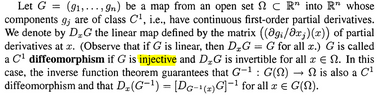
Then there's a paragraph in Folland's book:

diffeo.PNG


I have read the inverse function theorem and its proof in Spivak's Calculus on Manifolds and I have a hard time reconciling it with what Folland states in his book on the chapter on the ##n##-dimensional Lebesgue measure, especially the last sentence. I find his definition of ##C^1## diffeomorphism a bit convoluted. I suspect there is a "global version" to the inverse function theorem that Folland is using. How does this "global version" follow from the one above by Spivak? I'd be grateful for a proof or something similar.
 

Attachments

  • diffeo.PNG
    diffeo.PNG
    37.1 KB · Views: 61
Physics news on Phys.org
It looks exactly the same except for the notations. His ##G## is the ##f## and his ##D_xG## is ##f'(a)##. Being invertible is the same as the determinant is not zero.
 
martinbn said:
It looks exactly the same except for the notations. His ##G## is the ##f## and his ##D_xG## is ##f'(a)##. Being invertible is the same as the determinant is not zero.
I disagree. I think Folland uses some sort of global version of the inverse function theorem Here's the local version (Spivak's version):

Inverse function theorem (local). Let ##E\subset\mathbb{R}^n## be open, and let ##f:E\to\mathbb{R}^n## be a ##C^1## map. Let ##a\in E## be such that ##\det f'(a)\neq0##. Then there exists open sets ##U\ni a## and ##V\ni f(a)## such that ##f:U\to V## is a ##C^1## diffeomorphism (here ##C^1## diffeomorphism means the function and the inverse are ##C^1##). Moreover $$(f^{-1})'(y)=[f'(f^{-1}(y))]^{-1},\quad\forall y\in V.$$
Here's the global version Folland uses:
Inverse function theorem (global). Let ##E\subset\mathbb{R}^n## be open and let ##f:E\to\mathbb{R}^n## be a ##C^1## diffeomorphism (here ##C^1## diffeomorphism means injective and ##\det f'(a)\neq0## for all ##a\in E##). Then the local inverse function theorem implies that ##f^{-1}:f(E)\to E## is also a ##C^1## diffeomorphism and $$(f^{-1})'(y)=[f'(f^{-1}(y))]^{-1},\quad\forall y\in f(E).$$
I'm looking to prove the second statement from the first, though I have a hard time even seeing the two definitions of ##C^1## diffeomorphism being the same.
 
I still don't understand. The condition holds for all points, which means that the map is locally invertible and the inverse is locally differentiable. But being differentiable globally means that it is differentiable around every point.
 
  • Like
Likes   Reactions: psie
Where do you think there is a difference? Differentiability is a local property and here it is the determinant condition that makes it local.

Wikipedia has a nice picture that demonstrates the local aspect:

300px-Implicit_circle.svg.png

The circle allows an inversion at point ##A## and does not at point ##B.## There is no "global" version.
 
Last edited:
  • Like
Likes   Reactions: psie
martinbn said:
I still don't understand. The condition holds for all points, which means that the map is locally invertible and the inverse is locally differentiable. But being differentiable globally means that it is differentiable around every point.
Then I don't understand why Folland specifies that ##G## should be injective. Why is this required? Doesn't the inverse function theorem as specified by Spivak guarantee a local inverse around a point of the domain? And since Folland also stipulates that the Jacobian is invertible at all points in the domain, we get a global inverse. So why require that ##G## should be injective?
 
psie said:
Then I don't understand why Folland specifies that ##G## should be injective. Why is this required? Doesn't the inverse function theorem as specified by Spivak guarantee a local inverse around a point of the domain? And since Folland also stipulates that the Jacobian is invertible at all points in the domain, we get a global inverse. So why require that ##G## should be injective?
Otherwise you need not have a global set theoretic inverse map.
 
martinbn said:
Otherwise you need not have a global set theoretic inverse map.
Isn't there a way to "glue" together the inverse maps one obtains from the inverse function theorem applied to each point and thus obtain a global inverse? Maybe there's no such tool, but it feels redundant to require ##G## to also be injective if the inverse function theorem already supplies inverse functions. It defeats the purpose of the name of the theorem. :smile:
 
psie said:
Isn't there a way to "glue" together the inverse maps one obtains from the inverse function theorem applied to each point and thus obtain a global inverse? Maybe there's no such tool, but it feels redundant to require ##G## to also be injective if the inverse function theorem already supplies inverse functions. It defeats the purpose of the name of the theorem. :smile:
No, because you can take ##\Omega## to be two disjoint sets that are translate of each other and map them 2 to 1 on another copy, then you cannot get an inverse.
 
  • #10
psie said:
Then I don't understand why Folland specifies that ##G## should be injective.
This all is a bit of a mix of the theorem about implicit functions and the theorem about the inverse function, which is a corollary. The first one - at least on Wikipedia - uses partial derivatives, the second one mentions a diffeomorphism. Different authors may handle their conditions slightly differently depending on how comfortable they want to have their proofs. However, I think it's only wording in this case. If you want to analyze the conditions that are actually used, you will have to look at the proofs. The theorem is usually proven with Banach's fixpoint theorem which uses a closed set (Newton-Raphson requires convergence!). So if you want to you could even add that the neighborhood contains a closed set.
 
  • Like
Likes   Reactions: psie
  • #11
martinbn said:
No, because you can take ##\Omega## to be two disjoint sets that are translate of each other and map them 2 to 1 on another copy, then you cannot get an inverse.
After having given this some more thought, I come to conclusion that local invertibility at each point of the domain does not imply global invertibility. Take the complex exponential; ##f(x,y)=(e^x \cos y,e^x \sin y)##. The Jacobian is ##e^x\neq 0## for all ##(x,y)\in \mathbb{R}^2##, but it is not injective on ##\mathbb R^2## since those trigonometric functions are periodic.
 
  • #12
psie said:
After having given this some more thought, I come to conclusion that local invertibility at each point of the domain does not imply global invertibility. Take the complex exponential; ##f(x,y)=(e^x \cos y,e^x \sin y)##. The Jacobian is ##e^x\neq 0## for all ##(x,y)\in \mathbb{R}^2##, but it is not injective on ##\mathbb R^2## since those trigonometric functions are periodic.
But that is obvious, i gave you an example!
 

Similar threads

  • · Replies 5 ·
Replies
5
Views
3K
  • · Replies 6 ·
Replies
6
Views
3K
  • · Replies 2 ·
Replies
2
Views
3K
  • · Replies 3 ·
Replies
3
Views
3K
  • Poll Poll
  • · Replies 1 ·
Replies
1
Views
4K
  • · Replies 2 ·
Replies
2
Views
2K
  • · Replies 16 ·
Replies
16
Views
5K
Replies
4
Views
2K
  • Poll Poll
  • · Replies 1 ·
Replies
1
Views
6K
  • · Replies 6 ·
Replies
6
Views
3K