Variation of parameters to obtain PS of 2nd Order non-hom equation

Click For Summary
SUMMARY

The discussion centers on solving the second-order non-homogeneous differential equation y" - 6y' + 9y = exp(3x)/(1+x). The general solutions identified are y1(x) = exp(3x) and y2(x) = xexp(3x), with the Wronskian calculated as exp(6x). The user encountered difficulties applying the variation of parameters formula, resulting in an expression that raised doubts about its correctness. A suggestion was made to verify the analytic solution against a numerical solution using Mathematica or another Computer Algebra System (CAS) to ensure accuracy.

PREREQUISITES
  • Understanding of second-order differential equations
  • Familiarity with the variation of parameters method
  • Knowledge of Wronskian calculations
  • Experience with Mathematica or similar Computer Algebra Systems
NEXT STEPS
  • Learn how to apply the variation of parameters method in detail
  • Explore Wronskian properties and their implications in differential equations
  • Study numerical methods for solving differential equations
  • Familiarize yourself with plotting solutions in Mathematica
USEFUL FOR

Mathematics students, educators, and professionals working with differential equations, particularly those interested in verifying analytic solutions through numerical methods.

robot1000
Messages
5
Reaction score
0
The question I'm trying to solve is:

y" - 6y' + 9y = \frac{exp(3x)}{(1+x)}

I formulated the Gen solution which are:

y1(x) = exp(3x) and y2(x) = xexp(3x)

I've then calculated the wronskian to get: exp(6x)

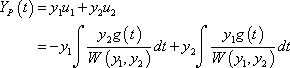
I then went onto to use the variation of parameters formula, which is where I got a bit stuck
eq0027M.gif


I ended up with

-exp(3x)*(x - ln(x+1) + xexp(3x)*ln(1+x)

The problem is, it just doesn't look right.

I would appreciate some guidance with this problem
 
Physics news on Phys.org
Except for a parentheses that you missed to close the (x - ln(x+1)), it looks right to me. Why would you say that it doesn't look right, and what guidance do you expect to get?
 
robot1000 said:
I would appreciate some guidance with this problem

Here's what you do. You solve it numerically first and then plot the analytic solution you get over the numeric solution. If they agree, right on top of one another, then there is very good odds your analytic solution is correct. If you're going to work with DEs, this is a very useful practice in my opinion. So learn how to set all this up in Mathematica or another CAS and you will never say again, "that don't look right."
 

Similar threads

  • · Replies 5 ·
Replies
5
Views
2K
  • · Replies 7 ·
Replies
7
Views
2K
  • · Replies 1 ·
Replies
1
Views
2K
  • · Replies 2 ·
Replies
2
Views
2K
  • · Replies 2 ·
Replies
2
Views
5K
Replies
1
Views
3K
  • · Replies 6 ·
Replies
6
Views
2K
  • · Replies 3 ·
Replies
3
Views
3K
  • · Replies 5 ·
Replies
5
Views
3K
  • · Replies 0 ·
Replies
0
Views
2K