Vector addition, trying to find the angle

Join the discussion
Ask a follow-up here, or get your own question answered by working scientists, mathematicians and engineers — people, not an autocomplete.
Real named experts · corrections over time · the nuance an AI answer skips
2 replies · 2K views
Ineedhelpwithphysics
Messages
43
Reaction score
7
Homework Statement
IN picture
Relevant Equations
Addition of angles
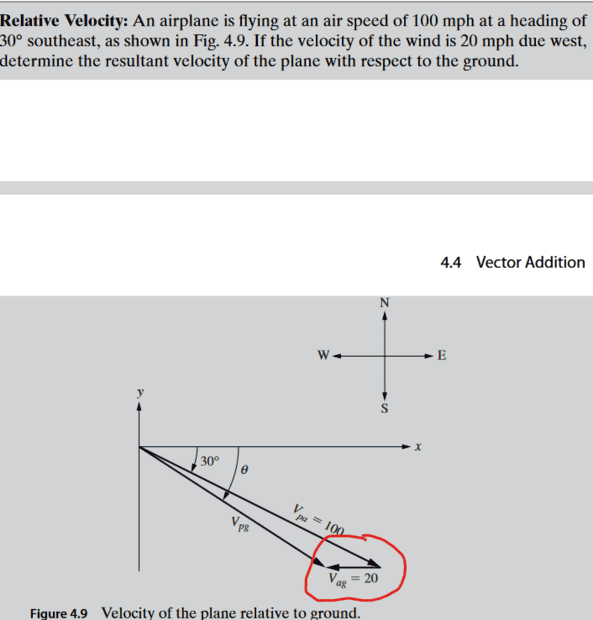
Is angle Vag 180 since the vector is a straight line pointing left?
Also you can add 30 degrees with 150 which will be 180?
1697737028016.png
 
Physics news on Phys.org
Yes, the wind velocity vector forms an angle of 180° with the positive x-axis.
Adding 30 degrees to 150 degrees will always give you 180 degrees, but that is not the angle that the resultant you are looking for forms relative to the positive x-axis.

By the way, "Addition of angles" is not an equation.
 
Reply
  • Like
Likes   Reactions: MatinSAR and topsquark
Ineedhelpwithphysics said:
Also you can add 30 degrees with 150 which will be 180?
How is this relevant to solving the problem? Just because you can combine two numbers given in the problem to produce a third doesn't mean you should do it. You need to have a valid reason for doing so.

When it comes to vector addition, you have three basic building blocks. First, you can resolve a vector into components. If a vector ##\vec A## has magnitude ##A## and direction ##\theta## (relative to the +x axis), its components are ##A_x = A \cos\theta## and ##A_y = A \sin\theta##. Second, you can go the other way: if you know the components of a vector, its magnitude is ##A = \sqrt{A_x^2 + A_y^2}## and its direction satisfies ##\tan \theta = A_y/A_x##. Finally, you have the rule about how to actually add the vectors: if ##\vec C = \vec A + \vec B##, then ##C_x = A_x + B_x## and ##C_y = A_y + B_y##.

Using just those building blocks, can you come up with a way to use them to solve the problem at hand?
 
Reply
  • Like
Likes   Reactions: nasu